DELOITTE CONSULTING, LLP
Tanzania Low-Cost Connections Assessment: Initial Findings and Barriers
The Tanzania Low-Cost Connections Assessment is a five-year program initiated in April 2014 by the Sector Reform and Utility Commercialization (SRUC) Task Order, funded by the US Agency for International Development (USAID) and implemented by Deloitte Consulting LLP.
2018 · 11 pages
Sign in to readA free account is required to download.
Abstract
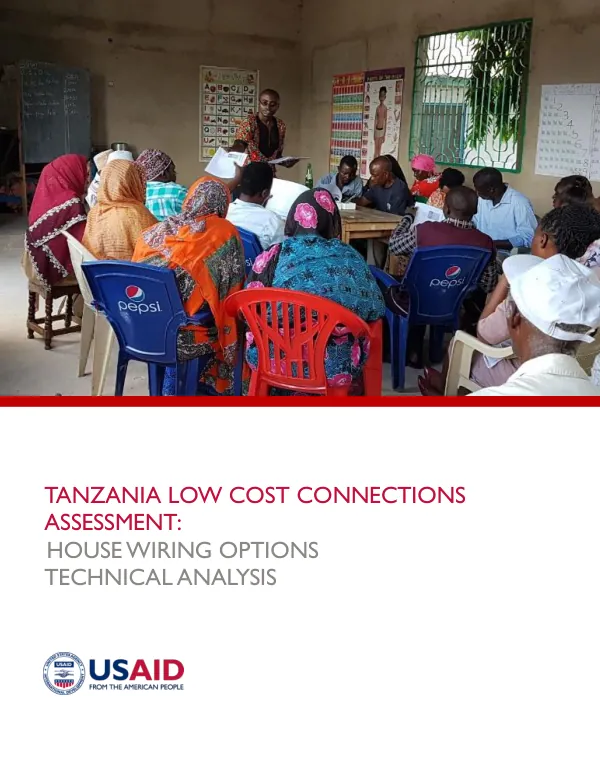
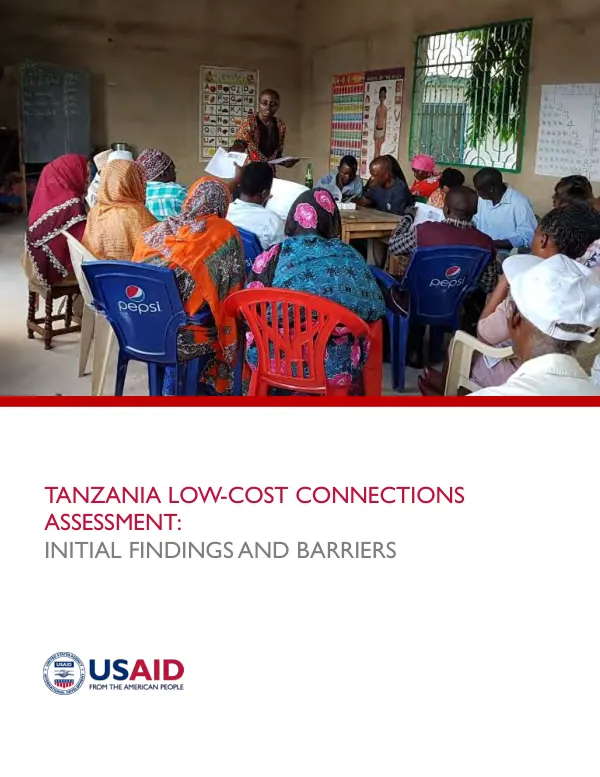
The program aims to promote utility commercialization and equitable, effective reforms that enhance the financial viability and long-term sustainability of developing countries' electricity systems. As part of this effort, SRUC works with USAID missions around the world to support demonstration projects, education, workshops, and in-country experience that improve developing country electricity sectors. The national utility Tanzania Electric Supply Company Limited (TANESCO) has added more than 800,000 customer connections to its network since 2012, with over 1.9 million customers. However, despite this progress, there are still large numbers of potential customers who remain unconnected, even in urban and periurban areas of Dar es Salaam and other population centers. The Government of Tanzania's Ministry of Energy estimates that electricity access has reached more than 30%, implying that approximately 15 million people are physically located within the vicinity of the grid. The SRUC Team conducted a Low-Cost Connections Assessment (LCCA) to help close the gap between the population that is actually connected to grid power and the population that is physically located within reach of the grid but has been unable to connect. Using data from a household survey conducted by MCC, the Team analyzed specific household wiring barriers that limit the number of new customers connecting to the electricity grid. The assessment examined the demand profile of existing/potential customers of TANESCO and designed a decision matrix to evaluate what different types of technologies may be most appropriate for safely installing internal wiring for new urban/periurban customers at a lower cost to the consumer. The Team also conducted multiple focus group discussions to develop a deeper understanding of the financial and technical barriers in household wiring and the affordability of connection fees. To complement the in-country research, the Team developed leading practice case studies from five countries to illustrate successful approaches that utilities and donors have used to increase household electricity connections. This document presents and discusses initial findings from the initial scoping visit for each type of barrier facing the target households in the Dar es Salaam service area. The assessment identified three types of barriers: house wiring, service line/connection, and customer consumption. The house wiring barrier includes the household's understanding of house wiring costs and options for purchasing house wiring materials and services, acceptable designs and installation options for different wiring schemes, and operation and ongoing maintenance for the wiring system. The service line/connection barriers include TANESCO's financial disincentives and its ability to complete customer connections. The customer consumption barrier includes the customer's financial ability to purchase and consume electricity, particularly as it pertains to the customer's designation as a T1 or D1 customer. The Team collected materials and labor cost quotes from suppliers in the Dar region to provide cost estimates for 3-5 house wiring options that potential customers can install given location factors such as house size and electricity-consuming devices. The Team will conduct a more detailed analysis of existing data to determine whether there is a need for additional primary data collection. If gaps in the existing data prevent informed conclusions from being made about the target group, the Team may conduct limited additional research through surveys/focus groups within target communities. An initial cost model will be developed that specifies 3-5 different house wiring options based on initial findings and discussions with customers. The cost model will be revised based on additional findings resulting from surveys/focus groups.
Related documents