FHI 360
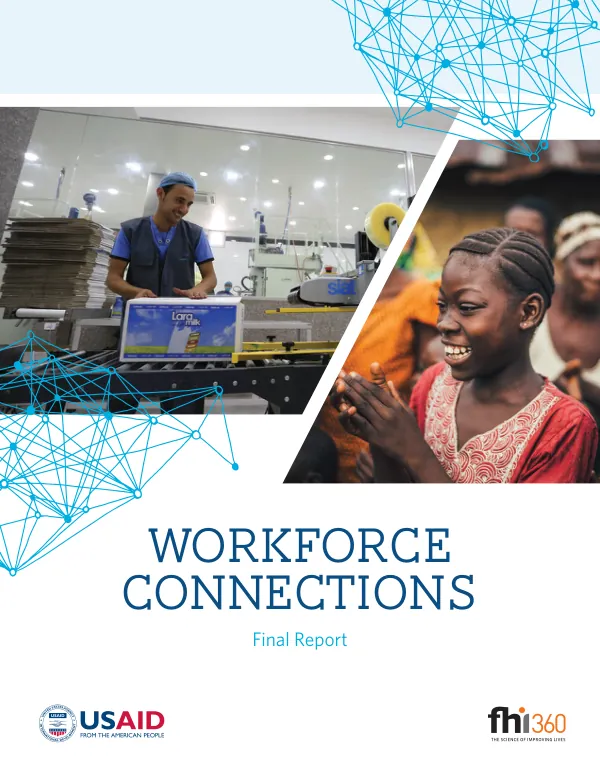
Workforce Connections Final Report
Workforce Connections was a five-year project operational from 2013 to 2018, designed to support the United States Agency for International Development (USAID) in addressing the youth employment crisis.
2018 · 32 pages
Sign in to readA free account is required to download.
Abstract
The project focused on three main components: generating, synthesizing, and disseminating evidence; providing technical leadership and field support; and building capacity for a range of workforce development stakeholders. Component 1, Generate, Synthesize, and Disseminate Evidence, aimed to bring together evidence and best practices from three technical areas: education systems alignment with labor market demand, positive youth development, and economic growth approaches to job creation and demand-driven skills development. Key achievements of this component included launching the Workforce Connections Community of Practice, which grew to over 200 members, and awarding technical grants that resulted in innovative research products, an e-learning course, a web portal, and well-attended learning events. The Community of Practice was launched on May 28, 2014, and three working groups were established in November 2014, focusing on informality, systems, and measuring employment outcomes. The Informality working group analyzed labor market assessment tools and studies, and workforce development program evaluations to analyze how these resources incorporate information and analyze informality. The group finalized a technical brief, Youth and Informality, prepared by Dr. Anne Genin (Morgan State University). Component 2, Provide Technical Leadership and Field Support, aimed to provide innovative and influential research on soft and non-cognitive skills, publication of a rigorous guide to labor market assessment approaches, and delivery of webinars and best practice briefs focused on higher education programming in the Middle East and North Africa (MENA) and Latin America and the Caribbean (LAC). Key achievements of this component included innovative research on soft and non-cognitive skills, publication of a guide to labor market assessment approaches, and delivery of webinars and best practice briefs. Component 3, Build Capacity for a Range of Workforce Development Stakeholders, aimed to deliver workforce development trainings, sessions, and workshops for USAID staff and other practitioners, publication of an influential research paper on labor market information systems, and design and delivery of a comprehensive fellowship program on youth employment. Key achievements of this component included delivery of 10 separate workforce development trainings, publication of a research paper on labor market information systems, and design and delivery of a fellowship program. The Workforce Connections project supported USAID and the community of practice for better program design and implementation, addressing the youth employment crisis throughout its operational period. The project's focus on three main components and its achievements in generating, synthesizing, and disseminating evidence, providing technical leadership and field support, and building capacity for workforce development stakeholders contributed to its success in advancing the achievement of Goal 2 of the USAID Education Strategy.
Related documents