USAID DEC
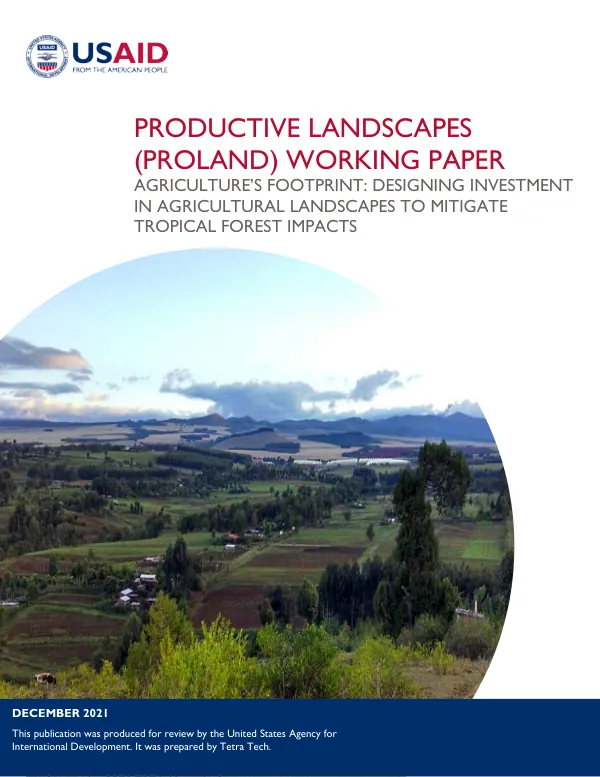
Working Paper Agriculture’s Footprint: Designing Investment in Agricultural Landscapes to Mitigate Tropical Forest Impacts
Sign inTETRA TECH
Working Paper Agriculture’s Footprint: Designing Investment in Agricultural Landscapes to Mitigate Tropical Forest Impacts
The Productive Landscapes (ProLand) project aims to improve land use management using a systems approach to resilient development that integrates ecological, economic, and governance aspects.
2021 · 95 pages
Sign in to readA free account is required to download.
Abstract
The project supports the United States Agency for International Development (USAID) Missions to develop and disseminate evidence-based guidance around best management practices for sustainably intensifying land use. The ultimate objective of the guidance is to help USAID achieve integrated impacts related to increased food production, reduced biodiversity loss, reduced greenhouse gas emissions, and increased resilient and inclusive economic growth. To achieve this objective, the ProLand team was tasked to review the evidence-based literature to develop guidance on how governments and their development partners may limit the risks of deforestation that may result from investments in agriculture. The report focuses on the relationship between agricultural intensification and deforestation, production strategies that impact agriculture's footprint, and governance actions that impact agriculture's footprint. The report identifies conventional intensification, diversification, and governance actions as key strategies to mitigate tropical forest impacts. Conventional intensification involves increasing annual crop production, transitioning farmers from shifting cultivation to continuous cultivation of fields, and monocrop trees. However, this approach has risks, including soil degradation, water pollution, and loss of biodiversity. Diversification, on the other hand, involves diversifying cultivated annuals and livestock varieties, introducing other crops into tree crop systems, and introducing trees into crop and livestock systems. This approach has the potential to reduce deforestation and promote sustainable land use. Governance actions that impact agriculture's footprint include broad governmental functions, such as government fiscal policy, trade policy, and transportation infrastructure. Effective governance actions can reduce deforestation and promote sustainable land use. The report highlights the importance of land-use planning and zoning, designating areas outside of forest agroecological zones for agricultural investment, revitalizing degraded, underproductive, and abandoned lands, and siting and managing protected areas. The report also discusses market system approaches, including forest-based enterprises, payments for ecosystem services, and performance standards. These approaches can help reduce deforestation and promote sustainable land use. The report concludes that there are three pathways to managing agriculture's footprint: reducing food loss, improving governance, and promoting sustainable land use practices. The report provides a framework for assessing deforestation threats from road investments and highlights the potential benefits, constraints, and trade-offs of restoring degraded land through agroforestry. The report also provides a list of documents that provide key information or practical guidance on sustainable land use practices. Overall, the report provides a comprehensive analysis of the relationship between agricultural intensification and deforestation, and identifies key strategies to mitigate tropical forest impacts. The report highlights the importance of effective governance actions, sustainable land use practices, and market system approaches to reduce deforestation and promote sustainable land use.