U.S. DEPT. OF AGRICULTURE. ECONOMIC RESEARCH SERVICE. INTERNATIONAL ECONOMICS DIV.
World food needs and availabilities, 1988/89 : spring
The need for food aid has fluctuated dramatically in recent years due to changes in cereal prices, local harvests, and consumer demand.
1989
Sign in to readA free account is required to download.
Abstract
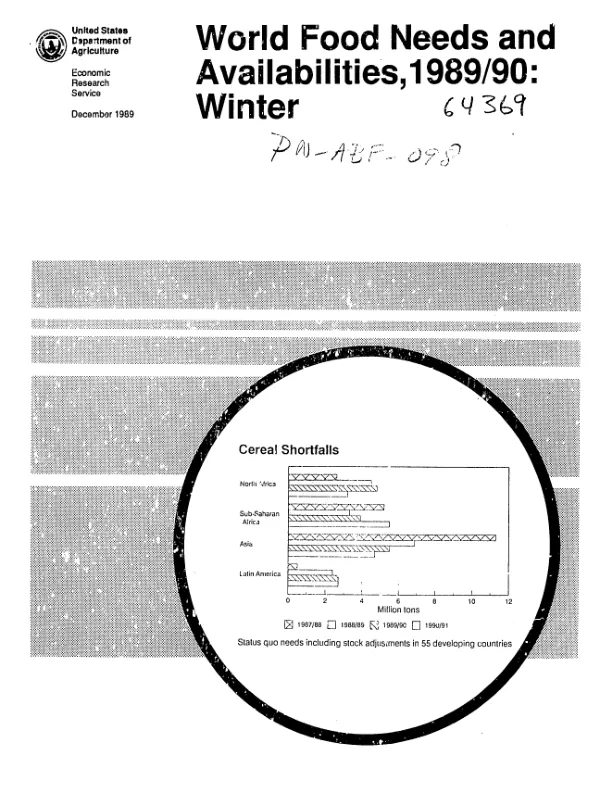
This report reviews, on a regional basis, the need for cereal food aid in 55 food aid recipient countries for 1988/89 and 1989/90 and updates estimates for four individual countries - Egypt, Tunisia, India, and Sri Lanka. Though cereal production in the 55-country group is up 13% over 1987-88, overall cereal needs continue to be high due to sharp increases brought on in several countries by higher commodity prices and stock rebuilding. Status quo (SQ) additional cereal needs for 1988/89 are estimated at 14.4 million tons, down 11.7 million from 1987/88. This figure is expected to drop by 2.1 million for the 1989/90 period, though requirements will depend heavily on weather and economic developments. Nutrition-based (NB) needs for 1988/89 are 29.4 million tons. As a result of a 4% increase in cereal production in 1988, Egypt"s SQ additional cereal needs have dropped to 2.6 million tons; NB needs are 0.0. Servicing the country"s $47 billion debt, however, threatens to seriously constrain food imports. Cereal production in Tunisia plunged 85% to 275,000 tons in 1988. Estimated production in 1989 will double the 1988 amount, but will remain well below the recent average of 1.4 million tons. SQ additional cereal needs total 1.2 million tons, with NB needs at 600,000 tons. In India, higher than expected kharif grain harvests and soaring rice production have virtually eliminated additional SQ cereal needs and reduced NB needs to 2.9 million. Sri Lanka"s 1989 rice production, on the other hand, is estimated at 1.42 million tons, 15% below 1988 levels and the lowest output in a decade, raising SQ and NB additional cereal needs to 202,000 and 189,000, respectively.
Related documents