USAID DEC
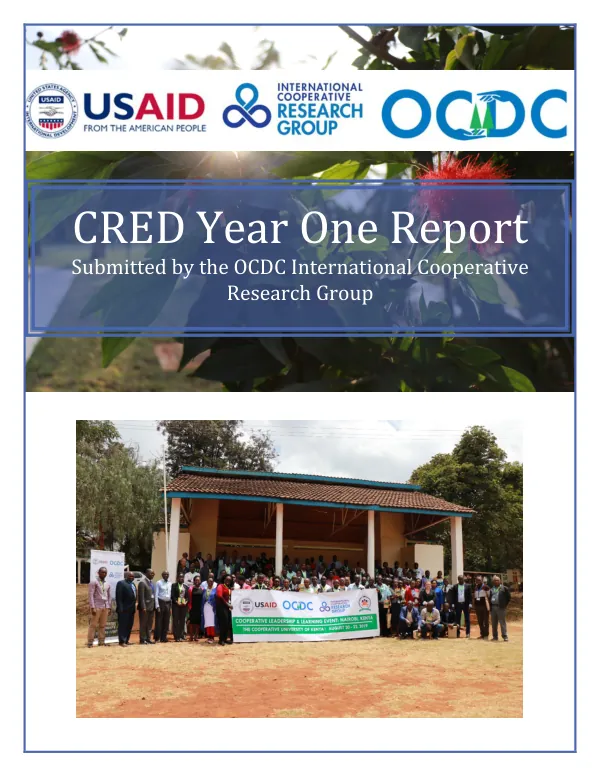
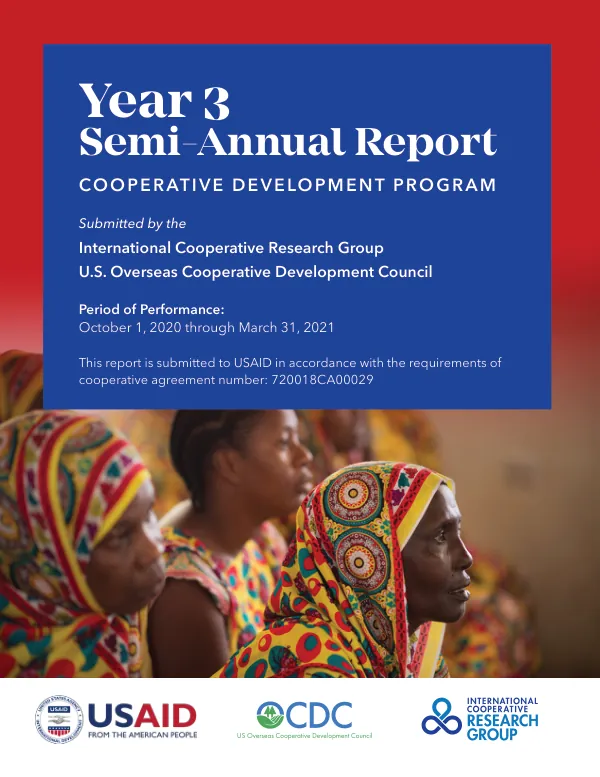
Year 3 Semi-Annual Report: Cooperative Research, Education, and Dissemination (CRED)
Sign inGLOBAL COMMUNITIES
Year 3 Semi-Annual Report: Cooperative Research, Education, and Dissemination (CRED)
The International Cooperative Research Group (ICRG) has responded to the global COVID-19 pandemic with agility, adapting its research and development efforts to address the challenges faced by Cooperative Development Organizations (CDOs), cooperatives, and their members.
2021 · 15 pages
Sign in to readA free account is required to download.
Abstract
The pandemic has had a significant impact on livelihoods worldwide, particularly in low- and middle-income countries, with working hour losses in 2020 being about four times greater than losses from the 2009 global financial crisis. The ICRG's work embodies Cooperative Principle #6: Cooperation among Cooperatives, facilitating information sharing among a robust community of cooperative development partners. Sharing experiences from cooperative best practices around the world strengthens the collective movement to meet the pressing challenges of our time. The ICRG's research focuses on collecting robust new evidence and developing data-driven solutions for internal and external challenges faced by cooperatives, both locally and nationally. The CRED program, implemented through the ICRG, has three mutually reinforcing program components: collecting robust new evidence, working with OCDC members to design, adopt, share, and apply field-derived learning, and disseminating key research findings deeply and widely. The program aims to build a robust learning community that enriches cooperative development programming and enhances its impact. The evidence is intentionally disseminated to bridge the findings to action, including through strengthened program design. The ICRG conducts original, independent, academically rigorous research and disseminates data-driven results to increase the impact of cooperative development and foster broad-based, inclusive growth in USAID-assisted countries. The research is both policy-focused and practice-focused, characterized by engagement with stakeholders throughout its process and targeted dissemination approaches. The ICRG's research has two main goals: providing action-oriented evidence to inform policymakers and improving program design and implementation by CDOs and other implementers. Key ICRG achievements during this reporting period include publishing WDDCM country studies publications in Kenya and the Philippines, hosting the engaging and interactive virtual Peru Policy Dialogue, selecting sub-awardees for the Collaborative Research for Cooperative Resilience, publishing the ICRG research report in a peer-reviewed journal, and launching a new global virtual learning community. These achievements demonstrate the ICRG's commitment to advancing women's economic empowerment in Sub-Saharan Africa research and adapting and collaborating as part of the CRED program. The CRED program's Year Three Implementation Plan, approved by USAID in November 2020, serves as the roadmap for the program's progress. The plan focuses on three main areas: Cooperatives in the Economy, Broad-based Economic Development, and Women's Economic Empowerment. The program aims to build a robust learning community that enriches cooperative development programming and enhances its impact. The ICRG's research and development efforts are critical in addressing the challenges faced by cooperatives and their members. The program's focus on collecting robust new evidence, working with OCDC members, and disseminating key research findings will help to stimulate a robust learning community that enriches cooperative development programming and enhances its impact.