USAID DEC
Internal controls and illegal wildlife trade: A systemic approach to corruption prevention and law enforcement integrity
Sign inUSAID DEC
Internal controls and illegal wildlife trade: A systemic approach to corruption prevention and law enforcement integrity
Internal controls play a crucial role in preventing corruption and ensuring law enforcement integrity in the context of illegal wildlife trade (IWT).
2023 · 8 pages
Sign in to readA free account is required to download.
Abstract
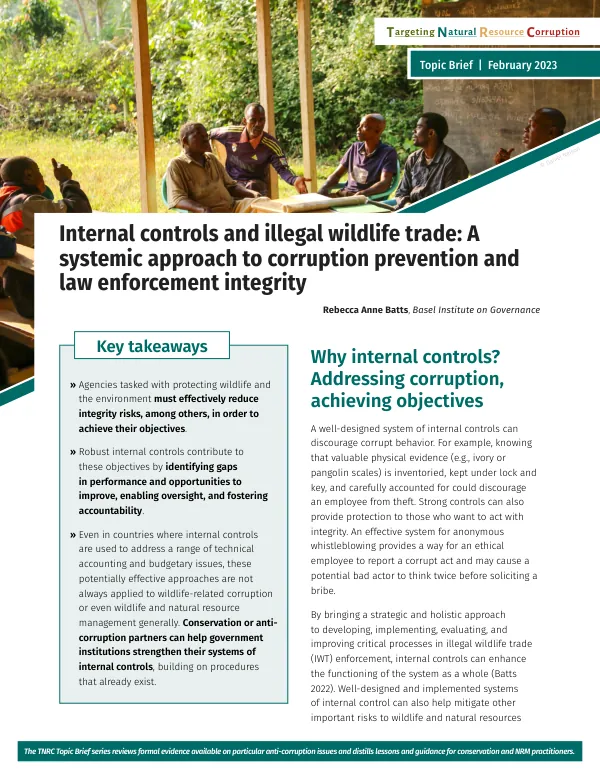
A well-designed system of internal controls can discourage corrupt behavior, provide protection to those who act with integrity, and enhance the functioning of the system as a whole. Internal controls relevant to IWT enforcement are dispersed among various public institutions across different levels of government. At the national level, institutions such as Supreme Audit Institutions, Offices of the Comptroller General, and National Audit Offices provide oversight for government departments and actions, including those responsible for wildlife protection and natural resource management. Within individual government agencies, responsibility for internal controls may include development and oversight of policies, procedures, and practices that help organizations achieve their goals and reduce their risks, including corruption risks. Effective internal control systems include five key components: the control environment, risk assessment, control activities, information and communication, and monitoring. The control environment refers to the context in which an organization seeks to achieve its objectives, including political, economic, legal, cultural, and organizational factors. A risk assessment is a systematic evaluation of the risks that an organization faces as it attempts to achieve its objectives, such as the risk of "deliberate case weakening" by prosecutors. Control activities are the specific steps or activities someone will perform to achieve a control objective, such as signing a receipt for a piece of evidence or conducting an independent performance audit. Information and communication refer to the flow of information within an organization, including the dissemination of policies, procedures, and practices. Monitoring involves the ongoing evaluation of an organization's internal controls to ensure they are operating effectively. A positive tone at the top, where leaders uphold ethics and integrity, can drive effective internal control. A negative tone at the top, where managers dismiss violations as unimportant, can present a barrier to effectiveness that is difficult to overcome. The implementation gap, the difference between an organization's aspirations, goals, and objectives, and what actually happens in practice, can be addressed through the development and implementation of effective internal controls. In a three-country study in Sub-Saharan Africa and Latin America, the Basel Institute on Governance used an internal control lens to analyze IWT-related law enforcement. The study examined how internal control systems were working to address high-priority risks identified in the corruption risk assessment and identified opportunities to mitigate risks and help achieve the agencies' objectives through a strengthened system of internal controls.
Related documents