USAID DEC
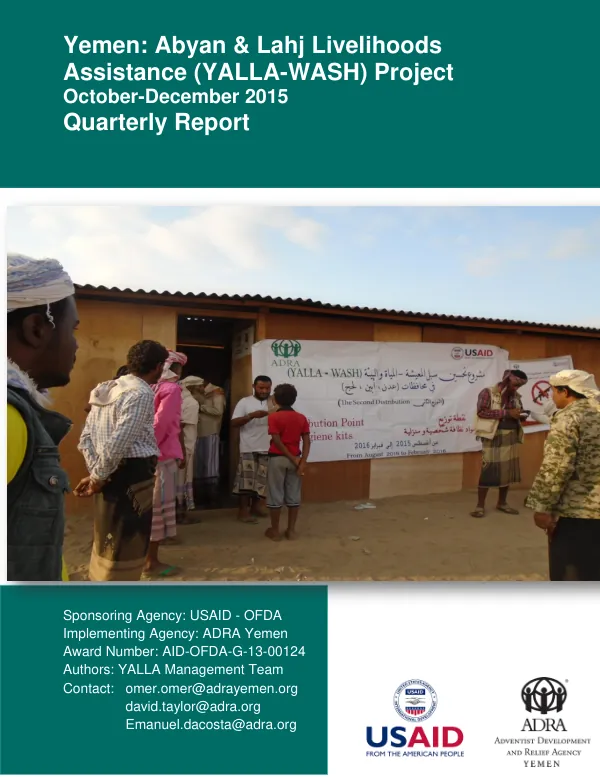
Yemen: Abyan & Lahj Livelihoods Assistance (YALLA-WASH) Project Quarterly Report October-December 2015
Sign inUSAID DEC
Yemen: Abyan & Lahj Livelihoods Assistance (YALLA-WASH) Project Quarterly Report October-December 2015
The YALLA-WASH project in Yemen aimed to provide humanitarian assistance to internally displaced persons (IDPs), returnees, and host communities in Aden, Abyan, and Lahj governorates.
2015 · 10 pages
Sign in to readA free account is required to download.
Abstract
The project was implemented by ADRA Yemen, with funding from USAID's Office of Foreign Disaster Assistance (OFDA). The project's main objective was to provide life-saving assistance, including water trucking, distribution of non-food items (NFIs), and hygiene promotion. The project targeted 3,200 households, with a focus on female-headed households, households with children under five, and households with no monthly income. Community committees were established in each targeted area to help select eligible beneficiaries and facilitate project implementation. The committees consisted of 314 community members, with 254 males and 60 females. ADRA installed 80 distribution points, including 94 tanks with a total capacity of 4,000 liters and 2,000 liters. The tanks were used as distribution centers for drinking water, and mobile water trucks were used to provide water to communities while the tanks were being installed. A total of 21,096,000 liters of water was produced, treated, and distributed to 3,200 targeted households during the quarter. The project's WASH technical team identified and selected 9 water sources in the targeted governorates, with 7 used as main sources and 2 as backup sources. Chlorine was secured for daily water treatment, and trained volunteers from the targeted areas were used to treat water with chlorine and register the daily rates of chlorine throughout the supply chain. A baseline survey was conducted to determine the services baselines and document the main characteristics of the targeted community. The survey showed that the majority of households in the targeted areas had no monthly income, and female-headed households were a significant proportion of the population. A survey was also conducted to ensure the quality of water delivered to households and the acceptable levels of chlorine. The project's implementation was facilitated by ADRA's established relations and partnerships with local communities. The project's activities were well-planned and smoothly implemented, with a focus on community participation and engagement. The project's achievements included the distribution of water to 3,200 households, the installation of 80 distribution points, and the establishment of community committees to facilitate project implementation. The project's impact was significant, with a total of 22,263 individuals served with water trucking through the distribution points. The project's activities also helped to improve the overall living conditions of the targeted communities, with a focus on providing life-saving assistance and promoting hygiene and sanitation practices. The project's achievements were a result of the collaborative efforts of ADRA, USAID, and the local communities, and demonstrated the importance of community-based initiatives in addressing humanitarian needs. The project's implementation was also facilitated by the availability of funding from USAID's OFDA, which enabled ADRA to implement the project's activities and achieve its objectives. The project's achievements were a testament to the effectiveness of community-based initiatives in addressing humanitarian needs, and highlighted the importance of partnerships between humanitarian organizations and local communities in achieving project objectives. The project's activities were well-coordinated with other humanitarian organizations operating in the targeted areas, including the ERU (Emergency Respond United Aden, Lahj and Abyan). The project's implementation was also facilitated by the availability of technical expertise and resources, including the installation of 80 distribution points and the provision of chlorine for water treatment. Overall, the YALLA-WASH project in Yemen demonstrated the importance of community-based initiatives in addressing humanitarian needs, and highlighted the effectiveness of partnerships between humanitarian organizations and local communities in achieving project objectives. The project's achievements were a testament to the collaborative efforts of ADRA, USAID, and the local communities, and demonstrated the importance of community-based initiatives in promoting humanitarian assistance and development.
Related documents