ICRC
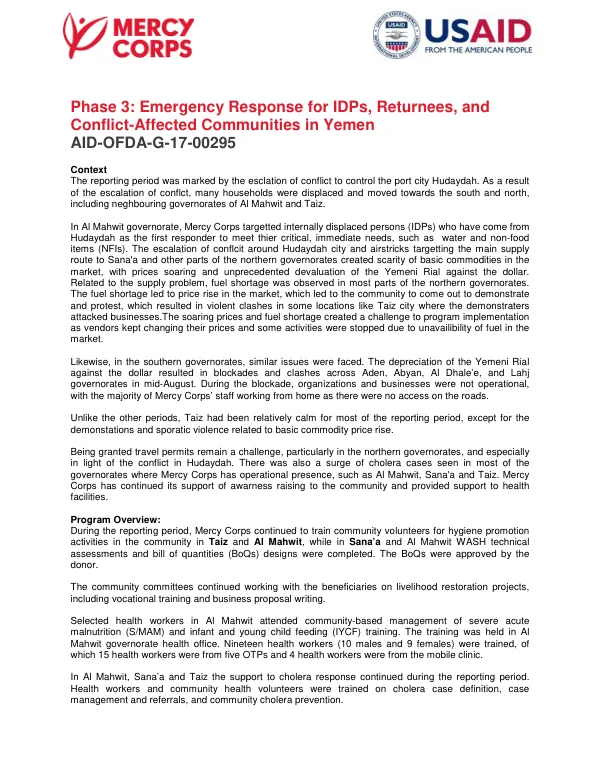
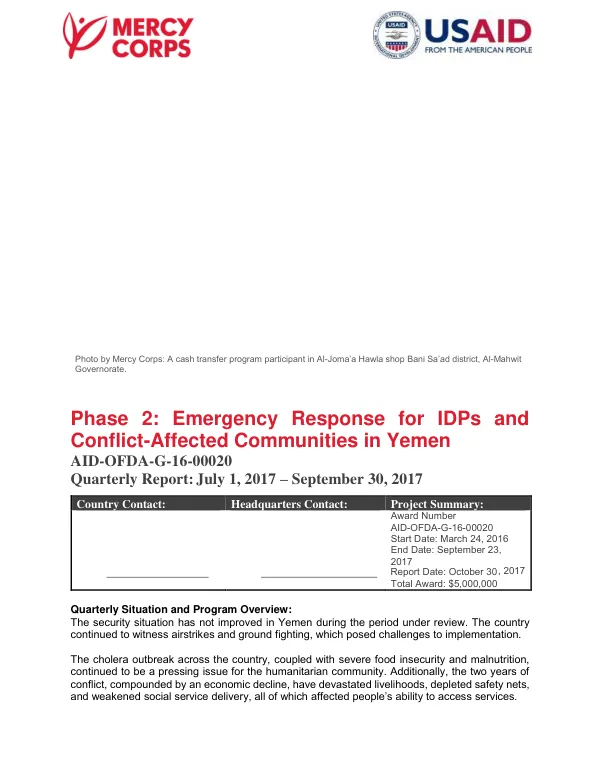
Phase 2: Emergency Response for IDPs and Conflict-Affected Communities in Yemen
The security situation in Yemen has not improved during the period under review.
2017 · 22 pages
Sign in to readA free account is required to download.
Abstract
The country continued to witness airstrikes and ground fighting, posing challenges to implementation. The cholera outbreak across the country, coupled with severe food insecurity and malnutrition, remains a pressing issue for the humanitarian community. The two years of conflict, compounded by an economic decline, have devastated livelihoods, depleted safety nets, and weakened social service delivery, affecting people's ability to access services. In Sana'a, airstrikes continued periodically during the reporting period, along with continued ground fighting and shelling. In Taiz, the security situation has not improved, with ground fighting between different frontlines continuing. Access in and out of the enclave remains a challenge, with many areas cordoned off. Securing travel permits to move in and out of the enclave remains an ongoing challenge. Although the political situation in the South remains volatile, Aden was relatively quiet during the last quarter, with a few incidents demonstrating a familiar pattern of armed crime, unexplained violent incidents, and armed clashes between security forces and others. The reopening of parliament in Aden was the latest move made by President Hadi as they strive for influence in the city and across the South. However, his firing of several governors, including the Governor of Aden, has backfired, resulting in the formation of the Southern Transitional Political Council (SPTC). Several rallies were staged in Aden, led by the SPTC. Since then, the Hadi administration has been engaged in a power struggle with the SPTC as they attempt to build support bases in the city and across the South. A host of other local, political, economic, military, sectarian, and criminal loyalties also divide actors in Aden and across the broader South, making the situation in Aden liable to destabilization. Programming in Sana'a and Al Mahwit focused on complementary WASH interventions, including a cash transfer program that channeled USD $300,000 through money transfer agents to the most vulnerable households in Bani Sa'ad district of Al-Mahwit governorate. Activities were determined in close consultation with local authorities, community committees, and supported by Mercy Corps' Community Mobilizer and field monitoring staff. Where no such committees existed, Mercy Corps established them, ensuring that they were inclusive of both men and women. Mercy Corps maintained positive feedback and acceptance through this approach, as members felt a sense of ownership over the projects being implemented in their areas. In the South, activities this reporting period were focused on completing the livelihood and new livelihood activities with disbursement of grants to beneficiaries completed. Monitoring, evaluation, and learning (MEL) activities, including post-distribution monitoring (PDM) and participatory impact assessment (PIA, end-line survey, data analysis), were conducted. Beneficiary satisfaction surveys for WASH projects were also conducted to determine the satisfaction level of the target communities on the recently completed WASH projects. As a result, two WASH community projects were re-assessed and fixed to address the beneficiary concerns over the project.
Related documents
Documents in this collection
 2017
2017USAID DEC
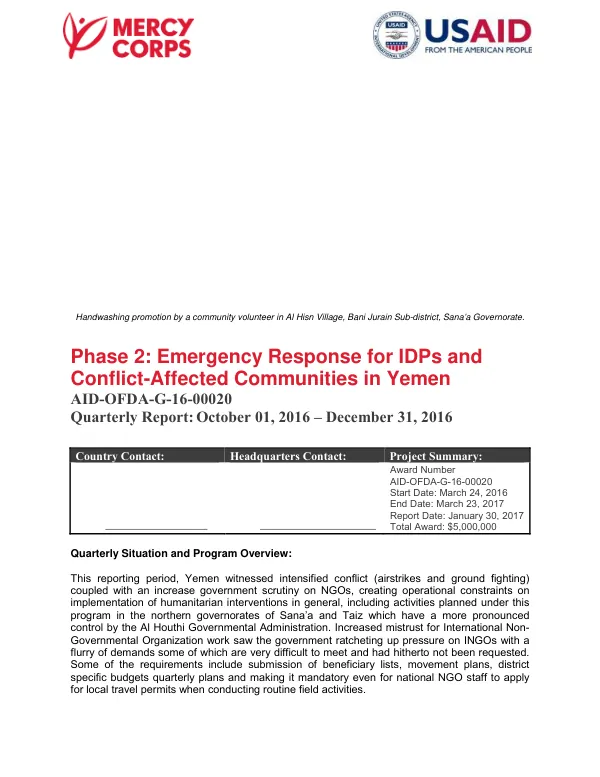
Quarterly Report: October 01, 2016 – December 31, 2016, Phase 2: Emergency Response for IDPs and Conflict-Affected Communities in Yemen
Open record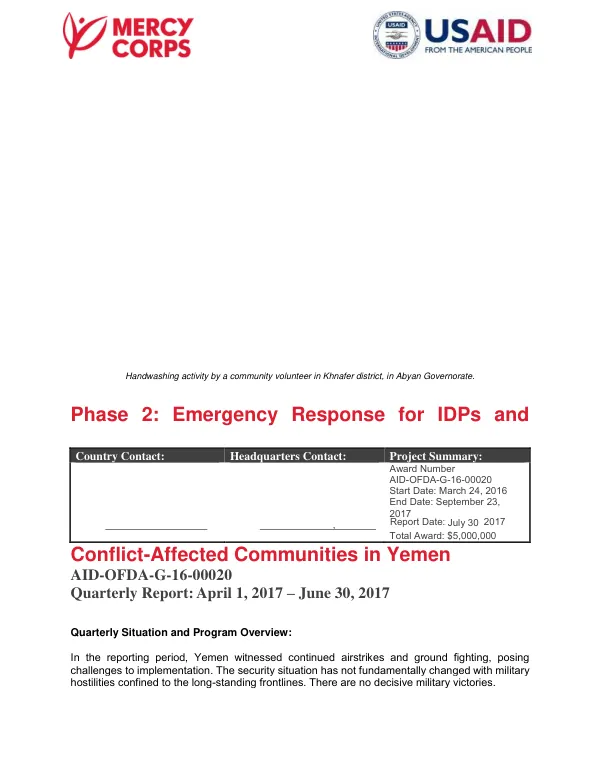 2017
2017USAID DEC
Quarterly Report: April 1, 2017 – June 30, 2017: Phase 2: Emergency Response for IDPs and Conflict-Affected Communities in Yemen
Open record