USAID DEC
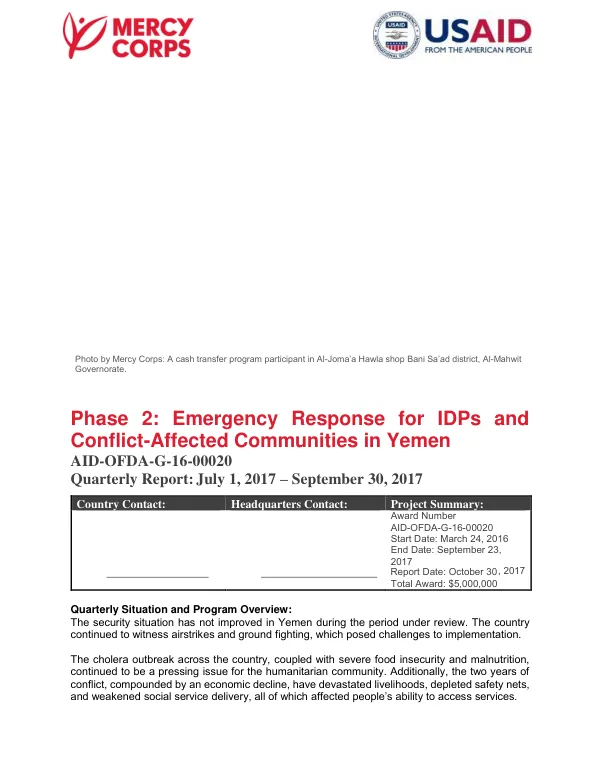
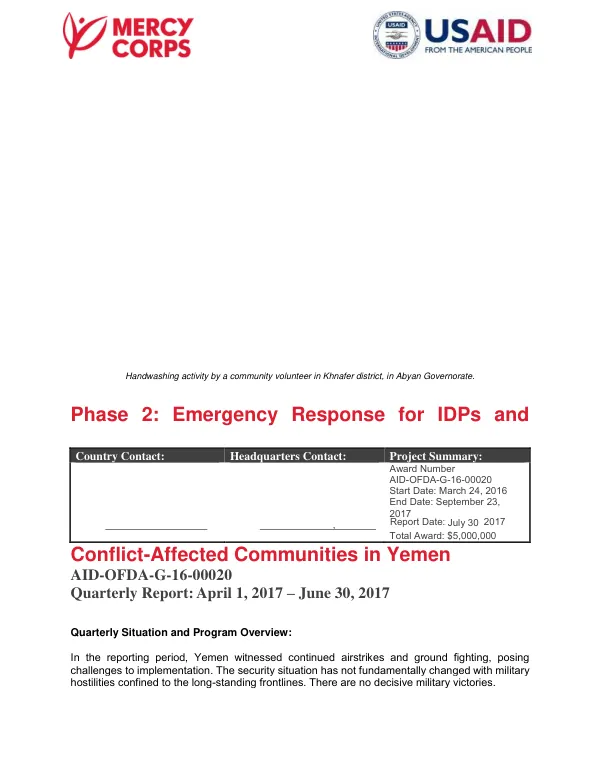
Quarterly Report: April 1, 2017 – June 30, 2017: Phase 2: Emergency Response for IDPs and Conflict-Affected Communities in Yemen
Sign inMERCY CORPS INTERNATIONAL
Quarterly Report: April 1, 2017 – June 30, 2017: Phase 2: Emergency Response for IDPs and Conflict-Affected Communities in Yemen
The humanitarian crisis in Yemen continues to worsen, with ongoing airstrikes and ground fighting posing significant challenges to implementation.
2017 · 24 pages
Sign in to readA free account is required to download.
Abstract
The security situation remains volatile, with no decisive military victories. The cholera outbreak, declared a state of emergency by the Ministry of Public Health and Population (MoHP) on May 14, 2017, has become one of the most pressing concerns for the humanitarian community. As of July 19, 2017, over 360,000 suspected cases have been reported, with 1,828 deaths (case fatality rate 0.5%). The cholera emergency has outgrown the capacities of the health humanitarian actors, necessitating a multi-sector response. The situation is further aggravated by high prevalence of severe food insecurity and malnutrition. The health condition of the vulnerable Yemeni population is already compromised by the deteriorating situation, increasing their susceptibility to cholera infection and associated complications contributing to a higher case fatality rate. Two years of conflict, compounded by an economic decline, have devastated livelihoods, depleted safety nets, and weakened social service delivery, affecting people's ability to access social services. In Sana'a, airstrikes in the Nihm frontline initially decreased, then increased again by the end of the reporting period, with continued ground fighting and shelling. In Taiz, the security situation did not improve during the reporting period, with escalation of conflict seen in the eastern front of Taiz in the month of Ramadan, leading to the closure of Mercy Corps' office for a few days due to security concerns relating to staff movement. In addition to the ground fighting, airstrikes continued during the quarter, and carjackings by armed groups increased, particularly in the enclave. In the South, although the security situation was quiet, the political dynamics in Aden and across the south remain volatile. A number of rallies and demonstrations were held by the Southern Transitional Political Council (SPTC), which started after President Hadi's prior round of firings of top government officials and governors in the southern governorates. The Hadi administration is engaged in a power struggle with the SPTC as they attempt to build support bases in the city and across the south. Mercy Corps implemented various activities in the WASH sector, including environmental health campaigns, hygiene promotion, sanitation infrastructure rehabilitation, and water supply infrastructure rehabilitation. In Sana'a and Al-Mahwit governorates, five environmental campaigns were conducted, benefiting an estimated 96,873 people and 14 sub-districts and 6 villages. In Taiz, although all preparation activities were completed, the solid waste removal and environmental campaign activities were unable to proceed due to leadership issues with the Taiz Community Infrastructure Fund (TCIF). The humanitarian response in Yemen requires a multi-sector approach to address the complex needs of the affected population. Mercy Corps continues to implement activities in the WASH sector, including environmental health campaigns, hygiene promotion, sanitation infrastructure rehabilitation, and water supply infrastructure rehabilitation. The organization also conducts mine risk education (MRE) campaigns and distributes MRE materials, including posters, brochures, and safety game cards.