USAID DEC
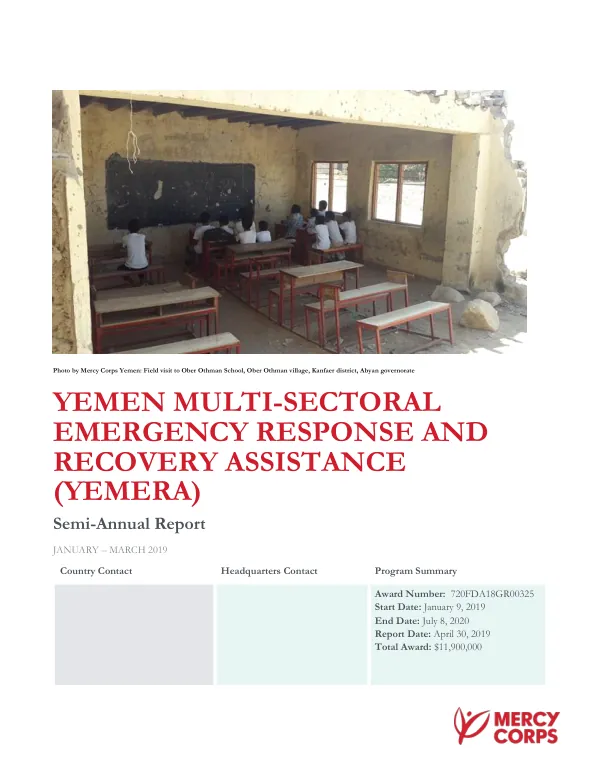
YEMEN MULTI-SECTORAL EMERGENCY RESPONSE AND RECOVERY ASSISTANCE (YEMERA) Semi-Annual Report JANUARY – MARCH 2019
Sign inMERCY CORPS INTERNATIONAL
YEMEN MULTI-SECTORAL EMERGENCY RESPONSE AND RECOVERY ASSISTANCE (YEMERA) Semi-Annual Report JANUARY – MARCH 2019
The Yemen Multi-Sectoral Emergency Response and Recovery Assistance (YEMERA) program, funded by the United States Agency for International Development (USAID) through the Office of U.S.
2019 · 15 pages
Sign in to readA free account is required to download.
Abstract
Foreign Disaster Assistance (OFDA), began on January 9, 2019. The program aims to provide emergency response and recovery assistance to conflict-affected populations in Yemen. The YEMERA program focuses on improving access to safe water, sanitation facilities, and hygiene practices for internally displaced persons (IDPs), returnees, and other conflict-affected populations. The program is implemented in several governorates, including Aden, Abyan, Hadramaut, Al-Dhale’e, and Sana’a/Mahwit. The WASH sector is a key component of the YEMERA program, with a focus on improving access to safe water, sanitation facilities, and hygiene practices. The program has several objectives, including increasing access to safe water, improving sanitation facilities, and promoting hygiene practices. In the WASH sector, the program has several indicators, including the number of people receiving improved service quality from solid waste management, drainage, or vector control activities, and the average number of community cleanup/debris removal activities conducted per community targeted by the environmental health program. The program also aims to increase the number of people receiving direct hygiene promotion, improve the percentage of people using a latrine the last time they defecated, and increase the percentage of people knowing at least three critical times to wash hands. The YEMERA team has started conducting a rapid assessment for the communities through meetings with community leaders and key stakeholders. This assessment will be strengthened by meetings with health authorities who shared reports that reflected the main diseases these communities are suffering from, as well as the ongoing needs. Through continued consultation with health authorities, the YEMERA team is trying to understand the reason for the spread of these diseases and design interventions to mitigate negative outcomes through ‘hard’ and ‘soft’ WASH interventions. In Taiz, the WASH Assessment began in 4 districts inside the enclave. The primary list of proposed projects has been prepared with 2 sanitation projects, and more than 10 water point and infrastructure projects identified, so far. The WASH assessment process is ongoing and the final list of targeted projects will be finalized in the next reporting period. In Aden, four projects have completed their preparation, specifically the project descriptions and BoQs. These projects, as well as the budgets were originally designed under the recently closed OFDA-funded program, Emergency Phase 3. Mercy Corps has submitted a detailed modification request to transfer these projects to the YEMERA program, including the funds required to complete them. To prepare for the start of these projects, the team has raised all the PRs of the projects to the procurement department, but will not begin implementation until OFDA provides approval. The YEMERA program has made significant progress in its first six months, with a strong focus on improving access to safe water, sanitation facilities, and hygiene practices for conflict-affected populations in Yemen. The program has established a strong foundation for its WASH sector, with a clear understanding of the needs and challenges faced by the communities it serves.
Related documents