ACTED
Yemen Emergency Food Assistance (YEFA) Quarterly Report: January– March 2018
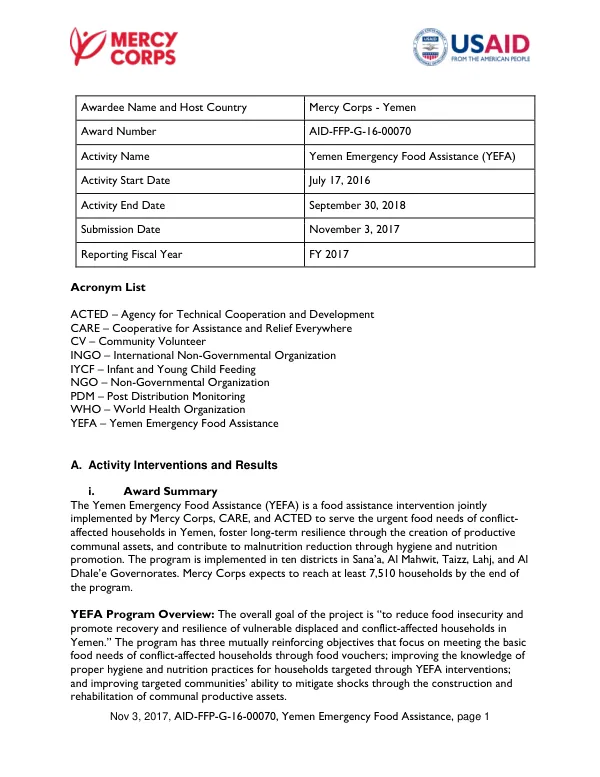
The Yemen Emergency Food Assistance (YEFA) program is a food assistance intervention jointly implemented by Mercy Corps, CARE, and ACTED to serve the urgent food needs of conflict-affected households in Yemen.
2018 · 13 pages
Sign in to readA free account is required to download.
Abstract
The program aims to reduce food insecurity and promote recovery and resilience of vulnerable displaced and conflict-affected households in Yemen. The program has three integrated reinforcing objectives: meeting the basic food needs of conflict-affected households through distribution of food vouchers, improving the knowledge and skills of communities on proper hygiene, sanitation, and nutrition practices, and improving targeted communities' ability to mitigate shocks through the construction and rehabilitation of communal productive assets. The program is implemented in Sana'a, Al Mahwit, Taiz, Lahj, and Al Dhale'e governorates of Yemen, with a focus on nine districts. The program expects to reach at least 12,317 households by the end of the program in September 2018. The program utilizes complementary approaches to ensure the realization of its objectives, including unconditional and conditional food transfers, nutrition, sanitation, and hygiene promotion, and community projects aimed at reducing community exposure to risk, hazards, and disasters. The humanitarian situation in Yemen remains critical, with a large number of internally displaced persons (IDPs) in Sana'a governorate. The conflict has resulted in civilian casualties, damage to houses and farms, and a new wave of cholera epidemic is expected around April with the arrival of the rainy season. Despite the conflict, the market situation is reasonably stable, with basic food items still available at stable prices. However, the further deterioration of the Yemeni Rial against USD is aggravating the complex humanitarian crisis in the country. Access constraints have been reported by Mercy Corps and ACTED in all the districts in the respective governorates, most due to administrative, insecurity, or infrastructure-related challenges. Administrative restrictions are the most pervasive access challenge facing humanitarian actors in Yemen, particularly for the approval of humanitarian activities and movements. Insecurity and difficult physical environments restrict the partner's ability to reach people in need. Currency exchange rates have also been affected, with the Yemeni Rial strengthening by nearly 10 per cent against the USD after Saudi Arabia signed an agreement to transfer $2 billion to the Yemen Central Bank. The program has also made significant progress in promoting hygiene, sanitation, and nutrition practices, with community health volunteers trained by Mercy Corps and partner staff and equipped with relevant information, education, and communication materials. The program's contingency plan was developed jointly to work through the community committee in the event the field staff could not access the village and serve the beneficiaries. The program will continue to provide food assistance through markets (commodity vouchers) and promote hygiene, sanitation, and nutrition practices through community projects. The program's overall goal is to reduce food insecurity and promote recovery and resilience of vulnerable displaced and conflict-affected households in Yemen.