USAID DEC
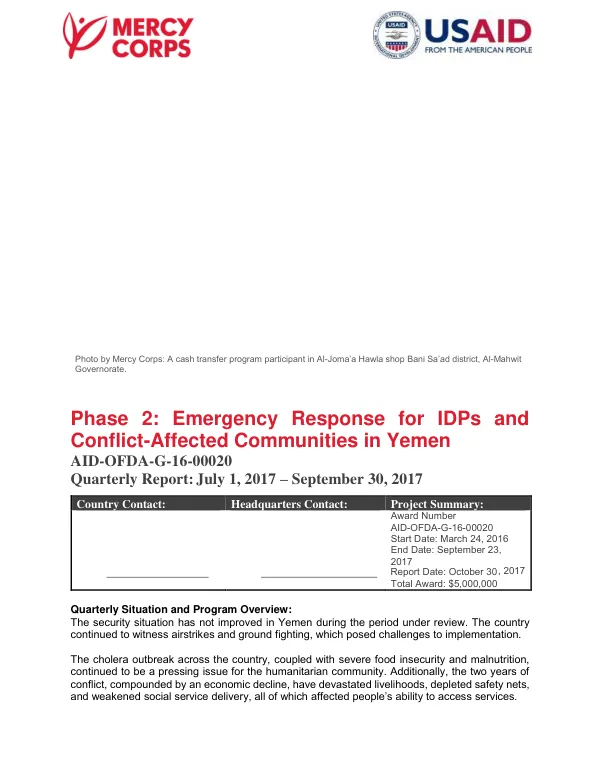
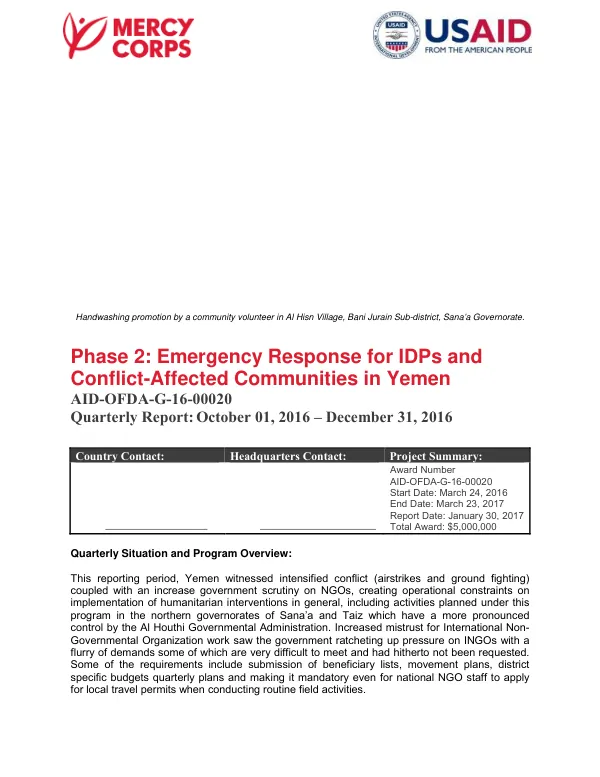
Quarterly Report: October 01, 2016 – December 31, 2016, Phase 2: Emergency Response for IDPs and Conflict-Affected Communities in Yemen
Sign inMERCY CORPS INTERNATIONAL
Quarterly Report: October 01, 2016 – December 31, 2016, Phase 2: Emergency Response for IDPs and Conflict-Affected Communities in Yemen
The humanitarian assistance program in Yemen, implemented by Mercy Corps, aimed to provide support to vulnerable populations in the country.
2017 · 25 pages
Sign in to readA free account is required to download.
Abstract
The program, funded by the US Agency for International Development (USAID), focused on improving access to safe water, sanitation, and hygiene (WASH) services, as well as promoting healthy hygiene practices among the target communities. In the reporting period from October 1 to December 31, 2016, Mercy Corps trained 285 community volunteers in six governorates, including Sana'a, Taiz, Lahj, Abyan, Al Dhale'e, and Hadramaut. The volunteers received training on hygiene promotion, including critical times for handwashing with soap, vector-borne disease prevention and control, clean drinking water, proper waste disposal, and safe stool disposal. The hygiene promotion activities reached 113,729 individuals, with 11,433 hygiene sessions conducted through door-to-door visits and in public places, including schools and farms. The sessions were conducted by the trained community volunteers, who also distributed Information, Education, and Communication (IEC) materials during the hygiene campaign. The program's WASH sector major activities included solid waste management, environmental health, and sanitation infrastructure rehabilitation. In the reporting period, Mercy Corps identified 30 WASH rehabilitation and 10 community projects and began the procurement process for these projects. The program also selected 79 Cash for Work laborers for the three WDR projects, which indirectly benefited 10,911 people. The economic situation in Yemen continued to worsen during the reporting period, with traders suspending new wheat imports and commercial importers unable to open lines of credit with the central bank due to dwindling foreign currency reserves. Despite these challenges, Mercy Corps continued to provide humanitarian assistance to vulnerable populations in the target areas. The program's sector 1, WASH, had several indicators, including the number of people benefiting from solid waste management, drainage, and/or vector control activities, and the number of communities targeted by the environmental health program. The program also conducted community cleanup and debris removal activities, with a target of 30 activities in the reporting period. In Sana'a, Mercy Corps was unable to conduct environmental campaigns due to restrictions on traveling to the field and a delay in signing sub-agreements with the Ministry of Planning and International Cooperation. In Taiz, Mercy Corps planned to conduct 30 environmental campaigns in January-March, but faced restrictions on obtaining travel permits. The program will target activities only within Taiz City, where there are no access constraints. The program's hygiene promotion activities showed significant improvements in the knowledge of healthy hygiene practices among the target communities. In Sana'a, the pre-test data analysis showed that only 25% of the training participants were aware of healthy hygiene practices, while the post-test results showed an increase in knowledge to 72%. In Taiz, the post-test results showed an improvement in the knowledge of all trainees, with scores ranging from 79 to 99. In the southern governorates, the pre-test scores showed that volunteers' knowledge on hygiene practices were between 51 and 79 out of 100, while the post-test results showed an increase in knowledge to 87.24%. Overall, the program's humanitarian assistance activities continued to provide support to vulnerable populations in Yemen, despite the challenging operational environment. The program's WASH sector major activities, including solid waste management, environmental health, and sanitation infrastructure rehabilitation, showed significant progress in improving access to safe water, sanitation, and hygiene services. The program's hygiene promotion activities also showed significant improvements in the knowledge of healthy hygiene practices among the target communities.
Related documents