BELUN
Youth Engagement to Promote Stability: Quarterly Report April 1st – June 30th, 2012
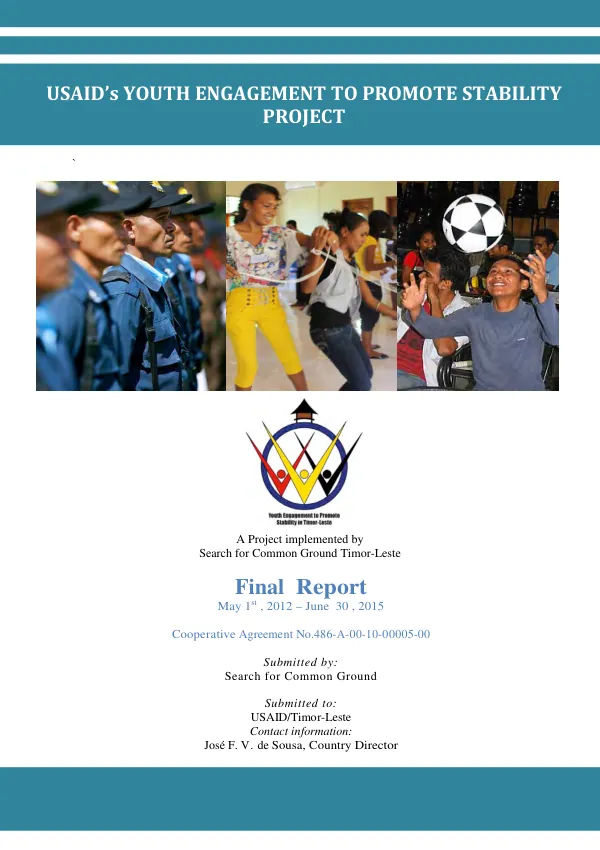
Youth Engagement to Promote Stability is a three-year project initiated by Search for Common Ground (SFCG) in collaboration with USAID, with the primary objective of transforming the way in which youth engage with government and community leaders to promote peace and reconciliation and prevent election-related violence.
2012 · 61 pages
Sign in to readA free account is required to download.
Abstract
The project aims to bridge the gap between Timorese youth and social and political structures at the local and national level, contributing to conflict prevention through the innovative use of media. The project's specific objectives include fostering responsible participation of youth in Timor-Leste's elections and post-elections processes, connecting youth with political decision makers at a national level to explore and articulate salient issues and drivers of youth-related conflict, and providing at-risk and disaffected youth nationwide with reliable information and specific skills to proactively address and respond to conflict-related issues. In May 2012, a signing ceremony was held at the US Embassy in Dili to celebrate the inauguration of the new phase of the project. The US Ambassador and USAID Mission Director were present, along with SFCG staff and youth volunteers who have made a strong contribution to project activities. The project is off to a very strong start, with staff recruitment, equipment procurement, and programming proceeding rapidly. The focus is shifting from the preparation phase to the implementation phase of project activities, with a baseline assessment and youth mapping exercise, as well as a National Youth Forum, slated to take place in the next quarter. The major programming success from this period was the holding of four Regional Forums to supplement the upcoming National Forum. The Regional Forums focused primarily on the role of youth in upcoming Parliamentary elections. A comprehensive Baseline Study will be conducted to establish benchmark data related to the specific objectives and expected results of the project. The primary target groups for this baseline study are youth, and policymakers, with the secondary target group being community members in general. The baseline study will take place in 6 districts in Timor-Leste, with samples including both rural and urban inhabitants, appropriately weighted to account for the distribution of the broader national population. The project's country context is characterized by a relatively peaceful transition from former President Jose Ramos-Horta to the President-elect, Taur Matan Ruak, following the second round of the presidential election on April 16th. The lead-up to the Parliamentary elections, held on July 7th, was also relatively peaceful, with few serious developments and minimal activity. However, there were some exceptions, including the burning of CNRT's district office in Ossu, Viqueque. The project's goals and objectives are aligned with the country's context, aiming to bridge the gap between Timorese youth and social and political structures at the local and national level, contributing to conflict prevention through the innovative use of media. The project will build on the previous Youth Radio for Peace Building (YR4PB) project and seek to achieve the following objectives: fostering responsible participation of youth in Timor-Leste's elections and post-elections processes, connecting youth with political decision makers at a national level, and providing at-risk and disaffected youth with reliable information and specific skills to address conflict-related issues.