USAID DEC
YouthBuild International, BiH YBFBD Revised Final Report
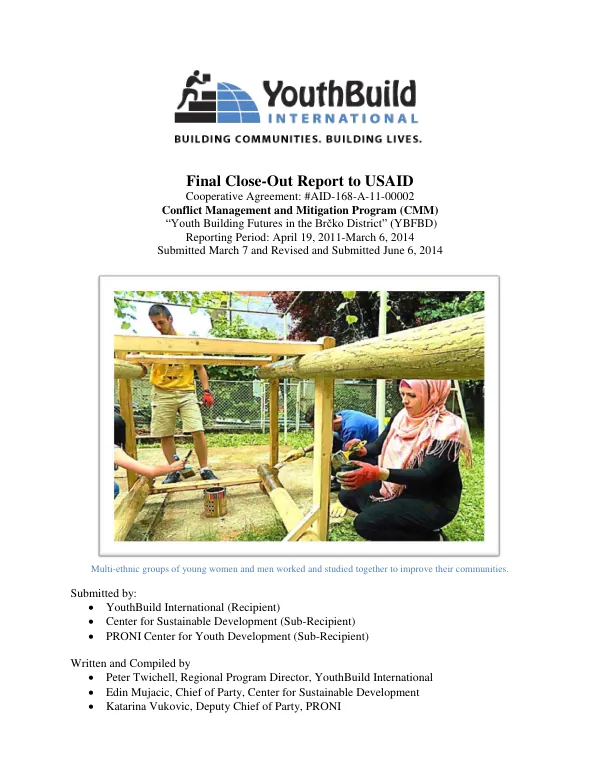
The Youth Building Futures in the Brčko District (YBFBD) project was a 32-month initiative implemented by YouthBuild International in partnership with the Center for Sustainable Development and the PRONI Centre for Youth Development.
2014 · 61 pages
Sign in to readA free account is required to download.
Abstract
The project aimed to increase the economic prospects, civic engagement, and peace-building skills of 400 young women and men aged 16-30 in the Brčko District and surrounding municipalities. The project's theory of change focused on building Healthy Relationships as the most relevant conflict mitigation and reconciliation intervention to address the human, historical, and war-related dynamics in Bosnia and the Brčko district. To achieve this, the project fostered change in youth participants across cognitive, behavioral, and emotional dimensions through a series of organized forums for group interaction, skills training, and the co-creation of valued community assets. The project's goals were to build tangible community improvements in the Brčko district engaging multi-ethnic teams of marginalized young people, increase the economic security of unemployed youth through technical skills training, educational reinforcement, livelihood development, and positive engagement with their communities, demonstrate the benefits of cooperative, multi-ethnic, multi-generational community building for conflict mitigation, reconciliation, and prevention, and test, evaluate, and codify a unique conflict mitigation model in the Brčko district that could be expanded to other parts of Bosnia and Herzegovina. Notable outcomes of the project included the enrollment of 441 young people, with 48% being women, and 86% of enrollees completing the program. Of those who completed, 65% improved their livelihood prospects, including 92 who found formal sector jobs, 27 who found apprenticeships, and 128 who completed internships. Additionally, 29 graduates were volunteering at NGOs or other civic organizations, and 163 participants completed intensive specialized livelihood training after the program. The project also contributed to the development of community assets, with participants contributing 50,000 hours of service building community assets with a value of $115,626 calculated at the local minimum wage. Nearly $100,000 in non-federal cost share was contributed to the project by local businesses, municipal officials, individuals, and private foundations. The project evaluation concluded that YBFBD demonstrated that YouthBuild's distinctive approach can be successfully adapted to an operational setting as challenging as Brčko and BiH. According to YB's theory of change, young people learn to internalize a sense of personal and civic responsibility less via seminars and roundtables than direct, hands-on practice. Through taking on tasks that teach by doing, through contributing to the production of tangible outputs that improve the lives of others, young people gain a sense of personal and collective efficacy that makes them more resilient, persevering, and engaged. The project's approach was highly valued by participants, with 91% of graduates saying the project's approach was relevant to their lives and communities, and 91% of participants surveyed in the evaluation saying a key value of the program was "making friends and expanding social relations." Additionally, 70% of graduates were civically active following the program, compared with 78% of applicants who reported no experience with the civic sector. The project's impact was also evident in the community, with 250 individuals visiting the project's Facebook page each week, and 1,277 actively following the page in Bosnia, Croatia, Serbia, Turkey, Austria, and the U.S. As an epilogue to YBFBD, many graduates continued their commitment to taking responsibility for their communities by joining flood recovery efforts in the months following the end of the program.