USAID DEC
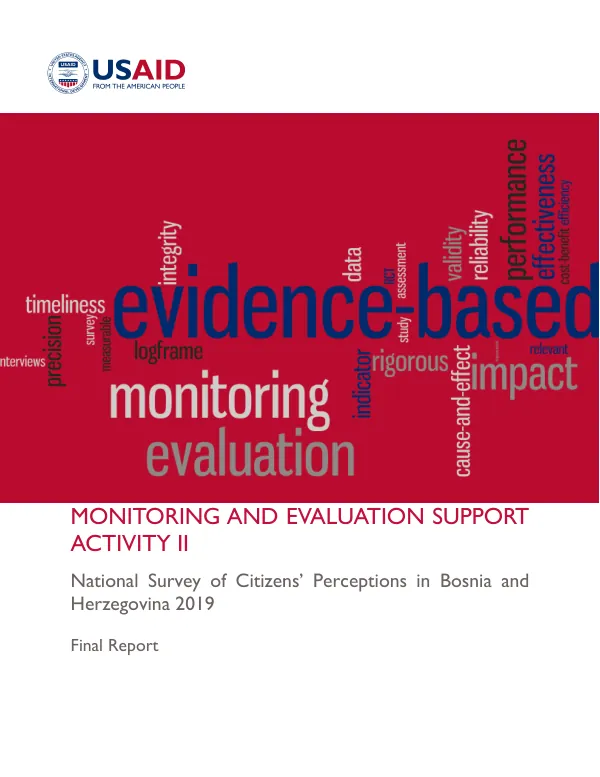
National Survey of Citizens’ Perceptions in Bosnia and Herzegovina 2019, Final Report
Sign inIMPAQ INTERNATIONAL, LLC
National Survey of Citizens’ Perceptions in Bosnia and Herzegovina 2019, Final Report
The National Survey of Citizens' Perceptions in Bosnia and Herzegovina 2019 was conducted to assess the opinions and attitudes of citizens towards various aspects of their country.
2020 · 98 pages
Sign in to readA free account is required to download.
Abstract
The survey was designed to provide insights into the demographic and socioeconomic characteristics of the population, as well as their perceptions of governance, corruption, media, civil society, education, inter-ethnic trust, and counteracting violent extremism. The survey sample consisted of 3,000 citizens from Bosnia and Herzegovina, with a response rate of 85%. The sample was representative of the country's population, with a distribution of 52% Bosniaks, 30% Serbs, and 18% Croats. The majority of respondents (62%) were between the ages of 25 and 54, and 55% had a secondary education or higher. The survey found that citizens in Bosnia and Herzegovina are generally pessimistic about the country's economic situation, with 71% of respondents expressing concerns about the country's development path. The economy remains the predominant priority for citizens, with 62% citing it as the most important issue facing the country. However, there is a slight increase in political participation among citizens, with 22% reporting that they have participated in a protest or demonstration in the past year. The survey also found that trust in public institutions is generally low, with 71% of respondents expressing distrust in the government and 63% expressing distrust in the judiciary. Corruption is a significant concern for citizens, with 83% reporting that corruption is widespread in the country. The majority of respondents (62%) believe that the fight against corruption is ineffective. In terms of education, the survey found that 71% of respondents believe that education is essential for personal and national development. However, there are significant disparities in access to education, with 22% of respondents reporting that they have not completed secondary education. The survey also examined inter-ethnic trust and interaction, finding that 55% of respondents believe that inter-ethnic relations are improving, while 31% believe that they are worsening. However, there are significant differences in perceptions of inter-ethnic trust between different ethnic groups. The survey's findings have significant implications for policymakers and development practitioners in Bosnia and Herzegovina. The results highlight the need for increased transparency and accountability in governance, as well as efforts to address corruption and improve access to education. The survey also underscores the importance of promoting inter-ethnic trust and interaction, as well as addressing the root causes of violent extremism. The survey's methodology involved a nationally representative sample of 3,000 citizens, with a response rate of 85%. The survey was conducted using a questionnaire that included a range of questions on governance, corruption, media, civil society, education, inter-ethnic trust, and counteracting violent extremism. The survey's results are based on a weighted analysis of the data to ensure that the sample is representative of the country's population. The survey's findings are presented in a range of exhibits, including demographic and socioeconomic characteristics of the population, perceptions of governance and corruption, and attitudes towards education and inter-ethnic trust. The survey's results are also compared to previous surveys to identify trends and changes in public opinion over time. Overall, the National Survey of Citizens' Perceptions in Bosnia and Herzegovina 2019 provides a comprehensive and nuanced understanding of the opinions and attitudes of citizens towards various aspects of their country. The survey's findings have significant implications for policymakers and development practitioners in Bosnia and Herzegovina, and highlight the need for increased transparency and accountability in governance, as well as efforts to address corruption and improve access to education.
Related documents