USAID. MISSION TO ZAMBIA
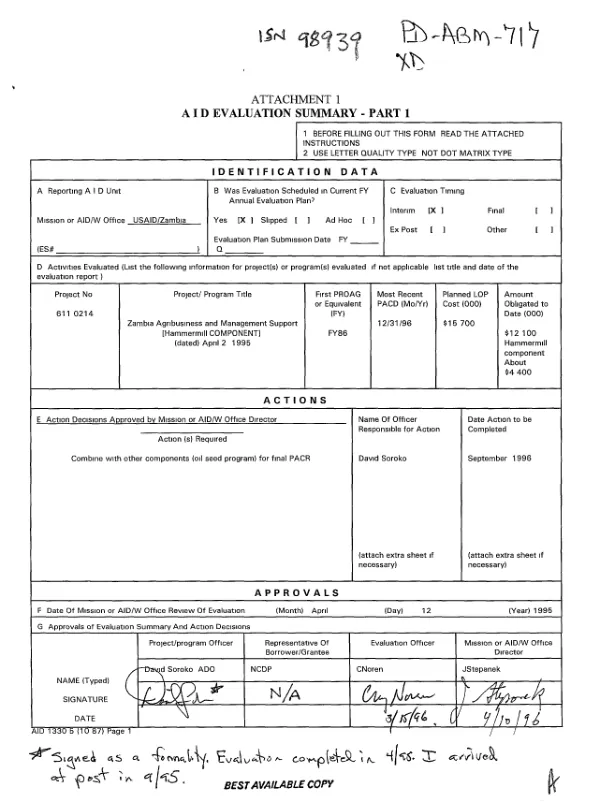
Zambia agribusiness and management support (Hammermill component)
Summarizes attached evaluation (XD-ABM-717-A) of a project component (2/91-9/94) to distribute hammermills for the Government of Zambia, and train millers in their maintenance.
1996
Sign in to readA free account is required to download.
Abstract
The component was implemented by SIDO, a parastatal for small-scale industry, and by Village Industry Services (VIS), an NGO. The project involved distribution of about 1,580 hammermills for maize processing, along with training of 785 millers (30% of whom were women). Procurement of the mills and financing of their purchase by the mill operators was funded by the host government, and was not part of the USAID effort. The hammermills, which are now plentiful and well distributed throughout rural Zambia, improve the quality of life of small farmers by reducing the time spent hand grinding maize, improving nutrition (because milled maize is readily available and cheaper now), and providing an alternate source of income. Some 87% of hammermill owners report that their mills are profitable. The NGO component broke down as the project became politicized and VIS proved unable to manage USAID"s funds properly. USAID withdrew its support from VIS and thus this important element for sustainability was lost. Nonetheless, hammermill training and maintenance services are reportedly continuing on a small-scale basis through USAID-trained local technicians and VIS. SIDO"s distribution efforts are not continuing, but private sector mill assemblers have become successfully installed in the market. The following lessons have been learned. (1) NGOs should promote transparency in activities which are politically sensitive in order to safeguard their financial control and relations with donors. (2) Projects in which an NGO figures prominently in a high-risk activity should involve several NGOs, so that the failure of one institution does not prematurely thwart project objectives. (3) The small-scale, short-term, and site-oriented training undertaken by the project in hammermill maintenance was very successful, with demand exceeding training capacity. The Mission, while judging that the evaluation responded satisfactorily to the basic issues in the project, criticizes it for neglecting certain aspects, such as the efficiency of training and information centers which the project helped to establish (3 are operated by VIS and 10 by the private sector), and the program to upgrade 35 urban hammermillers so they could compete with large public-sector mills. The evaluation also failed to assess the contributions of the various TA teams that worked on the project, and to note that the effort to professionalize the VIS by seconding 90% of its staff from government ministries left the institution vulnerable to political pressure.