USAID DEC
Zika Community Response Project (ZICORE) Annual Progress Report Year 2 – October 1, 2017 to September 30, 2018
Sign inMEDICAL CARE DEVELOPMENT INTERNATIONAL
Zika Community Response Project (ZICORE) Annual Progress Report Year 2 – October 1, 2017 to September 30, 2018
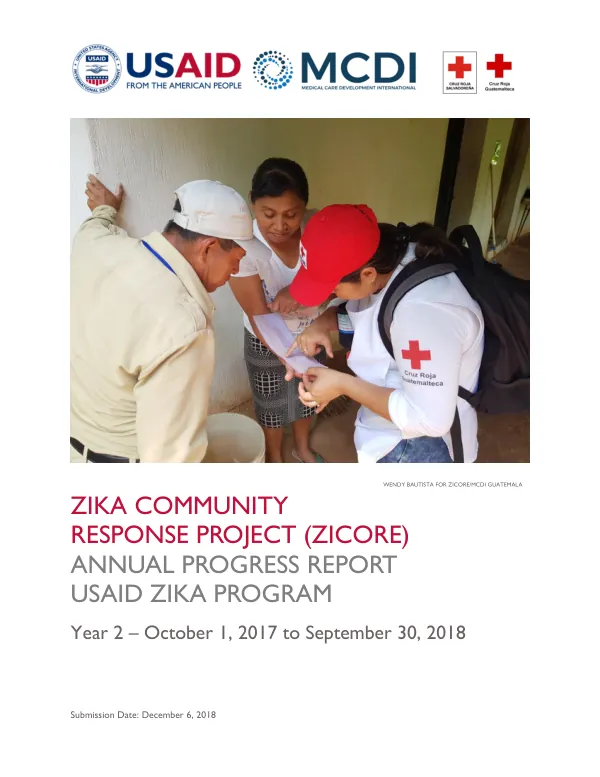
The Zika Community Response Project (ZICORE) is a USAID-funded initiative aimed at responding to the Zika virus epidemic in El Salvador and Guatemala.
2018 · 120 pages
Sign in to readA free account is required to download.
Abstract
Implemented by Medical Care Development International (MCDI) in partnership with the national societies of the Red Cross in Guatemala and El Salvador, and COMISCA, ZICORE works with communities to prevent and respond to Zika without the use of chemicals. The project generates and uses local entomological and epidemiological evidence to target low-cost, participatory, community-based approaches to vector control. ZICORE's primary objectives include improving monitoring of the Aedes aegypti vector, promoting social and behavior change through household visits and collective actions, and improving the identification and referral of suspected cases of Zika. The project also emphasizes knowledge exchange and the sharing of successful experiences at the local, national, and regional levels. Regional dissemination of best practices to involve communities in the Zika response takes place through COMISCA, together with other USAID implementing partners. Two fundamental strategies are used in vector monitoring: weekly entomological surveillance by ovitraps (VEO) to target the geographic areas with the highest Aedes egg production, and quarterly pupal/demographic surveys (EDP) to identify key containers that serve as the most productive breeding sites. The results of both EDP and VEO facilitate the concentration of efforts to eliminate potential sources of vector production, provide targeted behavior change communication and educational messages, and identify suspected Zika cases at the household level. The ZICORE Community Engagement Strategy (ECZ) brings together individual households and multi-sectoral actors to engender social and behavior change, ranks households according to their level of entomological risk, systematically tracks adherence to Zika prevention behaviors, and recognizes those households that are free of vector breeding sites. During the second year of the project (October 2017 to September 2018), ZICORE consolidated and expanded its community-based activities, with a focus on the use of entomological and epidemiological data for action-planning together with local authorities and continuous improvement of data collection and information management procedures. Strong collaboration with municipal and community-level authorities and the recruitment of community volunteers paved the way for a smooth hand-off of responsibilities and improved the chances of sustaining ZICORE's proven, cost-effective Zika prevention and control strategies. Performance highlights from Guatemala and El Salvador in the second year of the project include reaching 22,160 individuals with messages about Zika virus, visiting 10,282 households to conduct entomological surveillance, educate residents, and follow up on vector control actions, and distributing 5,513 cleaning kits. Additionally, 598 ovitraps were monitored each week as an early warning system for Zika transmission, and 109 community volunteers and 129 Red Cross volunteers were engaged. Furthermore, 56 communities took part in some form of physical vector control without the use of chemicals, and 17 communities developed emergency Zika response plans. KAP and mini-KAP studies conducted by ZICORE showed that knowledge of at least one vector-borne Zika transmission prevention method remained high, at 81% in Guatemala and 95% in El Salvador. Fully 73% of Guatemalans and 91% of Salvadorans in ZICORE intervention areas reported taking at least one evidence-based action to prevent Zika in the last month, with scrubbing or otherwise cleaning household containers being the most common action taken.
Related documents