USAID DEC
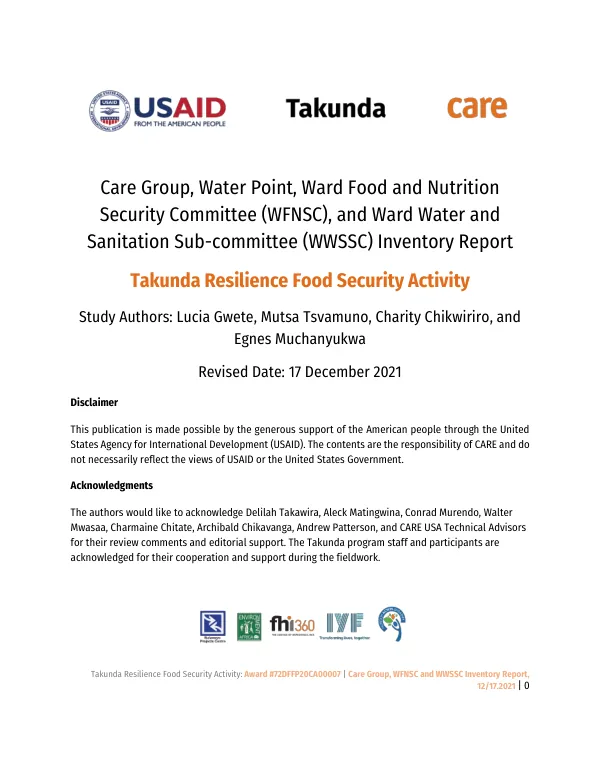
Zimbabwe Agricultural Income and Employment Development (Zim-AIED) Quarterly Report #3, 2012
Sign inCARE
Zimbabwe Agricultural Income and Employment Development (Zim-AIED) Quarterly Report #3, 2012
The Zimbabwe Agricultural Income and Employment Development (Zim-AIED) program is a technical assistance initiative aimed at improving food security and increasing household incomes of small-scale farmers throughout Zimbabwe.
2012 · 35 pages
Sign in to readA free account is required to download.
Abstract
The program, which began in October 2010 and will run through February 2015, covers all agro-ecological regions (Regions 1-V) and is generating new income streams from employment created in the wider agricultural sector. Zim-AIED is commercializing small-scale growers on communal and non-contested land by linking producers to local, national, regional, and international buyers, providing access to credit, raising efficiencies in production systems for an improved combination of cash and food crops, and training farmers to adopt good business practices. The program is building demand for a range of Zimbabwean crops and products by training growers on productivity, quality, continuity, and cost-competitiveness. The program is implemented by Fintrac, a US-based consultancy company, in cooperation with four subcontractors and grantees: International Relief and Development (IRD); the Cooperative League of the USA (CLUSA); Sustainable Agricultural Technology (SAT); and CARE International. Other local nongovernmental organizations (NGOs) and commercial companies work with the program as development partners, in some cases co-funded through a cost-sharing grant facility. The program's activities are focused on several key areas, including sales and income, market access, finance and credit, business development, productivity, climate change and environment, gender, and lessons learned. The program has achieved significant results, including a 27% increase in household income among program participants compared to the control group, and improved food security indicators across all target communities. In terms of sales and income, the program has helped farmers to increase their sales and income through the production and marketing of higher-value cash crops under contract. The program has also provided access to credit for farmers, enabling them to purchase essential inputs and new technologies. The program's market access activities have focused on linking producers to local, national, regional, and international buyers, and building demand for a range of Zimbabwean crops and products. The program has also provided training to farmers on productivity, quality, continuity, and cost-competitiveness. In terms of finance and credit, the program has provided access to credit for farmers, enabling them to purchase essential inputs and new technologies. The program has also established a cost-sharing grant facility to leverage technical support for farmers through conventional grants, and to fund purchases of essential inputs and new technologies on a cost-recovery basis. The program's business development activities have focused on training farmers to adopt good business practices, and raising efficiencies in production systems for an improved combination of cash and food crops. The program has also provided specialized technical support for the production of food crops to increase food availability on a sustainable basis in areas and communities most vulnerable to food insecurity. In terms of productivity, the program has focused on improving the productivity of staple food crops, horticulture, value addition, livestock, and irrigation. The program has also provided training to farmers on good agricultural practices (GAPs), crop selection, water management, soil fertility, and greenhouse gases. The program's climate change and environment activities have focused on commercializing small-scale growers on communal and non-contested land, and providing access to credit. The program has also established a cost-sharing grant facility to leverage technical support for farmers through conventional grants, and to fund purchases of essential inputs and new technologies on a cost-recovery basis. In terms of gender, the program has focused on promoting gender mainstreaming and providing training to farmers on good agricultural practices (GAPs). The program has also established a cost-sharing grant facility to leverage technical support for farmers through conventional grants, and to fund purchases of essential inputs and new technologies on a cost-recovery basis. The program's lessons learned have focused on the importance of commercializing small-scale growers on communal and non-contested land, and providing access to credit. The program has also established a cost-sharing grant facility to leverage technical support for farmers through conventional grants, and to fund purchases of essential inputs and new technologies on a cost-recovery basis. In terms of networking and collaborations, the program has worked with local nongovernmental organizations (NGOs) and commercial companies as development partners, in some cases co-funded through a cost-sharing grant facility. The program has also established partnerships with international organizations, including the United States Agency for International Development (USAID). The program's challenges have focused on the need to improve the productivity of staple food crops, horticulture, value addition, livestock, and irrigation. The program has also faced challenges in terms of access to credit, and the need to establish a cost-sharing grant facility to leverage technical support for farmers through conventional grants, and to fund purchases of essential inputs and new technologies on a cost-recovery basis. In conclusion, the Zim-AIED program has achieved significant results in improving food security and increasing household incomes of small-scale farmers throughout Zimbabwe. The program's activities have focused on several key areas, including sales and income, market access, finance and