USAID DEC
Zimbabwe (and) Namibia : anticipation of economic and humanitarian needs; transtition problems of developing nations in southern Africa
Sign inAFRICAN-AMERICAN SCHOLARS COUNCIL
Zimbabwe (and) Namibia : anticipation of economic and humanitarian needs; transtition problems of developing nations in southern Africa
This final report of the Southern Africa project represents a culmination of seven months of intensive research, consultation with the AID Africa Bureau, and an extensive effort to create a data base as well as a repository of information relevant to southern Africa.
Adams, S. C. · 1970
Sign in to readA free account is required to download.
Abstract
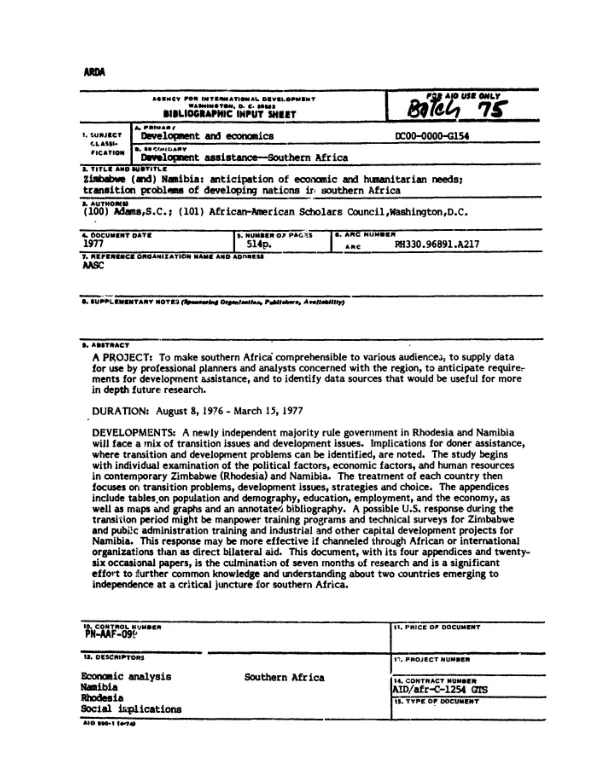
This study was undertaken to make southern Africa comprehensible to various audiences and to supply data for use by professional planners and analysts who are concerned with the region. A newly independent majority rule government in Rhodesia and Namibia will face a mix of transition issues and development issues. Implications for donor assistance, where transition and development problems can be identified, are noted. The study begins with individual examination of the political factors, economic factors, and human resources in contemporary Zimbabwe and Namibia. The treatment of each country then focuses on transition problems, development issues, strategies and choice. The appendices include tables on population and demography, education, employment, and the economy, as well as maps and graphs and an annotated bibliography. A possible U.S. response during the transition period might be manpower training programs and technical surveys for Zimbabwe and public administration training and industrial and other capital development projects for Namibia. This response may be more effective if channeled through African or international organizations than as direct bilateral aid. This document, with its four appendices and twenty-six occasional papers, is a significant effort to further common knowledge and understanding about two countries emerging to independence at a critical juncture for southern Africa.