USAID DEC
Namibia, anticipation of economic and humanitarian needs : the education of refugees in Zimbabwe and Namibia
Sign inAFRICAN-AMERICAN SCHOLARS COUNCIL
Namibia, anticipation of economic and humanitarian needs : the education of refugees in Zimbabwe and Namibia
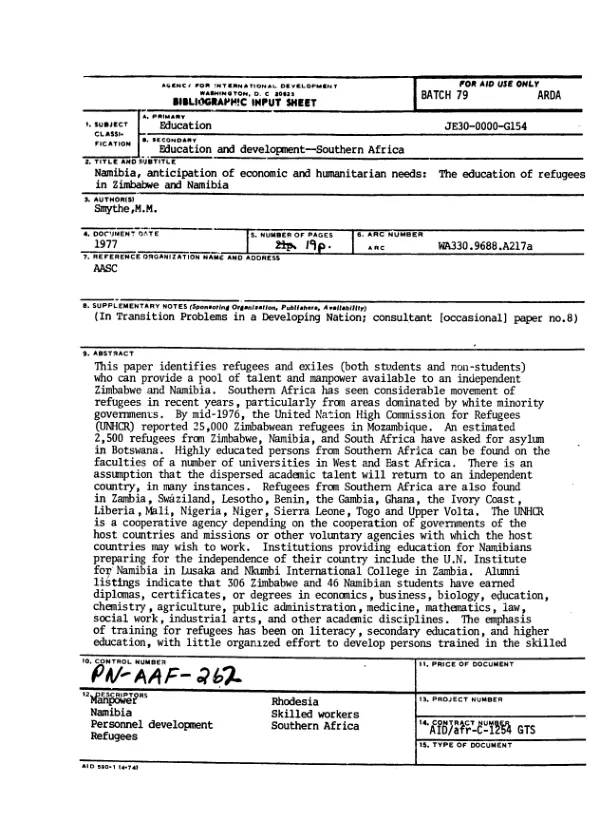
This paper identifies refugees and exiles (both students and non-students) who can provide a pool of talent and manpower available to an independent Zimbabwe and Namibia.
Smythe, M. M. · 1970
Sign in to readA free account is required to download.
Abstract
Southern Africa has seen considerable movement of refugees in recent years, particularly from areas dominated by white minority governments. By mid-1976, the United Nation High Commission for Refugees (UNHCR) reported 25,000 Zimbabwean refugees in Mozambique. An estimated 2,500 refugees from Zimbabwe, Namibia, and South Africa have asked for asylum in Botswana. Highly educated persons from Southern Africa can be found on the faculties of a number of universities in West and East Africa. There is an assumption that the dispersed academic talent will return to an independent country, in many instances. Refugees from Southern Africa are also found in Zambia, Swaziland, Lesotho, Benin, the Gambia, Ghana, the Ivory Coast, Liberia, Mali, Nigeria, Niger, Sierra Leone, Togo and Upper Volta. The UNHCR is a cooperative agency depending on the cooperation of governments of the host countries and missions or other voluntary agencies with which the host countries may wish to work. Institutions providing education for Namibians preparing for the independence of their country include the UN Institute for Namibia in Lusaka and Nkumbi International College in Zambia. Alumni listings indicate that 306 Zimbabwe and 46 Namibian students have earned diplomas, certificates, or degrees in economics, business, biology, education, chemistry, agriculture, public administration, medicine, mathematics, law, social work, industrial arts, and other academic disciplines. The emphasis of training for refugees has been on literacy, secondary education, and higher education, with little organized effort to develop persons trained in the skilled trades. There is an urgent need for training programs in these skills which are not now available to African workers in Zimbabwe and Namibia.
Related documents
Documents in this collection
 1970
1970USAID DEC
Namibia, anticipation of economic and humanitarian needs : an analysis of the main aspects of manpower and education needs for Namibia in a situation of transition
Open record 1970
1970USAID DEC