USAID DEC
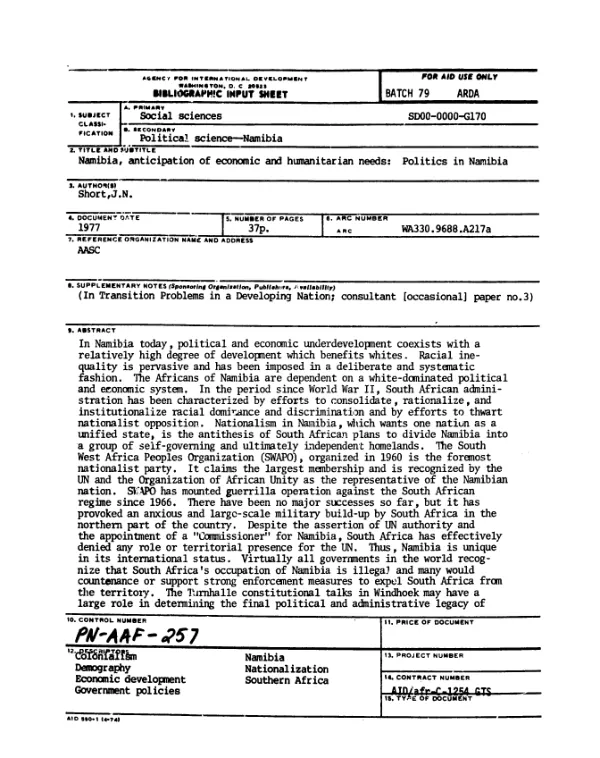
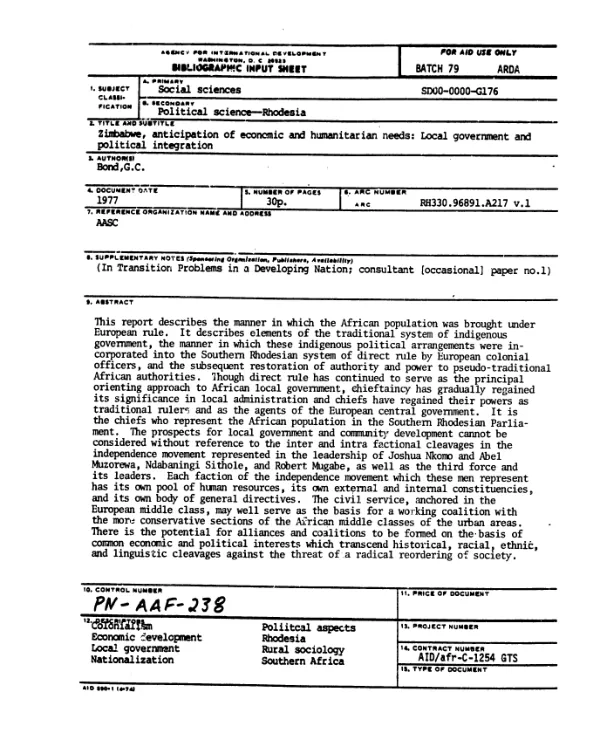
Zimbabwe, anticipation of economic and humanitarian needs : local government and political integration
Sign inAFRICAN-AMERICAN SCHOLARS COUNCIL
Zimbabwe, anticipation of economic and humanitarian needs : local government and political integration
This report describes the manner in which the African population was brought under European rule.
Bond, G. C. · 1970
Sign in to readA free account is required to download.
Abstract
It describes elements of the traditional system of indigenous government, the manner in which these indigenous political arrangements were incorporated into the Southern Rhodesian system of direct rule by European colonial officers, and the subsequent restoration of authority and power to pseudo-traditional African authorities. Though direct rule has continued to serve as the principal orienting approach to African local government, chieftaincy has gradually regained its significance in local administration and chiefs have regained their powers as traditional rulers and as the agents of the European central government. It is the chiefs who represent the African population in the Southern Rhodesian Parliament. The prospects for local government and community development cannot be considered without reference to the inter and intra factional cleavages in the independence movement represented in the leadership of Joshua Nkomo and Abel Muzorewa, Ndabaningi Sithole, and Robert Mugabe, as well as the third force and its leaders. Each faction of the independence movement which these men represent has its own pool of human resources, its own external and internal constituencies, and its own body of general directives. The civil service, anchored in the European middle class may well serve as the basis for a working coalition with the more conservative sections of the African middle classes of the urban areas. There is the potential for alliances and coalitions to be formed on the basis of common economic and political interests which transcend historical, racial, ethnic, and linguistic cleavages against the threat of a radical reordering of society.