ENCOMPASS, LLC
DEEP Year 3 Quarter 2 Report
The Data and Evidence for Education Programs (DEEP) initiative was established in August 2018 by the United States Agency for International Development (USAID) Bureau for Development, Democracy, and Innovation (DDI) Center for Education.
2021 · 45 pages
Sign in to readA free account is required to download.
Abstract
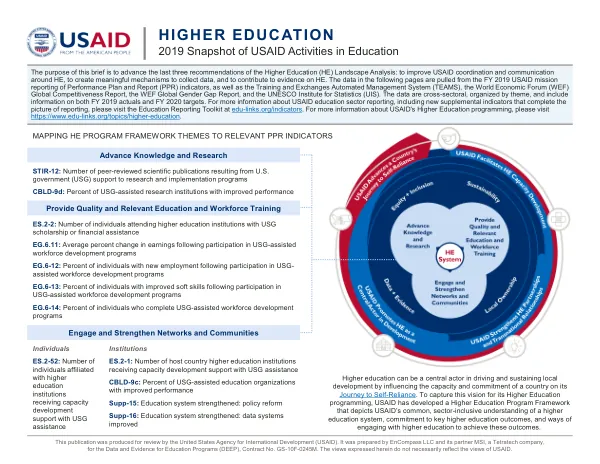
The DEEP team, led by EnCompass LLC and its partner MSI, a Tetra Tech company, aims to improve the quality, relevance, availability, accessibility, and use of education data. DEEP's five-pronged approach is centered on its theory of change, which consists of five key components: quality and relevant data are readily available, research is applied and accessible, dissemination is increased, data users are enabled, and coordination in United States Government (USG) basic education programming is increased. The initiative seeks to address challenges to effective data use and foster a shift in data culture to further the goal of improved and more equitable education programs. During the third year of project technical implementation, DEEP achieved several notable successes. The team developed an informational brief on the impact of the Corona Virus Disease 2019 (COVID-19) pandemic on education, which is being used to inform USAID Africa Bureau staff on the significant impact of the pandemic on education in the short- and long-term. DEEP also hosted multiple USG technical working group meetings, during which the team proposed and members voted to approve three indicators for workforce development. In addition, DEEP presented key findings from an Education Sector Analysis report as part of a day-long seminar with the Government of Nepal, USAID/Nepal, and other donors active in the education sector in Nepal. The workshop provided a critically useful opportunity for key stakeholders responsible for designing and implementing the next Education Sector Plan in Nepal to interrogate the findings and recommendations provided by DEEP and other consultant teams. DEEP also developed an action plan matrix to guide the Jordan Ministry of Education's plans on addressing findings of the PISA analysis. The team published Fiscal Year (FY)19 Performance Plan and Report (PPR) data briefs, which help USAID staff identify gaps and good practices related to disability-inclusive education, education in crisis and conflict, foundational skills, higher education, and youth workforce development. Furthermore, DEEP produced the Best Practices in Coordination brief that provides recommendations and action steps for Mission staff. The team published the Target Setting Guide, a consolidated resource that provides detailed guidance on a process to set targets and suggestions for analytical methods to apply to certain indicators and scenarios for deriving specific targets. DEEP also completed a working paper and held separate working sessions with implementing partners (IPs) and USAID staff to identify the best path forward on USAID's work in social and emotional learning (SEL)/soft skills measurement. Based on the outcomes of these sessions, USAID and the DEEP team determined that the best next steps are not to create an updated indicator, but rather to address existing challenges with measuring SEL/soft skills identified by stakeholders. The team facilitated and produced a 6-session, live cost analysis training, which was attended by 20 participants. At the end of the six weeks, participants gave the training an average score of 4.71/5 based on quality and usefulness. This training is the first attempt at developing comprehensive training in USAID's cost analysis methods. DEEP also updated the Fiscal Year (FY) 20 common output indicator data in Annex 1 and used FY20 disbursement data to complete Annex 2 for the annual USG Strategy report. The submission of the report has never before included round 2 PPR data, representing an improvement in accuracy and efficiency. In addition, the team developed the interactive Higher Education map, which allows users to explore and learn about USAID's higher Education programming. DEEP completed the interactive brief, "Pandemic-Era Responses in Higher Education and Youth Workforce Development," which complements other research conducted under this task by focusing on COVID-19's unique impacts on youth, particularly those vulnerable or marginalized. The team carried out a series of activities to support the dissemination of the Monitoring Distance Learning Roadmap, including a brief video, a series of webinars, and a Frequently Asked Questions (FAQ) document that will serve as a living resource that missions staff and IPs can reference when developing or planning for distance learning monitoring systems or activities. DEEP conducted an in-depth review of the planned University reform in Morocco via review of literature, key informant interviews in Morocco and the Middle East and North Africa (MENA) region, and a series of focus group discussions with faculty and students in a sample of universities. After meeting with Ministry and university representatives, the team developed a series of detailed recommendations regarding the reform design and its implementation. Findings and recommendations were presented in a report and a bi-lingual virtual presentation to high-ranking, Ministry, USAID, and University representatives and were very well received. DEEP designed and launched an outreach campaign to raise awareness of the Global Proficiency Framework (GPF) and Policy Linking, which included support for a series of webinars, social media promotion for the Comparative and International Education