ENCOMPASS, LLC
DEEP Year 3 Quarter 2 Report
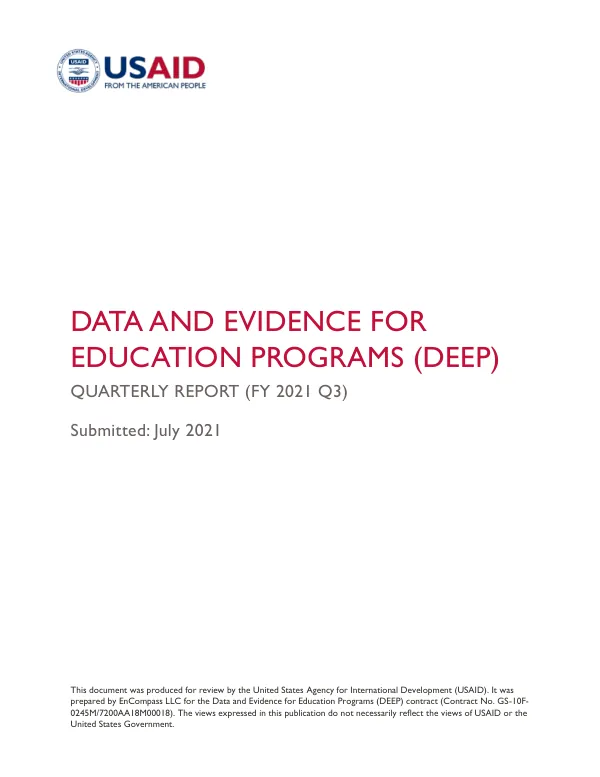
The Data and Evidence for Education Programs (DEEP) initiative was established in August 2018 by the United States Agency for International Development (USAID) Bureau for Development, Democracy, and Innovation (DDI) Center for Education.
2021 · 28 pages
Sign in to readA free account is required to download.
Abstract
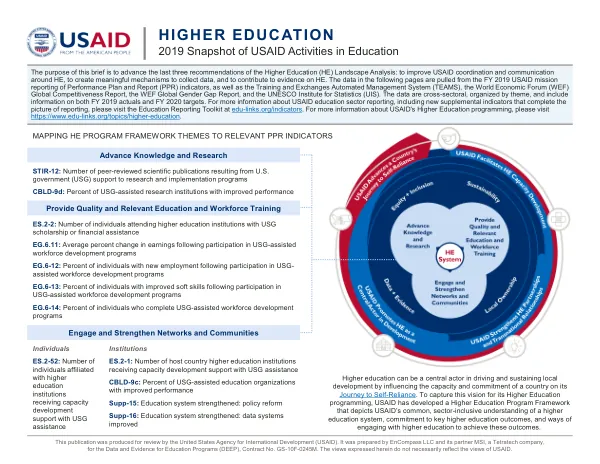
EnCompass LLC, in partnership with MSI, a Tetra Tech company, was awarded the DEEP contract to improve the quality, relevance, availability, accessibility, and use of education data. The DEEP team employs a five-pronged approach to address challenges to effective data use, fostering a shift in data culture to further the goal of improved and more equitable education programs. The five-pronged approach is encapsulated in DEEP's theory of change, which includes the following components: quality and relevant data are readily available, research is applied and accessible, and there is a better understanding of contributors and barriers to achieving strategic goals; dissemination is increased, and evidence on education sector priorities is widely disseminated and accessed; data users are enabled, and demand for and use of data are increased; and coordination in United States Government (USG) basic education programming is increased. During the first quarter of project technical implementation, DEEP achieved several successes and milestones. The team facilitated and produced a live, six-session cost analysis training, which was well-received by participants. DEEP also updated the Fiscal Year (FY) 2020 common output indicator data and used FY 2020 disbursement data to complete Annex 2 for the annual USG Strategy report. This represents an improvement in accuracy and efficiency, as the submission of the report now includes round 2 Performance Plan and Report (PPR) data. Additionally, DEEP developed the Interactive Higher Education Map, which allows users to explore and learn about USAID's higher education programming. The team also completed the interactive brief, "Pandemic-Era Responses in Higher Education and Youth Workforce Development," which focuses on COVID-19's unique impacts on youth, particularly those vulnerable or marginalized. Furthermore, DEEP carried out a series of activities to support the dissemination of the Monitoring Distance Learning Roadmap, including a brief video, a series of webinars, and a frequently asked questions (FAQ) document. DEEP also finalized a recommendations paper to inform USAID's strategy in social and emotional learning (SEL)/soft skill development. The team conducted an in-depth review of the planned university reform in Morocco, which included a review of literature, key informant interviews, and focus group discussions. After meeting with Ministry and university representatives, the team developed a series of detailed recommendations regarding the reform design and its implementation. Findings and recommendations were presented in a report and a bilingual virtual presentation to high-ranking Ministry, USAID, and university representatives. The DEEP team also designed and launched an outreach campaign to raise awareness of the global proficiency framework (GPF) and policy linking. This included support for a series of webinars, social media promotion for the Comparative and International Education Society (CIES) conference session, and the first policy linking training, conducted by MSI. DEEP produced three informational videos on policy linking to use at trainings, workshops, and on social media to promote awareness and understanding of the approach. In Task 2: Ongoing Data Support, DEEP conducted ongoing analyses and documentation of USAID education programming to support USAID reporting on strategic objectives. The team reached out to USAID technical teams to plan PPR data briefs for FY 2020 and undertook a detailed review of PPR narratives to support the development of gender, inclusive education, and COVID-19 response briefs. Future briefs are planned for higher education, finance, and pre-primary education. DEEP also reviewed standard performance indicator review sheets (PIRS) for education programming to ensure revisions are run consistently and everything makes sense and is reportable. The DEEP team has received positive feedback from USAID technical teams and implementing partners, highlighting the value of their work in supporting USAID reporting and improving the quality and relevance of education data.
Related documents