ABT ASSOCIATES
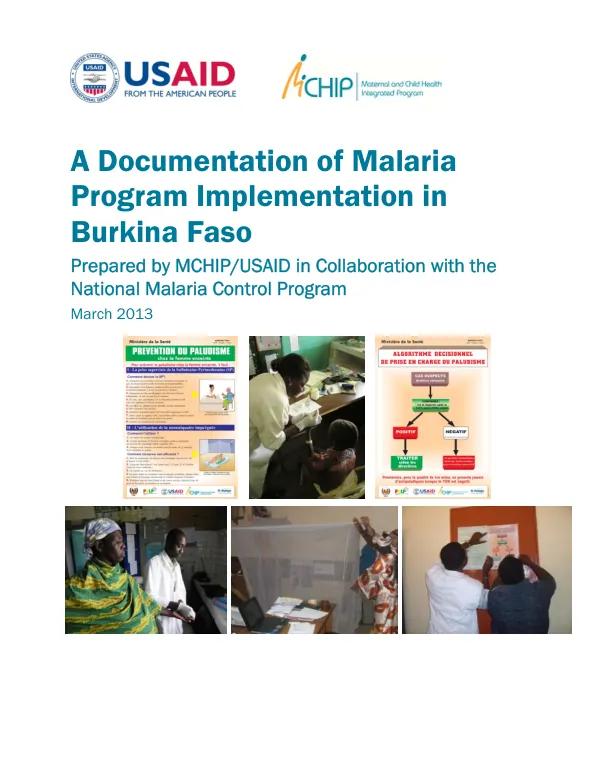
A Documentation of Malaria Program Implementation in Burkina Faso
Malaria is a significant public health concern in Burkina Faso, with a high endemicity rate and substantial morbidity and mortality.
2013 · 54 pages
Sign in to readA free account is required to download.
Abstract
The country's epidemiological profile indicates that malaria is a major cause of illness and death, particularly among children under the age of five and pregnant women. According to the World Health Organization (WHO), malaria is responsible for approximately 40% of outpatient visits and 20% of hospital admissions in Burkina Faso. The National Malaria Control Program (NMCP) has been working to control and eliminate malaria in the country since 2005. The program's strategy focuses on case management, intermittent preventive treatment, vector control, and advocacy, information, education, communication, and social mobilization. The NMCP has made significant progress in increasing access to malaria diagnosis and treatment, particularly through the use of artemisinin-based combination therapy (ACT). Implementation progress has been observed in various areas, including case management, where the proportion of suspected malaria cases tested for diagnosis has increased from 10% in 2005 to 80% in 2012. Intermittent preventive treatment has also been scaled up, with over 1 million pregnant women receiving treatment in 2012. Vector control efforts have focused on the distribution of insecticide-treated nets (ITNs) and indoor residual spraying (IRS), with over 2 million ITNs distributed between 2005 and 2012. The NMCP has also made significant progress in strengthening its systems and capacity. The program has established a robust monitoring and evaluation system, which has enabled it to track progress and identify areas for improvement. The NMCP has also strengthened its capacity for research and development, with several studies conducted to inform malaria programming. Despite these achievements, the NMCP still faces several challenges, including inadequate funding, limited access to commodities, and inadequate community awareness and involvement. The program has also faced challenges in integrating with other health services, particularly reproductive and maternal health services. The NMCP has made significant progress in implementing its strategy and policy, with a strong focus on case management, intermittent preventive treatment, and vector control. The program has also made significant progress in strengthening its systems and capacity, including its monitoring and evaluation system and its capacity for research and development. However, the program still faces several challenges, including inadequate funding, limited access to commodities, and inadequate community awareness and involvement. The NMCP has established a robust monitoring and evaluation system, which has enabled it to track progress and identify areas for improvement. The program has also strengthened its capacity for research and development, with several studies conducted to inform malaria programming. The NMCP has also made significant progress in integrating with other health services, particularly reproductive and maternal health services. The program's strategy for 2011-2015 focuses on increasing access to malaria diagnosis and treatment, particularly through the use of ACT. The NMCP has also scaled up its efforts to distribute ITNs and IRS, with a goal of reaching 80% of the population at risk. The program has also strengthened its capacity for advocacy, information, education, communication, and social mobilization, with a focus on increasing community awareness and involvement.