USAID DEC
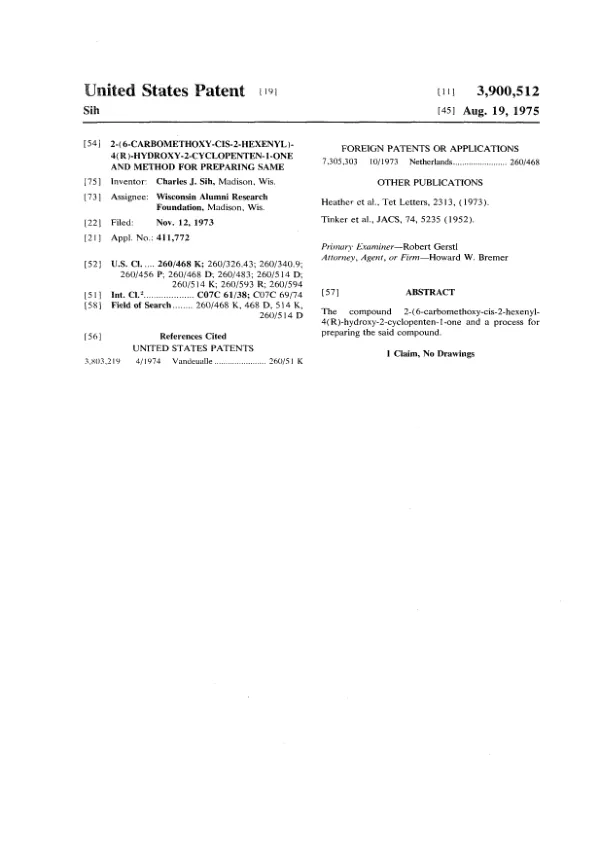
2-(6-Carbomethoxy-cis-2-hexenyl)-4(R)-hydroxy-2-cyclopenten-1-one and method for preparing same
Sign inUSAID
2-(6-Carbomethoxy-cis-2-hexenyl)-4(R)-hydroxy-2-cyclopenten-1-one and method for preparing same
The compound 2-(6-carbomethoxy-cis-2-hexenyl)-4(R)-hydroxy-2-cyclopenten-1-one is a key intermediate in the preparation of prostaglandins.
7 pages
Sign in to readA free account is required to download.
Abstract
Prostaglandins are a family of C20 carboxylic acids that elicit a broad spectrum of physiologic responses in animals, including man, even in nanomolar concentrations. Prostaglandin E1 (PGE1) and prostaglandin F2α (PGF2α) have commanded particular attention because they have elicited physiologic responses closely tied with reproduction. The compound of this invention is prepared by a process that involves the reaction of 3-rolidin-2-butenic acid ethyl ester (I) with 5-oxo-1-hexyne (II) to form a yellow oil. The oil is then treated with propargyl bromide to form a compound that is subsequently converted to 9-oxo-5-decynoic acid methyl ester (IV). The compound IV is then reduced to form 9-oxo-5-decenoic acid methyl ester (VI). The compound VI is then hydrogenated to form 9-oxo-5-decenoic acid (VII). The compound VII is then treated with a ketal to form 2-(6-carboxy-cis-5-hexenyl)-cyclopentane-1,3,4-trione (VIII). The compound VIII is then converted to 2-(6-carbomethoxy-cis-2-hexenyl)-4(R)-hydroxy-2-cyclopenten-1-one through a series of reactions. The compound 2-(6-carbomethoxy-cis-2-hexenyl)-4(R)-hydroxy-2-cyclopenten-1-one is a key intermediate in the preparation of prostaglandins. The compound is useful as an intermediate in the production of prostaglandins and is expected to be more readily available and at a lower price than current methods. The compound has been observed to be present in amniotic fluid and in the venous blood of women during the contractions of labor. This suggests that the prostaglandins may play an important role in parturition. Other observations of the activity of prostaglandins, and particularly PGF2α, in the reproductive cycle in animals indicate that the prostaglandin and perhaps others may become important population controlling agents. The development of prostaglandins has been limited because of the shortage of these materials and consequently their high cost. The success of the E and F type of prostaglandins as family planning aids has been demonstrated, and it is anticipated that there will be a massive need for such compounds. The compound of this invention is expected to be useful in the production of prostaglandins and to make them more readily available and at a lower price than current methods.
Related documents