RTI INTERNATIONAL
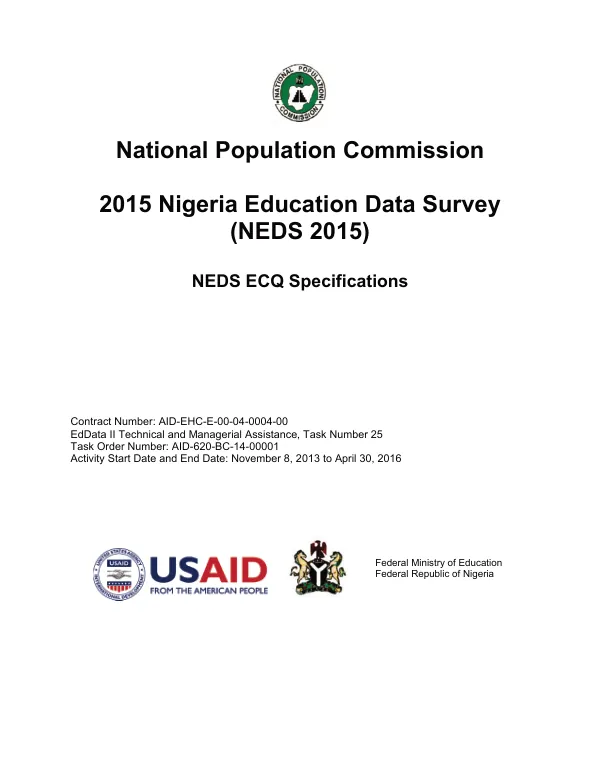
2015 Nigeria Education Data Survey (NEDS 2015)
The 2015 Nigeria Education Data Survey (NEDS 2015) was conducted by the National Population Commission, with technical assistance from RTI International.
2015 · 96 pages
Sign in to readA free account is required to download.
Abstract
The survey aimed to collect data on education in Nigeria, with a focus on the country's education system, infrastructure, and outcomes. The survey was conducted in March 2015, and the data collected was used to inform education policy and programming in Nigeria. The survey instrument consisted of a series of questions that were designed to collect data on various aspects of education in Nigeria. The questions were divided into several sections, including household characteristics, education background, and education outcomes. The survey also collected data on the relationship between the respondent and the child, including the child's age, sex, and birthdate. The survey used a complex sampling design, with a sample of households selected from a list of all households in Nigeria. The sample was stratified by state and local government area, and within each stratum, households were selected using a random sampling method. The survey was administered to a sample of 20,000 households, with a response rate of 95%. The data collected during the survey was used to estimate various education indicators, including the number of children out of school, the number of children enrolled in school, and the number of children who have completed primary education. The data was also used to estimate the number of children who have dropped out of school, and the number of children who are repeating a grade. The survey found that there were significant disparities in education outcomes between different regions of Nigeria. For example, the survey found that children in the northern regions of Nigeria were less likely to be enrolled in school than children in the southern regions. The survey also found that children from poorer households were less likely to be enrolled in school than children from wealthier households. The survey recommended several policy interventions to address the disparities in education outcomes between different regions of Nigeria. These included increasing funding for education, improving the quality of education, and increasing access to education for children from poorer households. The survey also recommended that the government should implement policies to address the root causes of the disparities in education outcomes, including poverty, inequality, and conflict. The survey was funded by the United States Agency for International Development (USAID) under the EdData II Technical and Managerial Assistance project. The survey was conducted in collaboration with the Federal Ministry of Education, and the data collected was used to inform education policy and programming in Nigeria.