POPULATION REFERENCE BUREAU
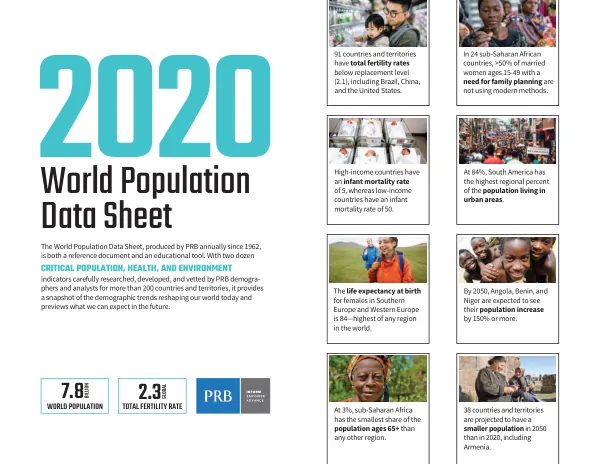
2015 World Population Data Sheet with a special focus on women’s empowerment
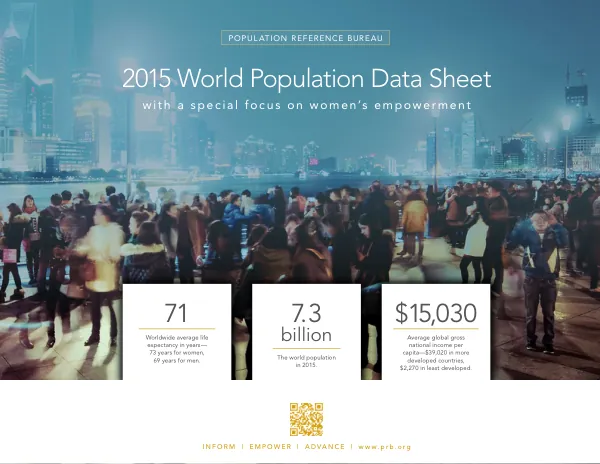
The global population in 2015 was 7.3 billion, with an average life expectancy of 73 years for women and 69 years for men.
2015 · 23 pages
Sign in to readA free account is required to download.
Abstract
The world population is projected to reach 7.4 billion by 2016 and 9.7 billion by 2050. The most populous countries in 2015 were China, India, the United States, Nigeria, and Indonesia, with India expected to surpass China as the most populous country by 2050. The total fertility rate, which is the average number of children a woman would have in her lifetime, varies significantly across countries. The highest total fertility rates in 2015 were found in Niger, South Sudan, the Democratic Republic of Congo, Somalia, Chad, Burundi, the Central African Republic, Angola, Burkina Faso, Mali, Mozambique, and Uganda, with rates ranging from 5.9 to 7.6 children per woman. In contrast, the lowest total fertility rates were found in Bosnia-Herzegovina, South Korea, Portugal, Taiwan, Greece, Moldova, Poland, Romania, Singapore, and Spain, with rates ranging from 1.2 to 1.3 children per woman. The population clock indicates that the world population is growing at a rate of 1.2% per year, with 145.9 million births and 57.1 million deaths occurring in 2015. The natural increase, which is the difference between births and deaths, was 88.8 million in 2015. Infant deaths accounted for 5.3 million of the total deaths in 2015. Rates of early marriage have declined in many countries over the past 20 years, particularly among girls under the age of 15. In Bangladesh, for example, the percentage of girls married by age 18 has declined from 83% in 1992 to 65% in 2014. However, the majority of Bangladeshi girls continue to marry before the age of 18. Women's empowerment is also reflected in their increasing participation in household decision-making, with 66% of married women in Nepal and 47% in Zambia having a say in decisions about their own health care. Family planning needs are increasingly being met by modern methods, but many countries remain far below the proposed 75% benchmark. In 2012, for example, 47% of demand for family planning was satisfied by modern contraceptive methods in Nepal, while in Zambia, the figure was 31%. Acceptance of wife beating has also receded in many countries, with 13% of Nigerian men and 25% of Nigerian women viewing a wife leaving home without telling the husband as justification for wife beating in 2013, down from 19% and 32% respectively in 2008. Financial inclusion, which refers to the availability of appropriate, affordable, and convenient financial services to all people, is a global development priority. For women, access to savings, credit, and other services can help them gain more financial independence and better manage and leverage their resources. In many countries, the share of women with bank accounts has increased over the past few years, with gaps remaining between men and women but narrowing in many cases.
Related documents