USAID DEC
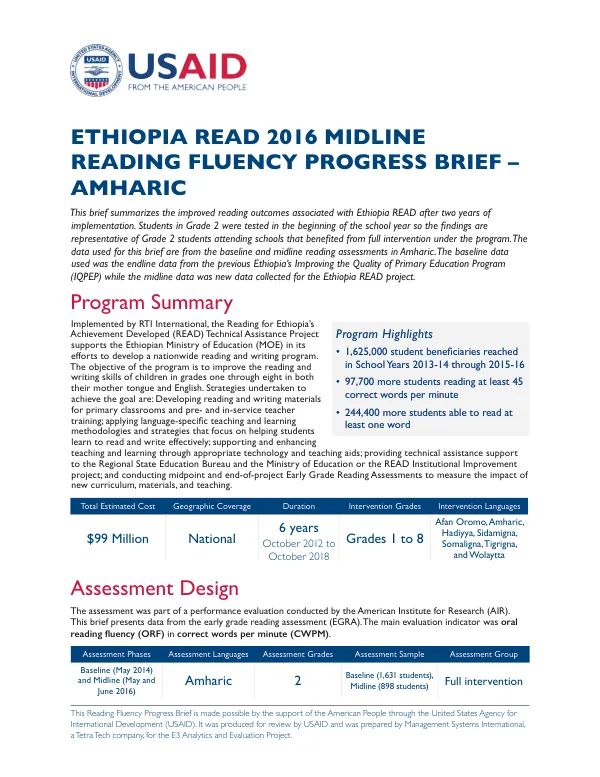
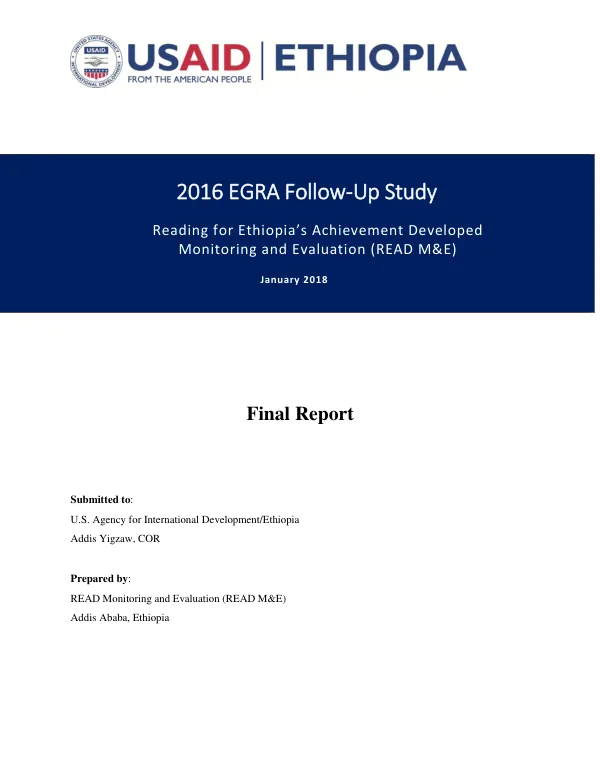
2016 EGRA Follow-Up Study: Reading for Ethiopia’s Achievement Developed Monitoring and Evaluation (READ M&E)
Sign inTHE AMERICAN INSTITUTES FOR RESEARCH
2016 EGRA Follow-Up Study: Reading for Ethiopia’s Achievement Developed Monitoring and Evaluation (READ M&E)
The 2016 EGRA Follow-Up Study was conducted in Ethiopia to assess the progress of the country's education system.
2018 · 74 pages
Sign in to readA free account is required to download.
Abstract
The study aimed to identify factors that contribute to reading achievement among students. The research was conducted in 2018 and involved a comprehensive analysis of learner-related, teacher-related, school environment-related, home-related, and community-related factors. The study employed a mixed-methods approach, combining both quantitative and qualitative data collection and analysis methods. The research design involved selecting a sample of schools, principals, teachers, parents, and cluster supervisors from various regions in Ethiopia. The sample size consisted of 207 teachers, 207 parents, and 207 cluster supervisors. The study identified several statistically significant factors associated with reading achievement, including learner-related factors such as age, sex, and grade level. Teacher-related factors, such as the use of mother-tongue materials and the provision of teaching-learning materials, were also found to be significant. The study also highlighted the importance of school environment-related factors, such as the presence of student textbooks and teacher guides. The analysis of home-related factors revealed that parents' perceptions of the parent-teacher relationship and the support made available by schools were significant predictors of reading achievement. Community-related factors, such as the presence of community-based programs and community engagement in education, were also found to be significant. The study's findings have implications for education policy and practice in Ethiopia. The results suggest that improving reading achievement requires a comprehensive approach that addresses multiple factors, including learner-related, teacher-related, school environment-related, home-related, and community-related factors. The study's recommendations include increasing the availability of teaching-learning materials, improving teacher training and support, and enhancing community engagement in education. The study's results are presented in a series of tables and figures, which provide a detailed analysis of the data. The tables present the statistically significant factors associated with reading achievement, while the figures illustrate the relationships between various factors. The study's conclusions are based on a comprehensive analysis of the data and provide a clear understanding of the factors that contribute to reading achievement in Ethiopia. The study's results are consistent with previous research on reading achievement in Ethiopia. The findings suggest that improving reading achievement requires a multifaceted approach that addresses the needs of learners, teachers, schools, homes, and communities. The study's recommendations are based on a comprehensive analysis of the data and provide a clear understanding of the factors that contribute to reading achievement in Ethiopia. The study's conclusions are based on a thorough analysis of the data and provide a clear understanding of the factors that contribute to reading achievement in Ethiopia. The results suggest that improving reading achievement requires a comprehensive approach that addresses multiple factors, including learner-related, teacher-related, school environment-related, home-related, and community-related factors. The study's recommendations include increasing the availability of teaching-learning materials, improving teacher training and support, and enhancing community engagement in education.