THE AMERICAN INSTITUTES FOR RESEARCH
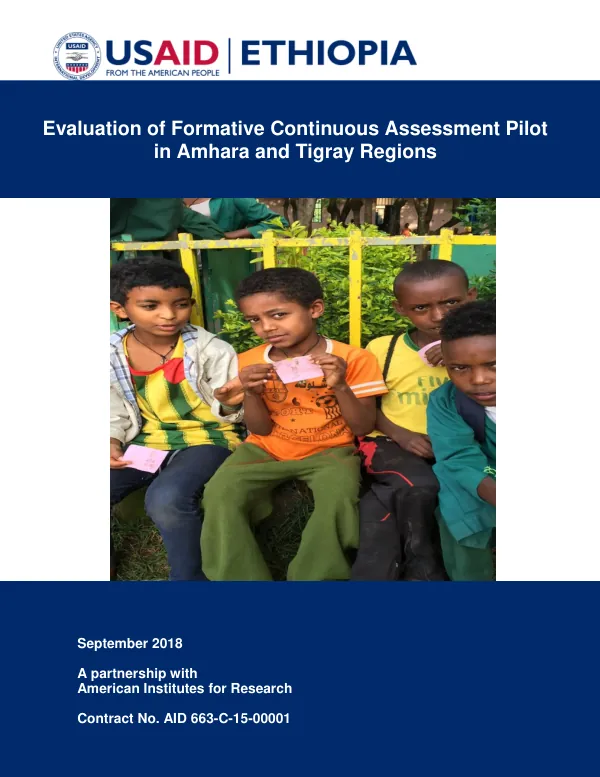
Evaluation of Formative Continuous Assessment Pilot in Amhara and Tigray Regions
The Formative Continuous Assessment (FCA) pilot project in Amhara and Tigray regions of Ethiopia aimed to improve literacy instruction in early grades.
2018 · 71 pages
Sign in to readA free account is required to download.
Abstract
The project was a partnership between the American Institutes for Research (AIR) and the United States Agency for International Development (USAID) under the contract number AID 663-C-15-00001. The project was designed to support the Ministry of Education's (MoE) efforts to enhance education quality in the country. The FCA project focused on developing and implementing a formative continuous assessment system to monitor students' learning progress and provide timely feedback to teachers. The project involved the development of various tools, including classroom observation guides, assessment tools, and record-keeping tools. These tools were designed to support teachers in identifying areas where students needed improvement and providing targeted interventions. The project's evaluation aimed to assess the availability, training, and use of FCA tools in classrooms, as well as the contributions of FCA training and tools to teachers' understanding of their role and students' learning and achievement. The evaluation also sought to identify challenges, opportunities, and measures to enhance the FCA system. The evaluation found that FCA tools were available in most classrooms, and teachers had received training on their use. However, the use of FCA tools varied across schools, with some teachers using them more frequently than others. The evaluation also found that FCA training and tools had contributed to teachers' improved understanding of their role and students' learning and achievement. Specifically, teachers reported that FCA tools had helped them identify areas where students needed improvement and provided them with the necessary information to develop targeted interventions. The evaluation also identified challenges and opportunities for enhancing the FCA system. Challenges included the lack of resources, including equipment and materials, and the need for more training and support for teachers. Opportunities included the potential for FCA to be scaled up and integrated into the national education system, as well as the potential for FCA to be used to inform policy decisions. The evaluation concluded that the FCA pilot project had been successful in improving literacy instruction in early grades. The project's findings and recommendations were intended to inform policy decisions and support the scaling up of the FCA system. The evaluation's results were expected to contribute to the improvement of education quality in Ethiopia and support the country's efforts to achieve its education goals. The FCA project's tools and materials were designed to be used in classrooms across the country. The project's evaluation found that the tools and materials were effective in supporting teachers in identifying areas where students needed improvement and providing targeted interventions. The evaluation also found that the tools and materials had contributed to teachers' improved understanding of their role and students' learning and achievement. The project's evaluation was conducted using a mixed-methods approach, which included both qualitative and quantitative data collection and analysis methods. The evaluation involved the collection of data from teachers, students, and school administrators, as well as the analysis of data from classroom observations and student assessments. The project's findings and recommendations were intended to inform policy decisions and support the scaling up of the FCA system. The evaluation's results were expected to contribute to the improvement of education quality in Ethiopia and support the country's efforts to achieve its education goals.