USAID DEC
Final Report: USAID/Ethiopia Reading for Ethiopia’s Achievement Developed Monitoring and Evaluation (READ M&E) Project
Sign inTHE AMERICAN INSTITUTES FOR RESEARCH
Final Report: USAID/Ethiopia Reading for Ethiopia’s Achievement Developed Monitoring and Evaluation (READ M&E) Project
The READ M&E project is a 5-year activity implemented by American Institutes for Research (AIR) in partnership with the Ethiopian Ministry of Education (MoE) and the National Educational Assessment and Examinations Agency (NEAEA).
2018 · 68 pages
Sign in to readA free account is required to download.
Abstract
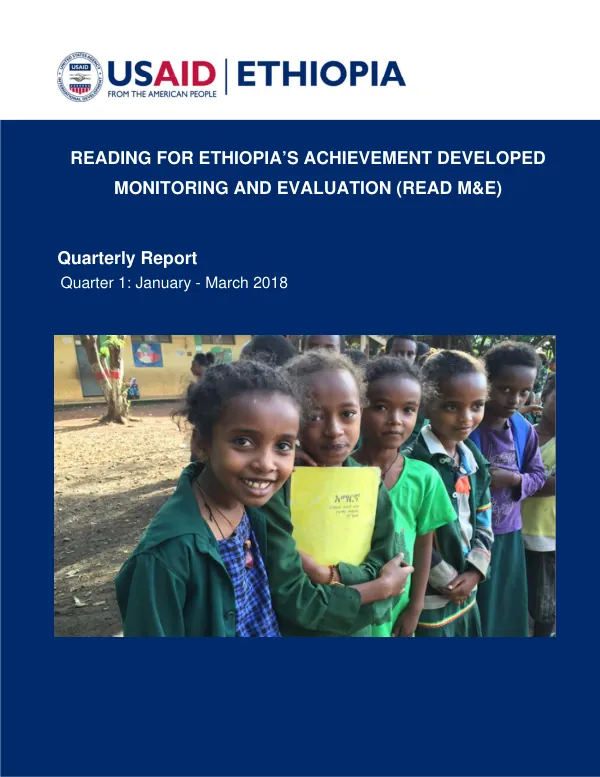
The project focuses on monitoring and evaluating early grade reading as well as on the M&E needs of the overall USAID READ program. READ M&E tracks progress and measures the performance and impact of key interventions supported by USAID through regular monitoring of READ projects and evaluating READ projects at defined intervals. The objectives of READ M&E are to assess student learning progress by analyzing and synthesizing nationally representative EGRA data collected for seven local languages, undertaking a National Learning Assessments (NLA) at grades 4 and 8 for reading, comprehension, and writing, supporting continuous assessment by teachers in schools, monitoring the performance of USAID's READ projects, conducting impact evaluations and research studies, and building the capacity of the National Agency for Educational Assessment and Examinations (NAEAE) of the Ministry of Education (MOE). In Quarter 1 of Fiscal Year 2018, the project supported the administration of the Early Grade Reading Assessment (EGRA) in seven mother tongues in five regions, with a total of 1,052 administrators and officials successfully trained with USG support. The project also conducted a Data Management training for 7 experts from NEAEA, and trained 28 data collectors and 3 supervisors on Formative Continuous Assessment (FCA) data collection at Bishoftu. The project's standard indicators show that 100% of the annual target for the number of standardized learning assessments supported by USG was achieved, and 100% of the annual target for the number of administrators and officials successfully trained with USG support was also achieved. The project's performance is considered on target for these indicators. The project works in close partnership with the Ethiopian Ministry of Education (MoE) and the National Educational Assessment and Examinations Agency (NEAEA), and collaborates and coordinates with key partners including other donors and NGO partners as well as projects in other sectors that relate to READ. The project also adapts to the evolving M&E needs and priorities of the READ program. The project's implementation progress is aligned with the READ Intermediate Result of Improved reading achievement, and the Sub-Intermediate Result 4 of Monitoring and evaluation conducted to ensure that implementation is on track. The project's activities are focused on supporting the administration of the EGRA, conducting a National Learning Assessments (NLA), supporting continuous assessment by teachers in schools, and monitoring the performance of USAID's READ projects. The project's quarterly report highlights the progress made in Quarter 1 of Fiscal Year 2018, and provides an overview of the activities implemented during this period. The report also provides a summary of the results achieved during this period, and highlights the challenges and lessons learned. The project's capacity-building and research activities are focused on building the capacity of the National Agency for Educational Assessment and Examinations (NAEAE) of the Ministry of Education (MOE), and providing technical assistance to the MOE, regional state education bureaus (RSEBs), and other development partners. The project also conducts research studies on issues aligned with USAID's global- and mission-level learning agendas that relate to the evolving needs of the READ program. The project's stakeholder participation and involvement activities are focused on engaging with key stakeholders, including the federal MOE, the National Evaluation Assessment & Examination Agency (NEAEA), Regional State Education Bureaus (RSEBs), and City Administration Education Bureaus (CAEBs), to ensure that their needs and priorities are taken into account in the project's implementation. The project's financial report provides an overview of the financial resources allocated to the project during Quarter 1 of Fiscal Year 2018, and highlights the expenditures made during this period. The report also provides a summary of the financial resources allocated to the project for the remaining quarters of Fiscal Year 2018. The project's planned activities for the next quarter are focused on continuing the implementation of the project's activities, including the administration of the EGRA, conducting a National Learning Assessments (NLA), supporting continuous assessment by teachers in schools, and monitoring the performance of USAID's READ projects. The project also plans to continue its capacity-building and research activities, and to engage with key stakeholders to ensure that their needs and priorities are taken into account in the project's implementation.
Related documents