THE AMERICAN INSTITUTES FOR RESEARCH
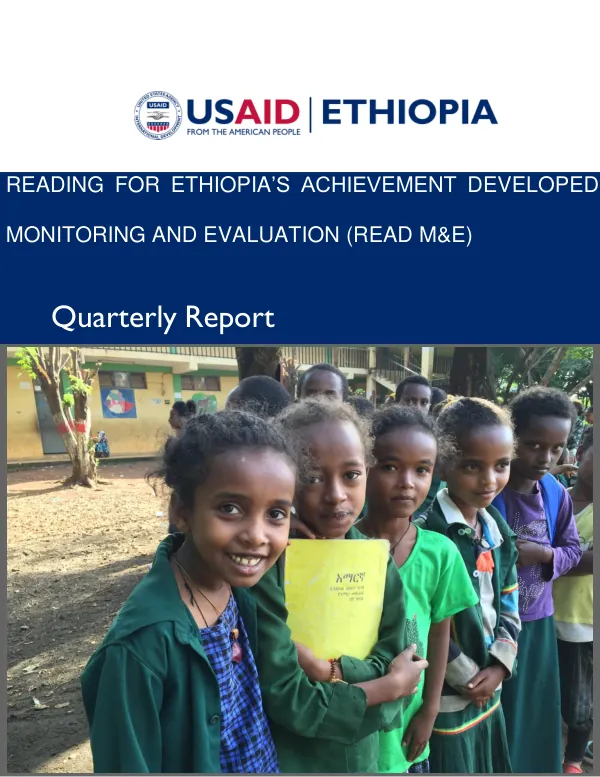
Quarterly Report 2016 Quarter 3: July 1 – September 30, 2016
The Reading for Ethiopia's Achievement Developed Monitoring and Evaluation (READ M&E) project is a 5-year U.S.
2016 · 31 pages
Sign in to readA free account is required to download.
Abstract
Agency for International Development (USAID)-supported activity implemented by American Institutes for Research (AIR). The project focuses on monitoring and evaluating early grade reading as well as the M&E needs of the overall USAID READ program. READ M&E works closely in partnership with the Ethiopian Ministry of Education (MoE) and the National Educational Assessment and Examinations Agency (NEAEA). The project also collaborates with regional state education bureaus (RSEBs) and city administration education bureaus (CAEBs). The objectives of READ M&E are to assess student learning progress by analyzing and synthesizing nationally representative Early Grade Reading Assessment (EGRA) data collected for seven local languages. The project also aims to support nationally representative learning assessments at grades 4 and 8 for reading, comprehension, and writing aligned to the new national reading curriculum developed through the READ Technical Assistance (TA) program. Additionally, READ M&E supports continuous assessment in schools, monitors the performance of USAID's READ projects, and conducts midterm and final evaluations of the three READ projects. During the third quarter of 2016, READ M&E conducted a materials development workshop with teachers and administrators for Formative Continuous Assessment (FCA), performed the Annual Data Assessment exercise (ADA), and analyzed the data from the EGRA administered in May. The team also delivered a presentation at The Working Group (TWG) meeting. These activities were accomplished with the assistance and support from directorates in the Ministry of Education, including the National Educational Assessment and Examination Agency (NEAEA), Planning Directorate, and the Directorate of Curriculum Development and Implementation. The team is pleased to report that all EGRA was collected and analyzed in 2016 using electronic tablets with Tangerine software, which allowed for a smooth and efficient data collection. To establish the comparability between the 2014 and 2016 EGRA tools, READ M&E conducted a small research project within the 2016 data collection. The study employed a common-persons research design, which is a recommended research paradigm for equating between EGRA forms. The 2016 EGRA result required no statistical adjustment on the Oral Reading Fluency (ORF) subtask. The team worked to ensure that all data analyses were conducted in accord with USAID standards and best practices. EGRA score data were analyzed and reported by number of participants (frequency), mean score, and standard deviation. Results comparing performance across years were also reported where appropriate with equated test forms. Sampling weights were applied to mean score estimations to ensure adequate representation of all students by school size. The team employed both independent sample t-tests and ANOVA to determine whether observed differences were statistically significant at the .05 level. The project has made significant progress in achieving its objectives. The number of standardized learning assessments supported by USG increased to 100% in the third quarter of 2016. The number of administrators and officials successfully trained with USG support also increased to 165 data collectors trained on EGRA. The project has also made progress in monitoring the performance of USAID's READ projects and conducting midterm and final evaluations of the three READ projects.