USAID
A Briefer: Gender Inequality Causes Poverty
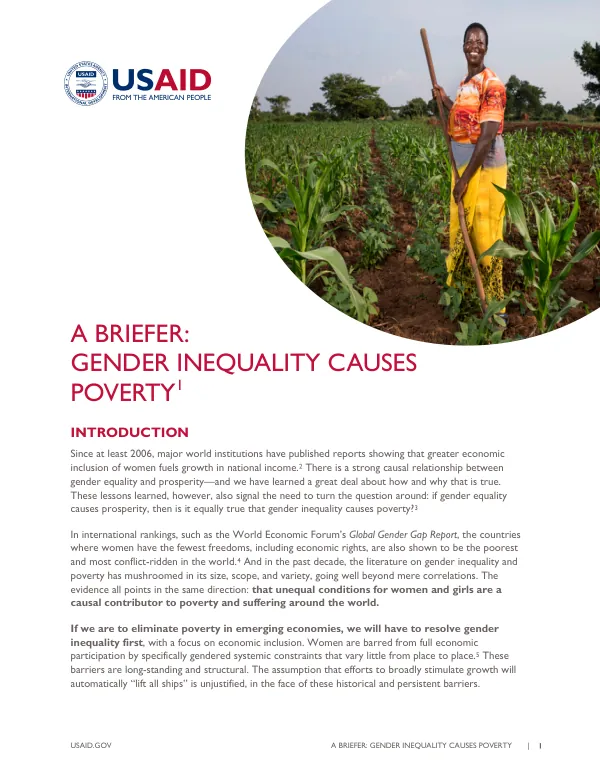
The relationship between gender inequality and poverty has been extensively studied in recent years, with a growing body of evidence suggesting that gender inequality is a causal contributor to poverty and suffering worldwide.
2021 · 19 pages
Sign in to readA free account is required to download.
Abstract
This conclusion is supported by international rankings, such as the World Economic Forum's Global Gender Gap Report, which show that countries with the fewest freedoms for women are also the poorest and most conflict-ridden. Research on gender inequality in emerging markets has employed a range of methods, including econometrics, ethnography, focus groups, geospatial analysis, interviews, participant observation, surveys, and randomized controlled trials. These studies have converged on a clear conclusion: gender inequality is not a symptom of poverty, but a fundamental cause of poverty. The mechanisms enforcing gender inequality are similar across nations and have similarly negative economic impacts. Women's economic marginalization is enforced in various ways, including workforce exclusion, prohibitions against property ownership, and restrictions on education and entrepreneurship. As a result, key economic factors like labor, education, and entrepreneurship manifest in distinctive ways among women than men, resulting in differential outcomes with large-scale, national impact. Nations are poorest where the limits on women's economic engagement are strongest. The inefficient use of resources is a significant economic impact of gender inequality. Female labor force participation (FLFP) is a key indicator of this impact. Over the past 50 years, GDP growth in developed nations has tracked closely with a steady rise in FLFP, particularly among married women. Increasing FLFP in those countries resulted from the abolition of gender-specific restrictions on women's employment. Even today, persisting labor constraints on women show room for growth in wealthy nations. In many emerging economies, restrictions and outright prohibitions prevent women from performing work outside the home, especially if they are married. Eliminating gender restrictions on paid work would have the most favorable impact on growth in areas where gender equality is at its lowest levels. The International Monetary Fund (IMF) estimates that bringing women into the workforce in numbers comparable to men would increase GDP in developed nations by 10 percent, and by 35 percent in South Asia, the Middle East, and North Africa. Women's economic inequality is also evident in enterprise. Most countries have many fewer female than male entrepreneurs; increasing the base of enterprise by including women should have positive economic implications. A study of 146 countries conducted by the World Bank in 2017 found that, while women's entrepreneurship is less than men's in all countries, it is especially underdeveloped in poor countries. Systemic factors, such as insufficient access to capital, impede the development of enterprise among females, especially in poor nations. The quality of human capital is also linked to national economic potential, which is largely a function of investment in education. Women, all over the world, were refused education for centuries; one of the biggest global achievements in the past 50 years has been the steep rise in education among females. Women in the developed countries now have educational achievements equal to or greater than men. However, in the poorest countries, girls are still excluded from education, especially at the secondary level, which has follow-on effects on both the size of the labor force and its quality. In addition to lost opportunities for growth, gender inequality affects economies by incurring systemwide costs. Research carried out by the Copenhagen Consensus Center showed that the economic costs associated with intimate partner violence against women, such as those incurred by police calls, lost workdays, and emergency room visits, average 5 percent of GDP. This is a significant economic burden that can be mitigated by addressing gender inequality.
Related documents