USAID DEC
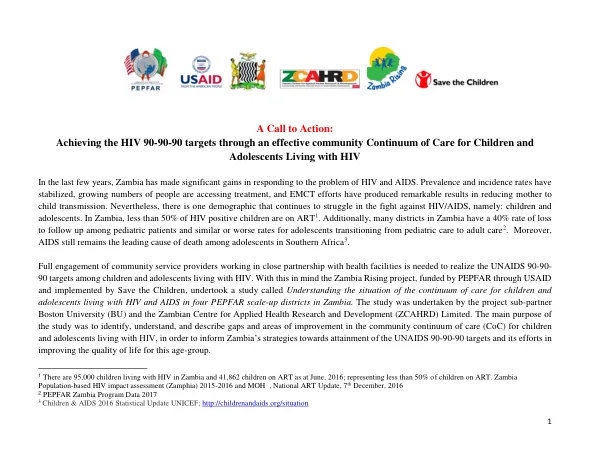
A Call to Action: Achieving the HIV 90-90-90 targets through an effective community Continuum of Care for Children and Adolescents Living with HIV
Sign inSAVE THE CHILDREN FUND
A Call to Action: Achieving the HIV 90-90-90 targets through an effective community Continuum of Care for Children and Adolescents Living with HIV
The Zambia Rising project, funded by PEPFAR through USAID and implemented by Save the Children, undertook a study to identify gaps and areas of improvement in the community continuum of care (CoC) for children and adolescents living with HIV in four PEPFAR scale-up districts in Zambia.
2017 · 17 pages
Sign in to readA free account is required to download.
Abstract
The study aimed to inform Zambia's strategies towards attainment of the UNAIDS 90-90-90 targets and improve the quality of life for this age-group. The study found that less than 50% of HIV-positive children in Zambia are on antiretroviral therapy (ART), and many districts have a 40% rate of loss to follow-up among pediatric patients and similar or worse rates for adolescents transitioning from pediatric care to adult care. AIDS remains the leading cause of death among adolescents in Southern Africa. The study also highlighted the need for full engagement of community service providers working in close partnership with health facilities to realize the UNAIDS 90-90-90 targets among children and adolescents living with HIV. To address these challenges, the study recommended several interventions, including improving HIV case-finding through targeted community-based HIV testing programs, reducing stigma and discrimination, and scaling up provider-initiated testing and counseling (PITC). The study also emphasized the need to increase ART uptake by escorting clients from HIV testing centers to ART centers, integrating testing and ART services, and scaling up test and start efforts. The Zambia Rising project held a stakeholder consultation event to develop action steps for improving the community continuum of care for children and adolescents living with HIV. The event brought together community partners, HIV/AIDS service providers, and funders in Zambia to discuss the study findings and develop recommendations for improving the CoC. The event resulted in a Call to Action for the Government of the Republic of Zambia (GRZ) and all partners in the health and social services sectors to improve HIV case-finding, increase ART uptake, and improve ART adherence and viral suppression. The Call to Action included several recommendations, including improving selection criteria for Community Health Workers (CHWs) and standardizing incentives across all community volunteers to reduce attrition of these service providers. The Call to Action also emphasized the need to train volunteers in current HIV national algorithm and psychosocial counseling, use the health center committees as a platform to improve coordination of HIV testing services, and establish focal point persons/linkages coordinators at the facility responsible for index tracing/PMTCT follow-up. In addition, the Call to Action recommended several actions to increase ART uptake, including escorting clients from HIV testing centers to ART centers, integrating testing and ART services, and scaling up provider-initiated testing and counseling (PITC). The Call to Action also emphasized the need to improve ART adherence and viral suppression by implementing a well-organized default prevention and tracking system, ensuring there is a designated adherence counseling room with dedicated adherence counselors, and facilitating the creation of different ART days for adolescents and adults at the facilities. Overall, the Zambia Rising project's study and Call to Action aim to improve the community continuum of care for children and adolescents living with HIV in Zambia and contribute to the attainment of the UNAIDS 90-90-90 targets.