USAID DEC
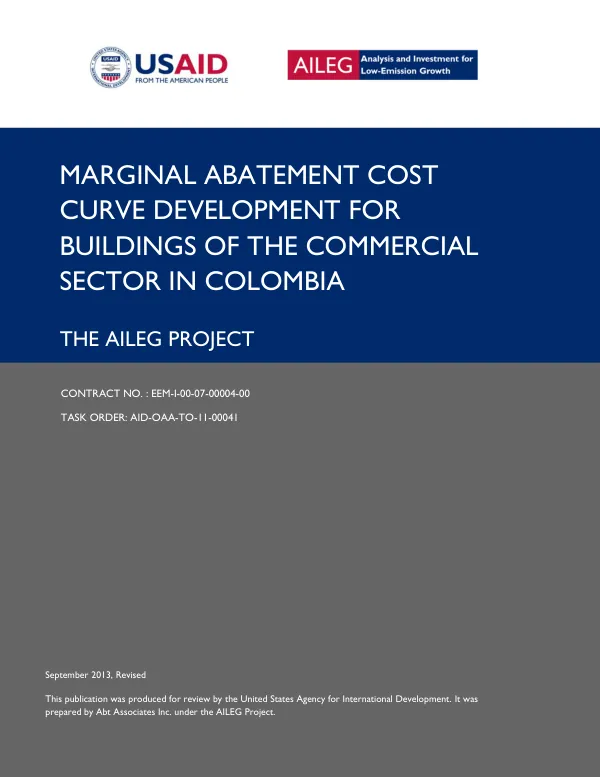
Marginal Abatement Cost Curve Development for Buildings of the Commercial Sector in Colombia
Sign inABT ASSOCIATES
Marginal Abatement Cost Curve Development for Buildings of the Commercial Sector in Colombia
The AILEG Project aimed to develop marginal abatement cost curves for buildings of the commercial sector in Colombia.
2013 · 54 pages
Sign in to readA free account is required to download.
Abstract
The project was conducted under the AILEG Project, with Contract No. EEM-I-00-07-00004-00 and Task Order AID-OAA-TO-11-00041. The project was submitted to the Office of Economic Policy, Bureau for Economic Growth, Education and Environment, and the Office of Environment, Energy and Climate Change in Bogota, Colombia. The project's methodology involved estimating energy consumption in 2010 using a bottom-up approach, which involved estimating base-year consumption with existing data, and a top-down approach, which used publicly consolidated data. The project also forecasted commercial sector growth and greenhouse gas scenarios, including a business-as-usual scenario and a reference scenario. The project identified and evaluated greenhouse gas emission mitigation measures, estimated their costs, and estimated marginal mitigation costs. The results of the project showed that the commercial sector in Colombia has significant potential for energy savings and greenhouse gas reductions. The project developed marginal abatement cost curves for shopping centers, office buildings, hospitals, and hotels, which showed that the costs of implementing energy-saving measures vary widely depending on the type of building and the level of energy savings achieved. The curves also showed that the costs of implementing energy-saving measures are generally lower for shopping centers and office buildings than for hospitals and hotels. The project identified several co-benefits of implementing energy-saving measures, including improved indoor air quality, reduced water consumption, and increased energy security. The project concluded that the commercial sector in Colombia has significant potential for energy savings and greenhouse gas reductions, and that implementing energy-saving measures can have numerous co-benefits. The project's findings and recommendations are based on a comprehensive analysis of the commercial sector in Colombia, including its energy consumption patterns, greenhouse gas emissions, and potential for energy savings. The project's results provide a valuable resource for policymakers, building owners, and operators, and can inform decisions about energy-saving investments and policies. The project's methodology involved a detailed analysis of the commercial sector in Colombia, including its energy consumption patterns, greenhouse gas emissions, and potential for energy savings. The project used a bottom-up approach to estimate energy consumption in 2010, which involved estimating base-year consumption with existing data, and a top-down approach, which used publicly consolidated data. The project also forecasted commercial sector growth and greenhouse gas scenarios, including a business-as-usual scenario and a reference scenario.