USAID DEC
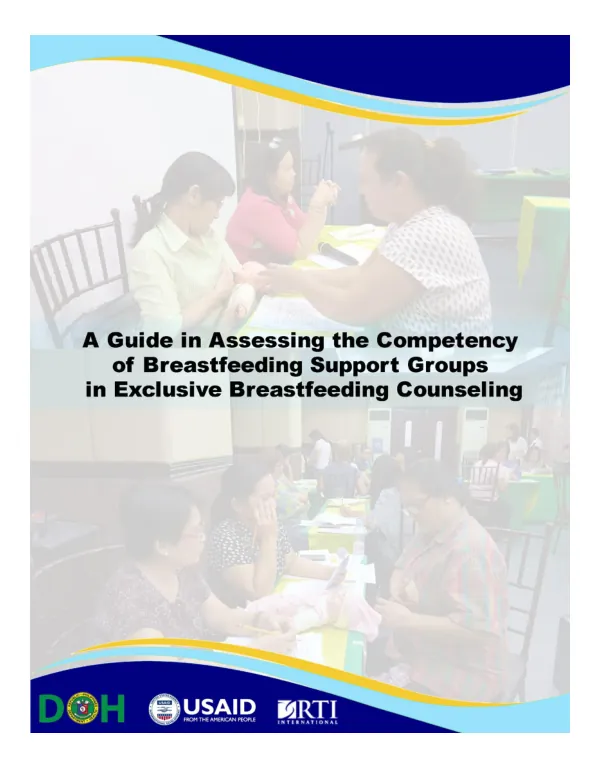
A Guide in Assessing the Competency of Breastfeeding Support Groups in Exclusive Breastfeeding Counseling
Sign inRTI INTERNATIONAL
A Guide in Assessing the Competency of Breastfeeding Support Groups in Exclusive Breastfeeding Counseling
The Global Infant and Young Child Feeding (IYCF) Strategy was launched by the World Health Organization (WHO) and United Nations Children’s Fund (UNICEF) in 2002.
2018 · 76 pages
Sign in to readA free account is required to download.
Abstract
The Philippines adopted this strategy as a country strategy to address malnutrition and reduce infant mortality. The strategy promotes optimum infant and young child feeding in various settings, with a focus on exclusive breastfeeding (EBF) for the first six months of a baby’s life and the introduction of complementary food with continued breastfeeding afterwards. The Department of Health-National Capital Regional Office (DOH-NCRO) recognizes the important role that Breastfeeding Support Groups (BFSGs) play in promoting breastfeeding among mothers, in the family, and in the community. From 2005 to 2007, the DOH-NCRO conducted a series of Training of Trainers’ Courses in IYCF for the NCR cities, training health center staff, barangay health workers (BHWs), barangay nutrition scholars (BNS), and mother leaders in IYCF. These individuals were organized into Breastfeeding Peer Counselor Groups and later into BFSGs. In 2008 to 2015, the DOH-NCRO allocated funds for the quarterly meetings for competency enhancement of the BFSGs in all the 17 LGU cities in NCR. The DOH-NCRO also conducted regional BFSG conventions since 2009, for about 1,200 BFSG members. In Caloocan City, the City Health Nutrition Team provides the BFSGs with regular quarterly and annual sessions on EBF/IYCF to update their knowledge and enhance their skills in providing information and counseling on EBF. The team conducts regular field monitoring and supportive supervision to assist the BFSGs in performing their tasks. However, the team wanted to conduct a more comprehensive competency assessment on EBF counseling among the BFSGs to determine if the IYCF training and subsequent regular updates had been helpful in making the BFSGs competent in providing EBF information and counseling. The Caloocan City Health Department requested the assistance of the USAID-LuzonHealth Project in developing the process and tools for the BFSG Competency Assessment in EBF Counseling. The Caloocan City Health Department and the USAID-LuzonHealth Project closely collaborated with the DOH-NCRO in developing the tools and implementing this BFSG competency assessment. The competency assessment was intended for BFSGs that the Caloocan City Health Nutrition Team trained in 2007 and 2010. The Head of the Regional Family Health Cluster and the Regional Nutrition Coordinator were part of the review team that finalized the competency assessment tools. The assessment used the Objective Structured Competency Evaluation (OSCE) methodology, which focuses on knowledge assessment as well as skills observation. This was the first time that such a competency assessment was conducted in the country in NCR, particularly in Caloocan City. The Caloocan City Health Nutrition Team has continued to use the set of tools annually since its introduction by the USAID-LuzonHealth Project. They find it very helpful in continually identifying the strengths and weaknesses of the BFSGs in providing EBF information and counseling, so that focused interventions to address the identified gaps are provided to them. This ensures that pregnant and postpartum mothers receive quality EBF information and counseling services starting at the community level. The Guide in Assessing the Competency of Breastfeeding Support Groups in Exclusive Breastfeeding Counseling was developed with the assistance of various individuals, including the Head of the Family Health Cluster, DOH-NCRO, the Regional Nutrition Program Coordinator, DOH-NCRO, the City Health Officer, Caloocan City, and other nutritionists, midwives, and barangay nutrition scholars. The guide provides a comprehensive framework for assessing the competency of BFSGs in EBF counseling, including the development of tools and the implementation of the competency assessment.
Related documents