RTI INTERNATIONAL
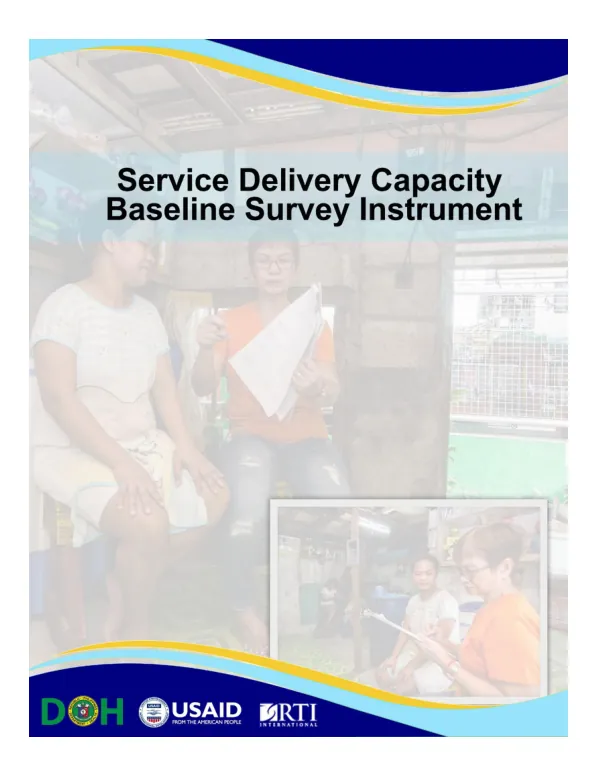
Service Delivery Capacity Baseline Survey Instrument
The Service Delivery Capacity Baseline Survey Instrument is a comprehensive guide for conducting a baseline survey to assess the service delivery capacity of health facilities in the Philippines.
2018 · 195 pages
Sign in to readA free account is required to download.
Abstract
The survey is designed to gather data on the availability and utilization of reproductive health services, including family planning, maternal and child health, and newborn care. The survey instrument consists of several forms, including the Main Questionnaire, Training Profile, Availability of IEC and Reference Materials, and Midwives' Worksheet. The Main Questionnaire is the primary form used to collect data from health facilities, and it covers topics such as the availability of reproductive health services, the number of trained health workers, and the availability of equipment and supplies. The Training Profile form is used to collect data on the training programs and activities conducted by health facilities, including the number of trainings conducted, the number of participants, and the topics covered. The Availability of IEC and Reference Materials form is used to collect data on the availability of information, education, and communication materials, as well as reference materials, in health facilities. The Midwives' Worksheet is a form used to collect data on the skills and knowledge of midwives, including their training and experience, and their ability to provide reproductive health services. The survey instrument also includes a guide for filling out the forms, which provides instructions and examples for completing each form. The survey is designed to be used by health facilities in the Philippines, and it is intended to provide a baseline assessment of the service delivery capacity of these facilities. The data collected through the survey will be used to identify areas for improvement and to develop strategies for strengthening the service delivery capacity of health facilities. The survey instrument is organized into several sections, including the introduction, the survey forms, and the guide for filling out the forms. The introduction provides an overview of the survey and its purpose, while the survey forms provide the tools for collecting data. The guide for filling out the forms provides instructions and examples for completing each form. The survey instrument is designed to be used in conjunction with other tools and resources, including the Field Health Service Information System (FHSIS) and the Electronic Drug Price Monitoring System (EDPMS). The survey is intended to provide a comprehensive assessment of the service delivery capacity of health facilities, and it is designed to be used by health facilities, local government units, and other stakeholders. The survey instrument includes a list of acronyms and abbreviations, which provides a reference for the meanings of commonly used terms and abbreviations. The list includes terms such as AMTSL (Active Management of the Third Stage of Labor), ANC (Antenatal Care), and BCC (Behavior Change Communication). The survey instrument is designed to be used in a variety of settings, including health facilities, local government units, and other organizations involved in reproductive health services. The survey is intended to provide a comprehensive assessment of the service delivery capacity of health facilities, and it is designed to be used by a variety of stakeholders. The survey instrument includes a guide for accomplishing the forms, which provides instructions and examples for completing each form. The guide includes information on how to complete the forms, how to ensure data quality, and how to use the data collected through the survey. The survey instrument is designed to be used in conjunction with other tools and resources, including the FHSIS and the EDPMS. The survey is intended to provide a comprehensive assessment of the service delivery capacity of health facilities, and it is designed to be used by health facilities, local government units, and other stakeholders. The survey instrument includes a list of annexes, which provides additional information and resources for completing the survey. The list includes annexes such as the Spiel, the Classification of Hospitals, and the Standards for Disposal of Sharps and Hazardous Wastes. The survey instrument includes a guide for accomplishing the Midwives' Worksheets, which provides instructions and examples for completing each worksheet. The guide includes information on how to complete the worksheets, how to ensure data quality, and how to use the data collected through the survey. The survey instrument includes a list of forms, which provides a reference for the forms used in the survey. The list includes forms such as the LH-RCH, the LH-GPH, and the LH-OPC.
Related documents