USAID DEC
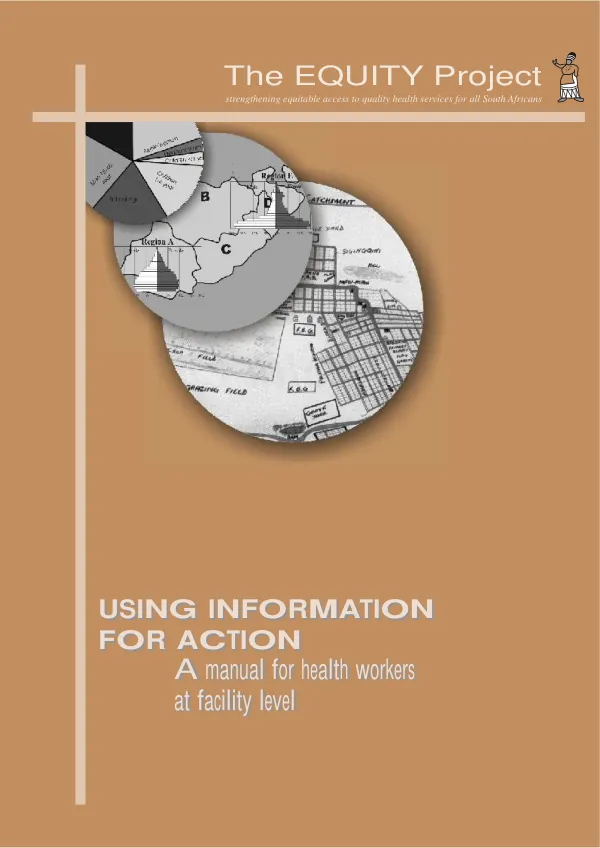
A manual for health workers at facility level: strengthening equitable access to quality health services for all South Africans
Sign inMANAGEMENT SCIENCES FOR HEALTH
A manual for health workers at facility level: strengthening equitable access to quality health services for all South Africans
The EQUITY Project, a project of the Department of Health funded by the United States Agency for International Development (USAID)/South Africa through Management Sciences for Health (MSH), aims to strengthen equitable access to quality health services for all South Africans.
131 pages
Sign in to readA free account is required to download.
Abstract
This manual, developed by the Health Information Systems Program (HISP) team, is a guide for health workers at facility level to record and use information for action. The manual is based on years of training programs, seminars, and workshops conducted throughout the country with health workers, information officers, and managers. It distills the experiences and discussions held with frontline workers who are responsible for collecting and using data to improve their performance. The authors express gratitude to the thousands of health workers in South Africa who are now collecting and using data themselves to improve their performance. The manual is prepared in the spirit of Batho Pele, with the hope that more transparent and clearly usable information about health will contribute to the improved health of all citizens of South Africa. It is offered as a contribution to the many nameless community members, clinic committees, hospital boards, and other interested citizens whose knowledgeable involvement in the health care system should be enhanced by improved and objective health information. The manual is divided into several chapters, with Chapter 1 introducing the concept of a health information system and its scope. It discusses the district health information system, which includes information on who gets sick, what conditions they have, where they come from, when they get sick, and why they get sick. It also covers the management information system, which provides information on the services that exist, for whom they are provided, where they are provided, when they are provided, and how much they cost. Chapter 2 focuses on collecting data, which is essential for a health facility. It outlines the essential dataset for a health facility, including special programs, routine service data, epidemiological surveillance, notifiable diseases, administrative data, organisational unit infrastructure and equipment, human resources data, logistical data, financial data, population data, census data, and births and deaths. It also provides data definitions and assessment of data collection tools. Chapter 3 deals with processing data, ensuring data quality, and collating data. It discusses visual scanning, what to do if errors are found, and reporting data. The manual also includes a table of contents and references to other chapters and sections. The manual is a valuable resource for health workers at facility level, providing them with the necessary tools and information to collect, process, and use data for action. It aims to contribute to the improved health of all citizens of South Africa by enhancing the use of health information in the health care system.
Related documents