USAID DEC
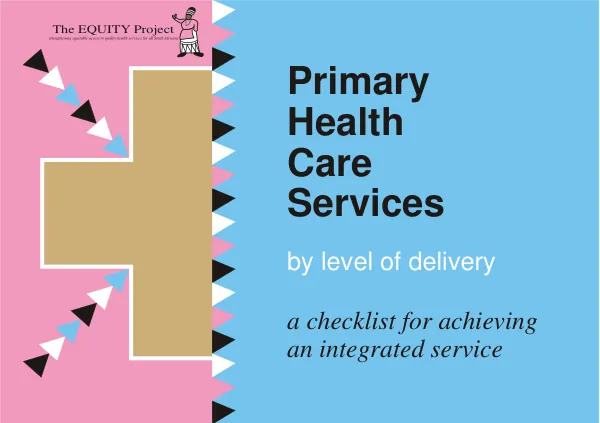
Primary Health Care Services by level of delivery a checklist for achieving an integrated service
Sign inDEPARTMENT OF HEALTH
Primary Health Care Services by level of delivery a checklist for achieving an integrated service
The EQUITY Project is a project of the Department of Health funded by the United States Agency for International Development (USAID)/South Africa through Management Sciences for Health (MSH).
84 pages
Sign in to readA free account is required to download.
Abstract
The project aims to strengthen equitable access to quality health services for all South Africans. A key component of this project is the development of a checklist for achieving an integrated primary health care service. The checklist is designed to provide a comprehensive, integrated approach to primary health care, eliminating or minimizing the promotive/preventive curative divide between former provincial services and local government services. It integrates many vertical services delivered by staff previously dedicated to providing single services with restrictions imposed by their job descriptions and by drug prescribing regulations. The aims of the Eastern Cape Province PHC package are to provide a checklist for determining the services, staff facilities, equipment, and drugs existing and needed at healthcare points, indicate PHC policy on services that should be available at each level of facility for all members of a community, form a framework for setting standards of care, facilitate implementation and operationalization of the services designed for different levels of delivery within a district, enable districts to develop a time frame in which to plan completing their packages at different levels, and stimulate continued development of PHC in the province to ensure that all age and sex groups of the population can benefit from fully functional health facilities providing comprehensive, accessible, high-quality PHC services. The document describes PHC in terms of specific needs of individuals and does not just describe service programs. It is oriented to cover all life stages in sequence: pregnancy, delivery, infants under one, preschool age, school age, adolescence, adults, and the elderly. The problems at these life stages and the services required differ. This approach enables a health unit to consider all the individuals in the population in its catchment area and to have better integration of the various components of a comprehensive package. The levels of service covered are Community, Mobile Point, Clinic, Health Centre, and District Community Hospital. Basic essential equipment, drugs, supplies, facilities, and staff are listed to define a fully functional health unit. The sequence of levels of service also helps to define the need for referral between these levels. The package, when used as a checklist, is provided to each health unit to complete a self-assessment of their own capacity and to provide the services for each life stage. It has also been used at district or regional level for groups of supervisors and managers to work through and determine what is not available in their clinics and consequently which services cannot now be provided. The checklist is designed to facilitate implementation and operationalization of the services designed for different levels of delivery within a district. It enables districts to develop a time frame in which to plan completing their packages at different levels. The three columns: "done now", "introduce now", and "introduce in 2-5 years time" allow supervisors to see what needs to be done and when, to achieve a fully functional health unit. This allows for the development of a district operational plan based on this assessment.