USAID DEC
A Meeting to Facilitate Development of an Operational Research Agenda to Measure and Response to HIV/AIDS Impacts in the Social Sectors
Sign inUSAID/ARD, INC.
A Meeting to Facilitate Development of an Operational Research Agenda to Measure and Response to HIV/AIDS Impacts in the Social Sectors
The HIV/AIDS epidemic remains one of the most serious and consequential health crises facing developing and transitional economies today.
2010 · 4 pages
Sign in to readA free account is required to download.
Abstract
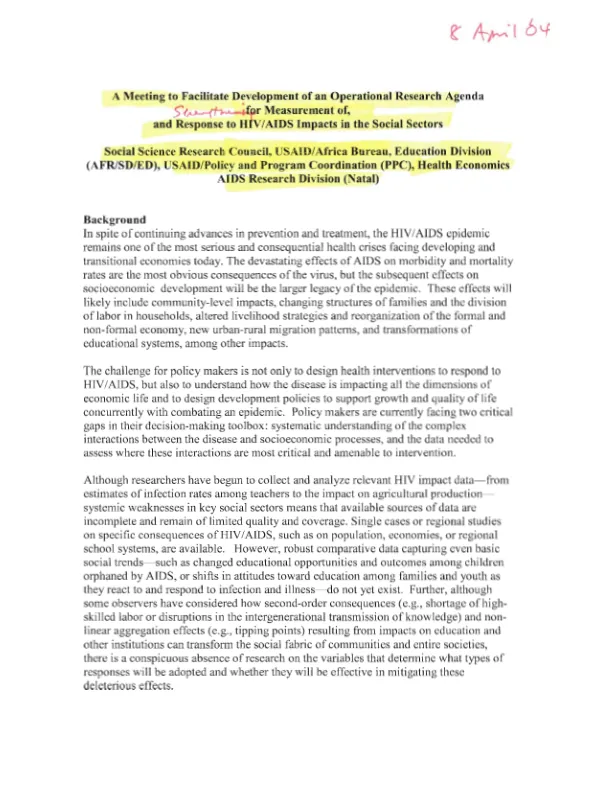
The devastating effects of AIDS on morbidity and mortality rates are the most obvious consequences of the virus, but the subsequent effects on socioeconomic development will be the larger legacy of the epidemic. These effects will likely include community-level impacts, changing structures of families and the division of labor in households, altered livelihood strategies and reorganization of the formal and non-formal economy, new urban-rural migration patterns, and transformations of educational systems, among other impacts. The challenge for policymakers is not only to design health interventions to respond to HIV/AIDS, but also to understand how the disease is impacting all the dimensions of economic life and to design development policies to support growth and quality of life concurrently with combating an epidemic. Policymakers are currently facing two critical gaps in their decision-making toolbox: systematic understanding of the complex interactions between the disease and socioeconomic processes, and the data needed to assess where these interactions are most critical and amenable to intervention. Although researchers have begun to collect and analyze relevant HIV impact data, systemic weaknesses in key social sectors mean that available sources of data are incomplete and remain of limited quality and coverage. Single cases or regional studies on specific consequences of HIV/AIDS, such as on population, economies, or regional school systems, are available. However, robust comparative data capturing even basic social trends, such as changed educational opportunities and outcomes among children orphaned by AIDS, or shifts in attitudes toward education among families and youth as they react to and respond to infection and illness, do not yet exist. The Social Science Research Council, USAID Africa Bureau Education Division, and USAID Program and Policy Coordination Bureau propose to explore ways to identify and coordinate priority actions to deepen the critical knowledge base for AIDS impact assessment and mitigation. A one-day technical meeting is proposed to explore possible priority actions in the following areas: survey of existing impact assessment and mitigation measurements of social transformations associated with HIV/AIDS in and across key service sectors such as education, health, and transportation; development of new methods and models, appropriate for district level data collection, to delineate the interactive relationship between health and development in ways that are meaningful to local communities and district level service providers. The meeting would emphasize that among the core challenges for researchers and policymakers is to move beyond theoretical approaches to data collection centered on individuals and households, to operational models that provide credible data meaningful to communities, and whose purpose is to mitigate impact of morbidity and mortality within the community's overall development context. The interaction between affected households and individuals on the one hand, and the community institutions and livelihood patterns on the other, is a key determinant of the true impact of disease. For example, recent research has questioned whether household or community characteristics are better predictors of orphan school attendance. The proposed external participants for the meeting include experts in the field of HIV/AIDS research and development, such as Stuart Gillespie, Michael Kremer, Anirudh Krishna, Edward Miguel, Owen Sichone, Susan Watkins, Peter Badcock-Walters, Jonathan Godden, Ishrat Husain, Dick Cornelius, and WWF. The Social Science Research Council was founded in 1923 as an independent, non-profit institution, and has a long history of promoting interdisciplinary collaborations to improve the quality and effectiveness of research programs focusing on areas of pressing public concern. The Council has made a strong commitment to developing a new collaborative network of leading researchers to tackle the challenge of HIV/AIDS, and has held a series of meetings to articulate priority research areas and identify the most vital domains of research.