USAID DEC
A new gall crab species (Brachyura, Cryptochiridae) associated with the free-living coral Trachyphyllia geoffroyi (Scleractinia, Merulinidae)
Sign inUSAID DEC
A new gall crab species (Brachyura, Cryptochiridae) associated with the free-living coral Trachyphyllia geoffroyi (Scleractinia, Merulinidae)
The gall crab species Lithoscaptus semperi was discovered in association with the free-living coral Trachyphyllia geoffroyi.
2015 · 12 pages
Sign in to readA free account is required to download.
Abstract
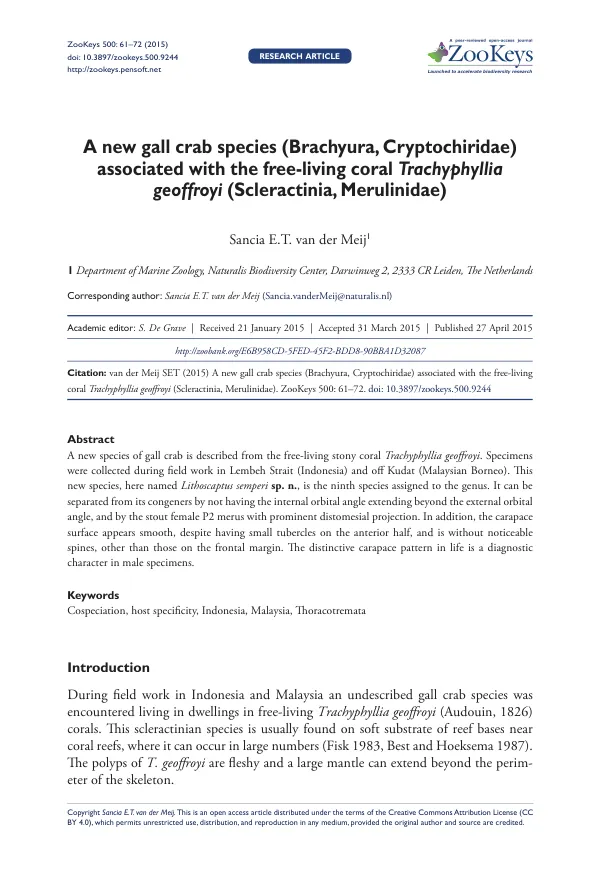
Specimens were collected in Lembeh Strait, Indonesia, and off Kudat, Malaysian Borneo. This new species is the ninth assigned to the genus Lithoscaptus and can be distinguished from its congeners by several characteristics, including the internal orbital angle not extending beyond the external orbital angle, and the stout female P2 merus with a prominent distomesial projection. The carapace surface of Lithoscaptus semperi appears smooth, despite having small tubercles on the anterior half, and is without noticeable spines, other than those on the frontal margin. The distinctive carapace pattern in life is a diagnostic character in male specimens. The gall crabs were found living in dwellings in free-living Trachyphyllia geoffroyi corals, which are usually found on soft substrate of reef bases near coral reefs. The coral host holotype of Lithoscaptus semperi is Trachyphyllia geoffroyi, and the type locality is Tigabu Isl. in Kudat, Sabah, Malaysia. The DNA barcoding of a paratype specimen has been deposited in GenBank under accession number KP688583. The gall crabs were collected from the scleractinian coral Trachyphyllia geoffroyi, and the material examined includes specimens from Indonesia and Malaysia. The description of the female holotype of Lithoscaptus semperi includes details of the carapace, eyestalk, antennular peduncle, MXP3, and pereiopods. The carapace is rectangular, longer than broad, and has small, sharp tubercles on the anterior half. The frontal margin is armed with small, anteriorly directed spines, and the pterygostomial region is fused to the carapace. The eyestalk is exposed dorsally, slightly granular, and has small spines on the mesial margin. The antennular peduncle has small, sharp tubercles on the dorsal surface, and the MXP3 has a rectangular exopod and a subtriangular ischium. The pereiopods are slender, with the P1 having a slender carpus and a propodus with a bundle of setae. The P2 is longer and coarser than the P1, with a stout merus and a smooth propodus. The P3 has a rounded merus and a smooth propodus. The gall crab species Lithoscaptus semperi is associated with the free-living coral Trachyphyllia geoffroyi, and its distinctive carapace pattern in life is a diagnostic character in male specimens. The gall crabs were found living in dwellings in free-living Trachyphyllia geoffroyi corals, which are usually found on soft substrate of reef bases near coral reefs. The coral host holotype of Lithoscaptus semperi is Trachyphyllia geoffroyi, and the type locality is Tigabu Isl. in Kudat, Sabah, Malaysia.
Related documents
Documents in this collection
 2024
2024USAID DEC
Population structure of endangered spinetail devil ray (Mobula mobular) in the Lesser Sunda Seascape, Indonesia, revealed using microsatellite and mitochondrial DNA
Open record 2019
2019USAID DEC