USAID DEC
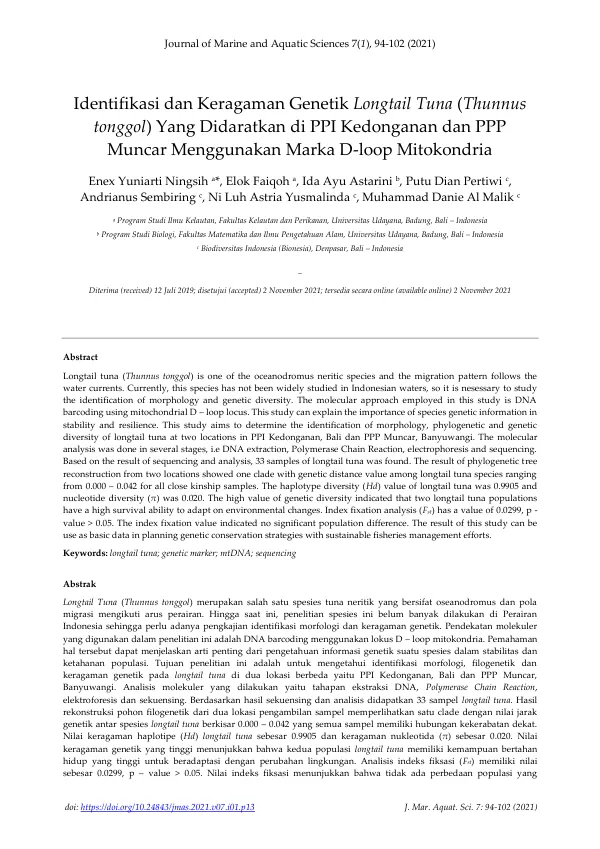
Identifikasi dan Keragaman Genetik Longtail Tuna (Thunnus tonggol) Yang Didaratkan di PPI Kedonganan dan PPP Muncar Menggunakan Marka D-loop Mitokondria
Sign inUSAID DEC
Identifikasi dan Keragaman Genetik Longtail Tuna (Thunnus tonggol) Yang Didaratkan di PPI Kedonganan dan PPP Muncar Menggunakan Marka D-loop Mitokondria
Longtail tuna (Thunnus tonggol) is one of the oceanodromus neritic species, characterized by its migration pattern following water currents.
2021 · 9 pages
Sign in to readA free account is required to download.
Abstract
This species has not been extensively studied in Indonesian waters, necessitating research on its identification and genetic diversity. The molecular approach employed in this study involves DNA barcoding using the mitochondrial D-loop locus. This study aims to determine the identification of morphology, phylogenetic, and genetic diversity of longtail tuna at two locations: PPI Kedonganan, Bali, and PPP Muncar, Banyuwangi. The molecular analysis was conducted in several stages, including DNA extraction, Polymerase Chain Reaction (PCR), electrophoresis, and sequencing. A total of 33 samples of longtail tuna were obtained. Phylogenetic tree reconstruction from the two locations revealed one clade with genetic distance values among longtail tuna species ranging from 0.000 to 0.042 for all close kinship samples. The haplotype diversity (Hd) value of longtail tuna was 0.9905, and nucleotide diversity (π) was 0.020. The high genetic diversity indicated that the two longtail tuna populations have a high survival ability to adapt to environmental changes. Index fixation analysis (Fst) had a value of 0.0299, with a p-value greater than 0.05. This result indicated no significant population difference. The findings of this study can be used as basic data in planning genetic conservation strategies with sustainable fisheries management efforts. Longtail tuna is one of the most significant commercial fish species in Indonesia, with a global catch of 7.7 million tons per year. The species is characterized by its oceanodromous migration pattern, following water currents. The study was conducted in two locations: PPI Kedonganan, Bali, and PPP Muncar, Banyuwangi. A total of 20 individuals were sampled from each location. The molecular analysis involved DNA extraction, PCR, electrophoresis, and sequencing. The results showed a high genetic diversity among the longtail tuna populations, with a haplotype diversity value of 0.9905 and nucleotide diversity value of 0.020. The high genetic diversity indicates that the species has a high survival ability to adapt to environmental changes. The study also found that the two longtail tuna populations had no significant genetic differences, as indicated by the index fixation analysis (Fst) value of 0.0299. The results of this study can be used as a basis for planning genetic conservation strategies with sustainable fisheries management efforts. The study highlights the importance of genetic information in understanding the stability and resilience of fish populations. The use of DNA barcoding with the mitochondrial D-loop locus has been shown to be effective in identifying fish species and understanding their genetic diversity. The study's findings have implications for the management of longtail tuna fisheries in Indonesia. The high genetic diversity of the species suggests that it has a high survival ability to adapt to environmental changes. However, the study also highlights the need for sustainable fisheries management efforts to conserve the species' genetic diversity. The results of this study can be used as a basis for developing conservation strategies that take into account the genetic diversity of the species.
Related documents
Documents in this collection
 2024
2024USAID DEC
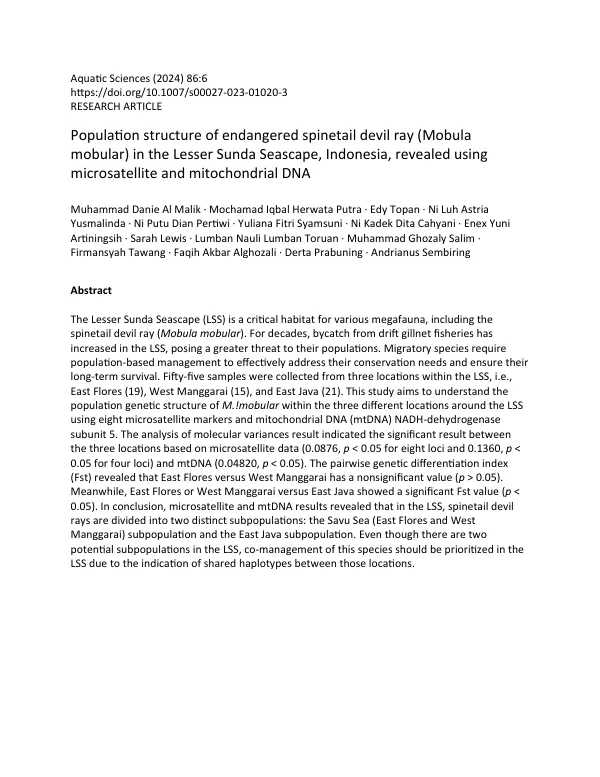
Population structure of endangered spinetail devil ray (Mobula mobular) in the Lesser Sunda Seascape, Indonesia, revealed using microsatellite and mitochondrial DNA
Open record 2016
2016USAID DEC