INDONESIAN MINISTRY OF RESEARCH, TECHNOLOGY, AND HIGHER EDUCATION
Genetic variations of Lansium domesticum Corr
The Karimunjawa Islands in the North Java Sea of Indonesia are home to a diverse array of marine life, including sponges that harbor a variety of fungi.
2019 · 8 pages
Sign in to readA free account is required to download.
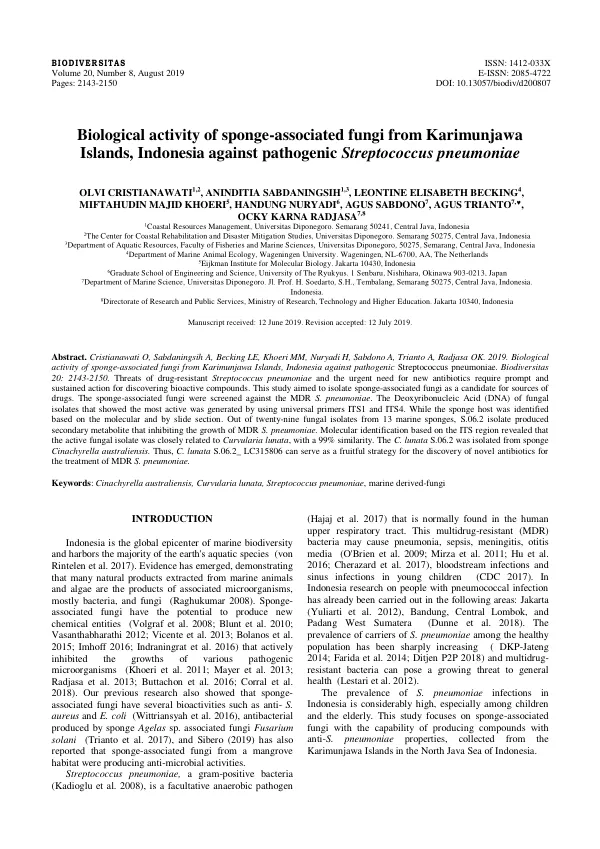
Abstract
These fungi have the potential to produce new chemical entities with antibacterial properties. A study was conducted to isolate sponge-associated fungi from the Karimunjawa Islands and screen them for their ability to inhibit the growth of pathogenic Streptococcus pneumoniae. The study involved collecting 13 sponge samples from six sites in the Karimunjawa Islands in March 2017. The sponges were stored in sterile plastic bags containing seawater and were immediately placed in a cooling box to preserve them. Half of each sample was preserved in 70% EtOH as a voucher. The sponge-associated fungi were isolated using a sterile scalpel, and the tissue of the sponges was cut into pieces of approximately 0.1 cm3 in size. The pieces were then rinsed for surface sterilization with sterilized seawater and 70% EtOH. The isolated fungi were screened for their ability to inhibit the growth of Streptococcus pneumoniae using the agar plug method. Fresh and pure cultures of Streptococcus pneumoniae were diluted to a suspension equivalent to the 0.5 McFarland standard and spread over the entire area of a Mueller Hinton susceptibility agar plate. Single tablets of fungi were placed on the inoculated agar plate, and the plates were then incubated at 35°C for 18 hours. The results showed that one potentially active fungal isolate, S.06.2, produced secondary metabolites that inhibited the growth of Streptococcus pneumoniae. The S.06.2 isolate was cultivated at a larger scale using 1,000 ml sterile bottles containing 200 ml of Malt Extract Broth. The fungal culture was filtered through filter paper to separate mycelia and media, and the medium was mixed with organic solvent MEB: EtOAc = 1: 2 (v/v). The organic solvent containing compounds that were secreted by the fungi was then evaporated using a rotary evaporator. The resulting extract was tested for its antibacterial activity against Streptococcus pneumoniae using the disc diffusion method. The results showed that the fungal extract inhibited the growth of Streptococcus pneumoniae, indicating the presence of antibacterial compounds. The molecular identification of the active fungal isolate S.06.2 was carried out using the internal transcribed spacer (ITS) region. The ITS region was amplified by using universal primer ITS 1 and ITS 4, and the PCR was carried out in a thermal cycler. The results showed that the S.06.2 isolate was closely related to Curvularia lunata, with a 99% similarity. The Curvularia lunata S.06.2 isolate was obtained from the sponge Cinachyrella australiensis. This isolate has the potential to serve as a fruitful strategy for the discovery of novel antibiotics for the treatment of multidrug-resistant Streptococcus pneumoniae. The study highlights the importance of exploring the potential of sponge-associated fungi as a source of new antibiotics.
Related documents
Documents in this collection
 2024
2024USAID DEC
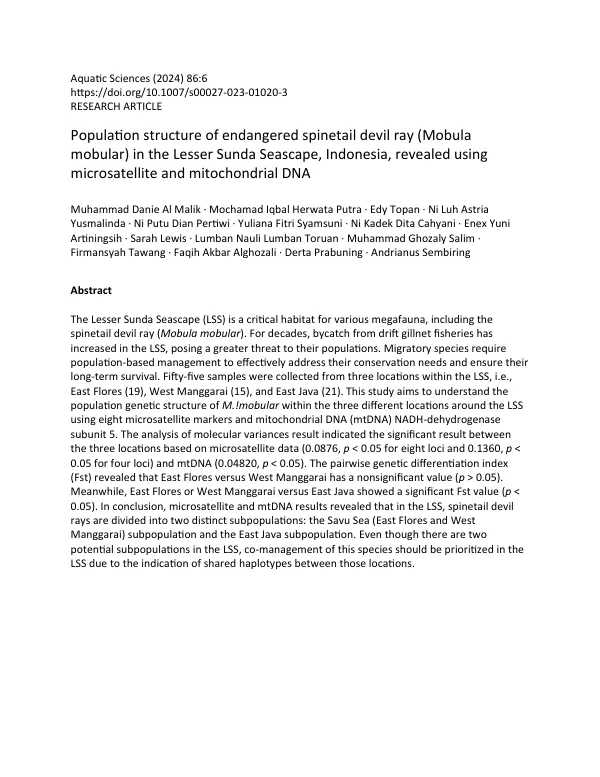
Population structure of endangered spinetail devil ray (Mobula mobular) in the Lesser Sunda Seascape, Indonesia, revealed using microsatellite and mitochondrial DNA
Open record 2015
2015USAID DEC