USAID DEC
The bioactivity of bacterium and fungi living associate with the sponge Reniera sp. against multidrug-resistant Staphylococcus aureus and Escherichia coli
Sign inUSAID DEC
The bioactivity of bacterium and fungi living associate with the sponge Reniera sp. against multidrug-resistant Staphylococcus aureus and Escherichia coli
The study aimed to isolate and identify the sponge-associated microorganisms producing antibacterial substances.
2019 · 6 pages
Sign in to readA free account is required to download.
Abstract
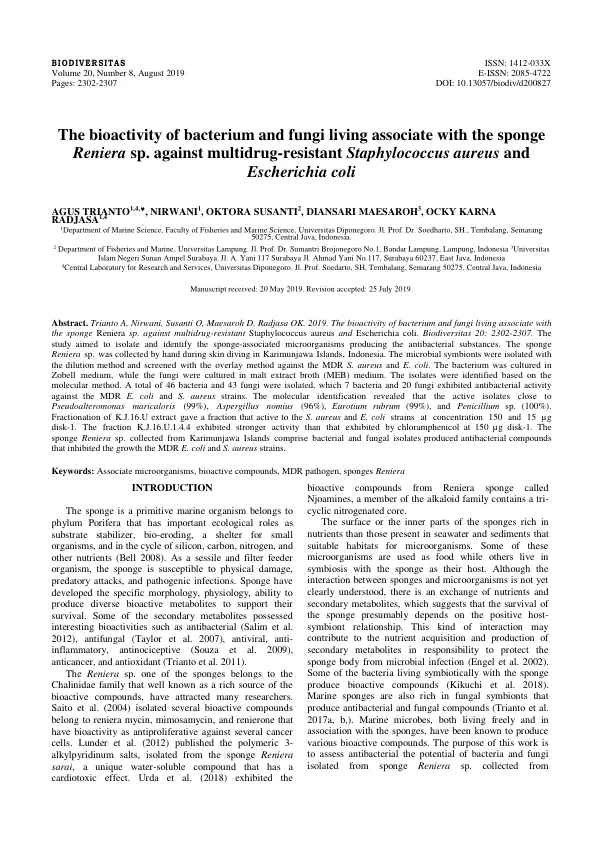
The sponge Reniera sp. was collected from Karimunjawa Islands, Indonesia, and the microbial symbionts were isolated using the dilution method and screened with the overlay method against multidrug-resistant Staphylococcus aureus and Escherichia coli. A total of 46 bacteria and 43 fungi were isolated, with 7 bacteria and 20 fungi exhibiting antibacterial activity against the MDR E. coli and S. aureus strains. The molecular identification revealed that the active isolates were close to Pseudoalteromonas maricaloris (99%), Aspergillus nomius (96%), Eurotium rubrum (99%), and Penicillium sp. (100%). Fractionation of K.J.16.U extract gave a fraction that was active against the S. aureus and E. coli strains at concentrations of 150 and 15 µg disk-1, respectively. The fraction K.J.16.U.1.4.4 exhibited stronger activity than that exhibited by chloramphenicol at 150 µg disk-1. The sponge Reniera sp. collected from Karimunjawa Islands comprises bacterial and fungal isolates that produced antibacterial compounds that inhibited the growth of the MDR E. coli and S. aureus strains. The study suggests that the interaction between sponges and microorganisms may contribute to the production of secondary metabolites that protect the sponge body from microbial infection. The sponge is a primitive marine organism that belongs to the phylum Porifera and has important ecological roles as a substrate stabilizer, bio-eroder, and shelter for small organisms. As a sessile and filter feeder organism, the sponge is susceptible to physical damage, predatory attacks, and pathogenic infections. To support their survival, sponges have developed specific morphology, physiology, and the ability to produce diverse bioactive metabolites. Some of the secondary metabolites produced by sponges possess interesting bioactivities, including antibacterial, antifungal, antiviral, anti-inflammatory, antinociceptive, anticancer, and antioxidant properties. The Reniera sp. is one of the sponges that belongs to the Chalinidae family and is known for its rich source of bioactive compounds. Several bioactive compounds have been isolated from the Reniera sp., including reniera mycin, mimosamycin, and renierone, which have been shown to have antiproliferative activity against several cancer cells. The surface or inner parts of the sponges are rich in nutrients, which provide a suitable habitat for microorganisms. Some of these microorganisms live in symbiosis with the sponge as their host, and there is an exchange of nutrients and secondary metabolites between the sponge and its symbionts. This interaction may contribute to the nutrient acquisition and production of secondary metabolites in the sponge, which are responsible for protecting the sponge body from microbial infection. The study aimed to assess the antibacterial potential of bacteria and fungi isolated from the sponge Reniera sp. collected from Karimunjawa Islands, Indonesia, against two multidrug-resistant bacteria (MDR). The sponge was collected by skin diving method, and the microbial symbionts were isolated using the serial dilution method. The isolates were screened for antibacterial activity against MDR S. aureus and E. coli using the modified overlay method. The bacterial symbionts were spotted on Zobell marine agar medium and incubated for three days, while the fungal strains were inoculated in the MEA medium and incubated for four days. The fresh culture of the pathogens was mixed with soft agar medium and overlaid over the agar surface of the previous microbial symbiont cultures. The plates were then incubated at 37°C for 24 h, and the antibacterial activity was defined by the presence of clear zones around the microbial symbiont. The bacterial Gram identification was carried out using the KOH 3% string and Gram staining tests. The KOH 3% string test was done according to Ali et al. (2015), and the Gram staining test was done according to Ayuningrum et al. (2017). The isolates with the strongest activity were chosen for further studies, and the most active isolates were cultured for the production of bioactive compounds. The bacterial inoculum was prepared in 5-mL Zobell broth medium on a rotary shaker at room temperature, and the fungi were cultured in malt extract broth (MEB) medium at room temperature for seven days. The microbial mass was separated from the culture medium for extraction of the bioactive substances. The extracts were partitioned using a solvent mixture of ethyl acetate and H2O solvents to provide the organic and water fractions. The antibacterial test was conducted by the disk diffusion method, and the extracts were dissolved in ethyl acetate to prepare the stock solutions with the concentration 1.5 µg µL-1. The
Related documents
Documents in this collection
 2024
2024USAID DEC
Population structure of endangered spinetail devil ray (Mobula mobular) in the Lesser Sunda Seascape, Indonesia, revealed using microsatellite and mitochondrial DNA
Open record 2015
2015USAID DEC