NATIONAL AGRICULTURE INSTITUTE
A REVIEW OF THE PROPOSALS OF THE FOOD RESERVE ACT CHAPTER 225 OF THE LAWS OF ZAMBIA
The proposed amendments to the Food Reserve Act (FRA) are deeply concerning as they move the FRA's mandate from a strategic reserve institution to a trader and exporter in the market place.
2017 · 4 pages
Sign in to readA free account is required to download.
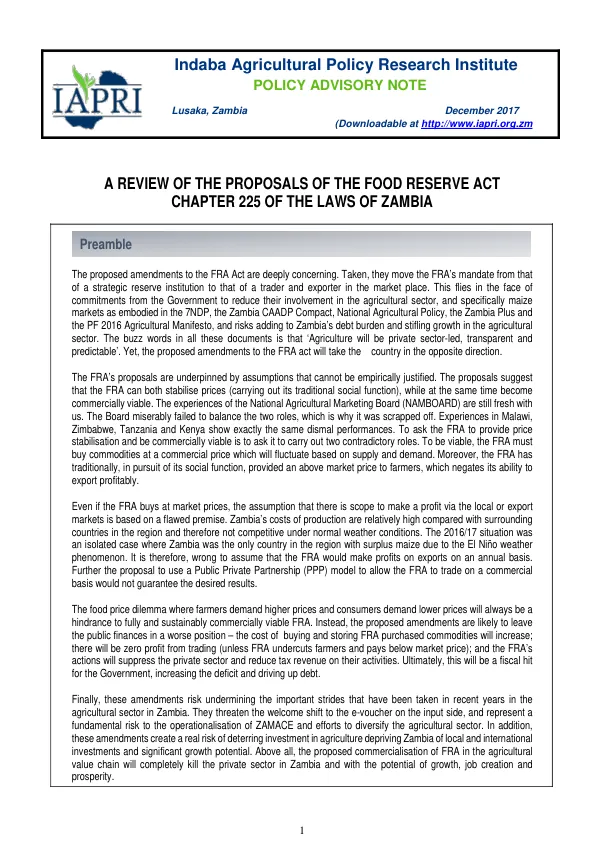
Abstract
This contradicts the government's commitment to reduce their involvement in the agricultural sector, as stated in the 7th National Development Plan (7NDP), the Zambia CAADP Compact, National Agricultural Policy, and the PF 2016 Agriculture Manifesto. The proposed amendments suggest that the FRA can both stabilize prices and be commercially viable, which is a contradictory role. The experiences of the National Agricultural Marketing Board (NAMBOARD) and other countries in the region show that this approach has been disastrous for farmers, consumers, and public finances. The FRA's proposal to use a Public-Private Partnership (PPP) model to allow the FRA to engage in business ventures is also flawed. This approach may not result in sustainable revenue for the FRA, and it may undermine recent market reforms that have made Zambia a leading destination for private sector investment in agriculture. The establishment of ZAMACE has led to increased participation of the private sector in grain markets, and an independent, transparent, and accessible market information system is long overdue. However, this function should not be the preserve of the FRA, but rather an independent organization capable of delivering it. The proposed amendments to the Act in relation to weights and measures are no longer relevant, as ZAMACE has led to harmonization of weights and standards in the private sector. Amendments in this area risk unnecessary over-legislation. The amendments to the Act propose to allow the FRA to engage in business ventures under a PPP model, establish a market information system, and designate storage facilities, but these proposals are fundamentally flawed and may undermine recent market reforms. The private sector has the capacity to build new storage facilities, so rather than providing facilities directly, the government should incentivize the private sector to build storage in areas where it is lacking. The FRA should focus on rehabilitating existing storage capacity and ensuring it meets required standards. The proposed amendments to the Act aim to provide a minimum short-term level of cover for the strategic reserve, but this may not be sufficient to meet the needs of the country. The FRA should not be responsible for providing an above-market price to farmers, which would undermine its ability to export profitably. The proposed amendments to the Act propose to designate storage facilities, but this may not be sufficient to meet the needs of the country. The FRA should not be responsible for providing an above-market price to farmers, which would undermine its ability to export profitably. The proposed amendments to the Act propose to allow the FRA to engage in business ventures under a PPP model, but this may not be sufficient to meet the needs of the country. The FRA should not be responsible for providing an above-market price to farmers, which would undermine its ability to export profitably. The proposed amendments to the Act propose to establish a market information system,
Related documents
Documents in this collection
 2015
2015USAID DEC
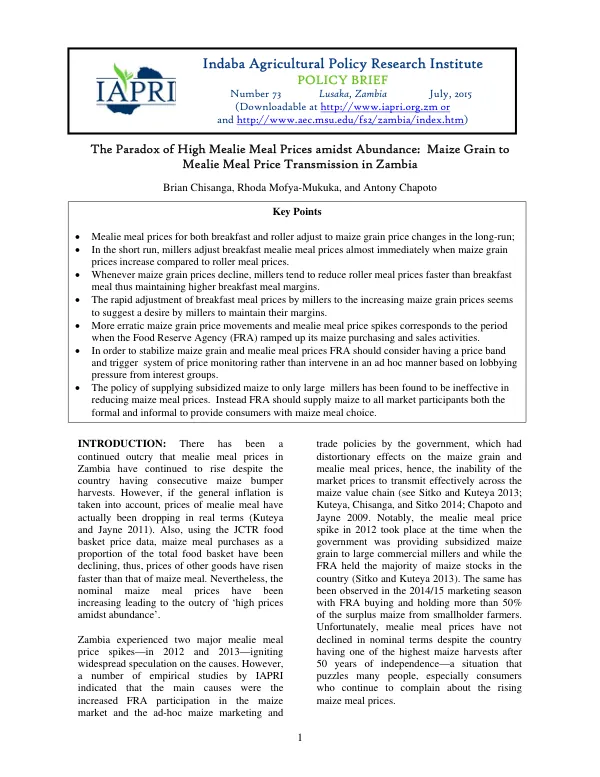
The Paradox of High Mealie Meal Prices amidst Abundance: Maize Grain to Mealie Meal Price Transmission in Zambia
Open record 2012
2012USAID DEC