USAID DEC
The Paradox of High Mealie Meal Prices amidst Abundance: Maize Grain to Mealie Meal Price Transmission in Zambia
Sign inNATIONAL AGRICULTURE INSTITUTE
The Paradox of High Mealie Meal Prices amidst Abundance: Maize Grain to Mealie Meal Price Transmission in Zambia
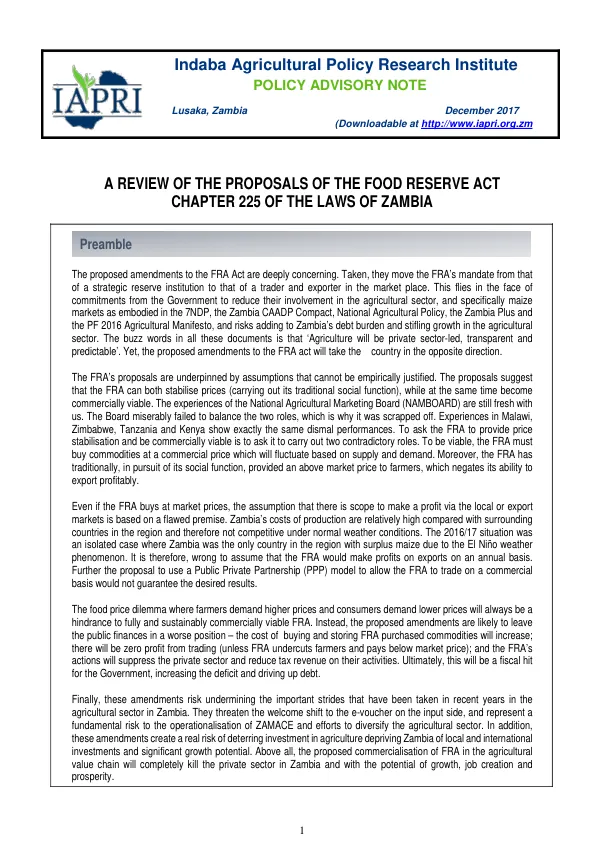
Maize Grain to Retail Roller Meal Price Margins Have Increased since FRA Increased Its Participation in the Market.
2015 · 4 pages
Sign in to readA free account is required to download.
Abstract
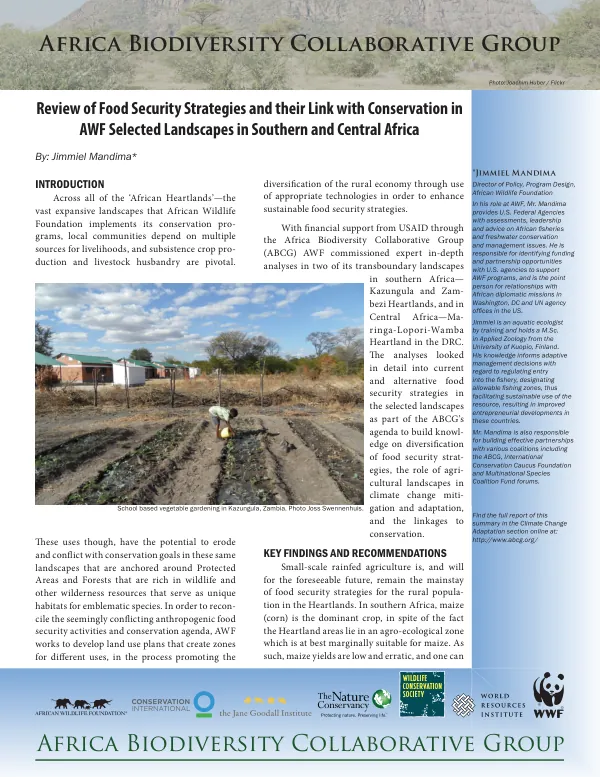
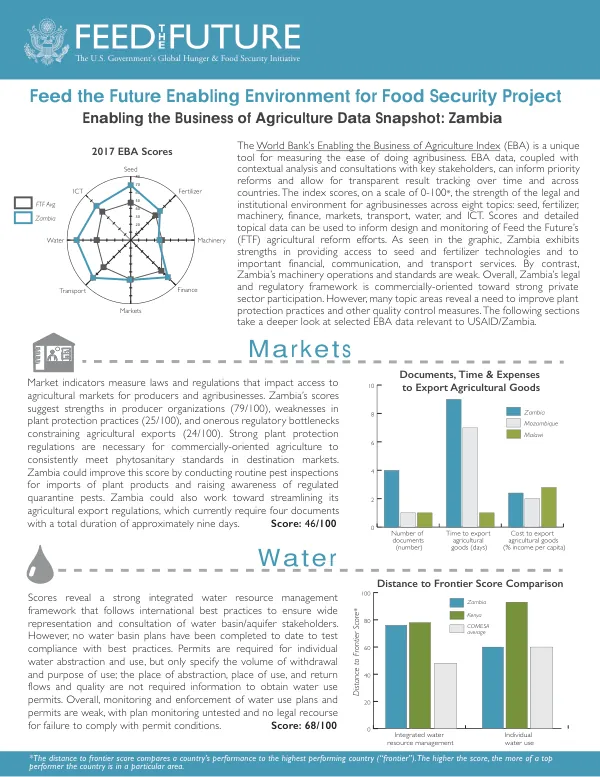
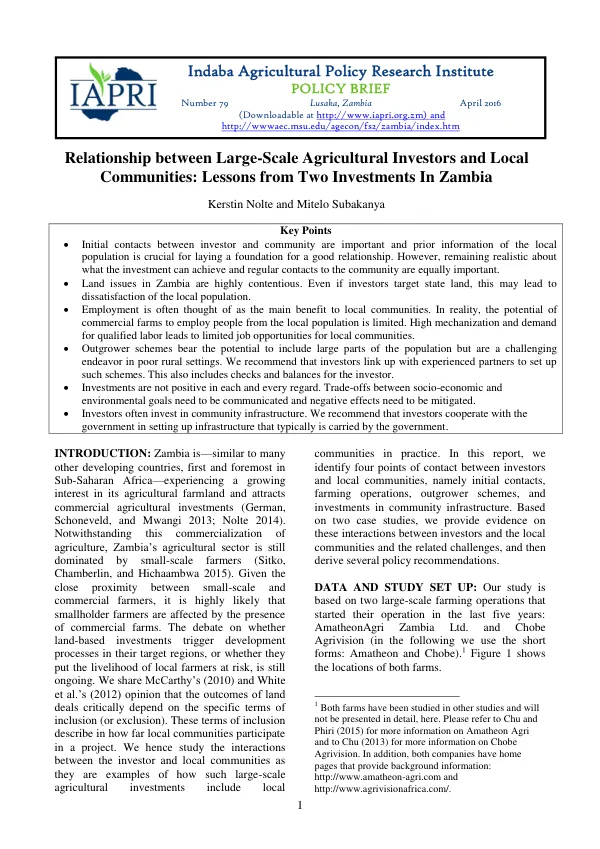
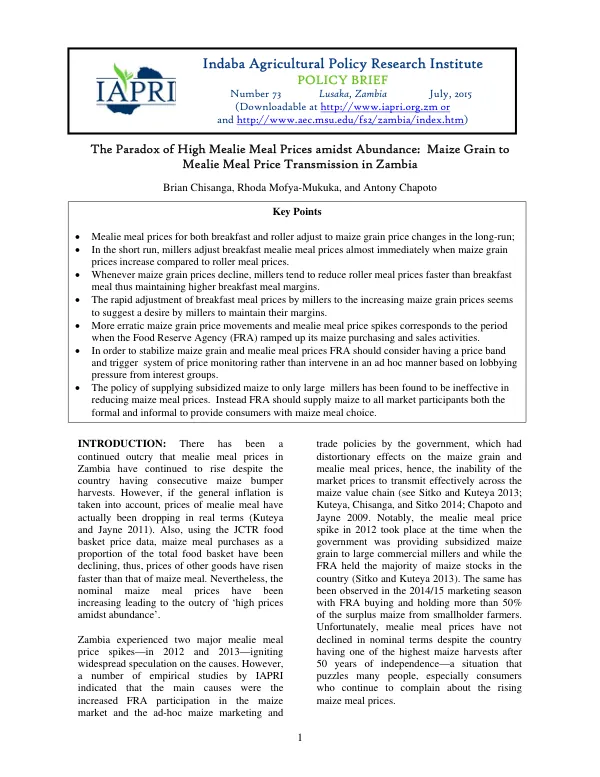
The trends in maize grain and retail roller meal prices show that in 2010, when the Food Reserve Agency (FRA) expanded its role in the maize market, both roller meal and maize grain prices initially declined until late 2012 when the prices increased. During that period, roller meal prices declined faster, causing margins to decline. From 2012 onwards, however, both maize grain and mealie meal prices rose, with roller meal prices rising more rapidly, causing margins to increase. This suggests rising market power among millers or inefficient functioning of the market. Maize Grain to Retail Breakfast Meal Prices Margins Have Increased since FRA Increased Its Participation in the Market. Similar to the case of roller meal prices, maize grain and retail breakfast mealie meal prices declined over the period when FRA increased its activities in 2010 but increased from August 2012 onwards. Thus, margins, which had been on a decline in 2010, rose from 2012 onwards. In comparison with roller meal prices, millers generally maintain a wider margin on breakfast mealie meal. Whenever these margins are threatened by rising grain prices, there is a tendency to maintain the margins by larger increases in breakfast meal prices. Breakfast Meal Prices Adjust More Rapidly to Changes in Maize Grain Prices than Roller Meal Prices. The results show that maize grain and mealie meal prices tend to move together in the long run, also referred to as cointegration. Roller meal retail prices and wholesale maize grain prices establish a long-term equilibrium such that the two prices move uniformly. Similarly, breakfast meal prices and wholesale maize grain prices also establish a long-term equilibrium. Price transmission results show that breakfast meal prices respond rapidly and significantly to changes in maize grain prices. When there is a change in the price of maize grain, breakfast meal prices will react almost immediately. About 72% of the price adjustment for breakfast meal is done within the same month when grain prices change. In comparison, only 43% of the adjustment to grain price changes is done within the same month for roller meal. Retail Breakfast and Roller Meal Prices Adjust Only When Grain Price Changes Exceed a Threshold. There is a minimum price change that must be exceeded by grain prices before mealie meal prices begin to respond. The analysis shows that the minimum price change for breakfast mealie meal is +K0.19 per kg or +K9.61 per 50 kg bag of maize. Roller meal prices, on the other hand, adjust when grain price changes exceed a price change of -K0.17 per kg or -K8.5 per 50 kg bag. The presence of a threshold for price transmission suggests that mealie meal prices are not perfectly responsive to changes in maize grain prices, indicating some degree of market power or inefficiency in the market. Policy Implications. The findings of this study have important policy implications for the management of the maize market in Zambia. The results suggest that the policy of supplying subsidized maize to only large millers has been ineffective in reducing maize meal prices. Instead, the Food Reserve Agency (FRA) should supply maize to all market participants, both formal and informal, to provide consumers with maize meal choice. Additionally, the FRA should consider implementing a price band and trigger system of price monitoring rather than intervening in an ad-hoc manner based on lobbying pressure from interest groups. This would help to stabilize maize grain and mealie meal prices and ensure that consumers have access to affordable mealie meal.
Related documents