USAID DEC
Feed the Future Enabling Environment for Food Security Project: Enabling the Business of Agriculture Data Snapshot: Zambia
Sign inFEED THE FUTURE
Feed the Future Enabling Environment for Food Security Project: Enabling the Business of Agriculture Data Snapshot: Zambia
The Enabling Environment for Food Security Project in Zambia, supported by the Feed the Future initiative, utilizes the Enabling the Business of Agriculture Index (EBA) to assess the country's legal and institutional environment for agribusiness.
2017 · 2 pages
Sign in to readA free account is required to download.
Abstract
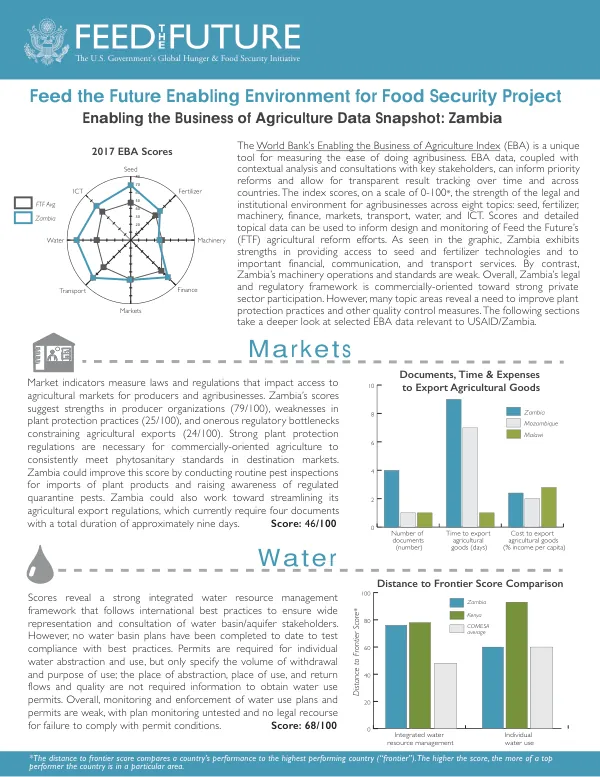
The EBA scores, ranging from 0 to 100, evaluate the strength of the environment across eight topics: seed, fertilizer, machinery, finance, markets, transport, water, and ICT. Zambia exhibits strengths in providing access to seed and fertilizer technologies, as well as financial, communication, and transport services. However, the country's machinery operations and standards are weak. Market indicators reveal Zambia's strengths in producer organizations, with a score of 79/100, but weaknesses in plant protection practices, scoring 25/100, and onerous regulatory bottlenecks constraining agricultural exports, scoring 24/100. Strong plant protection regulations are necessary for commercially-oriented agriculture to consistently meet phytosanitary standards in destination markets. Zambia could improve this score by conducting routine pest inspections for imports of plant products and raising awareness of regulated quarantine pests. The country could also work toward streamlining its agricultural export regulations, which currently require four documents with a total duration of approximately nine days. Zambia's integrated water resource management framework follows international best practices, ensuring wide representation and consultation of water basin/aquifer stakeholders. However, no water basin plans have been completed to date to test compliance with best practices. Permits are required for individual water abstraction and use, but only specify the volume of withdrawal and purpose of use; the place of abstraction, place of use, and return flows and quality are not required information to obtain water use permits. Overall, monitoring and enforcement of water use plans and permits are weak, with plan monitoring untested and no legal recourse for failure to comply with permit conditions. The country's score for water management is 68/100. The regulatory framework for tractors in Zambia is inadequate, slowing the growth of agricultural mechanization. Although the country excels in allowing the free flow of tractor imports, it could improve its score by adopting best practices such as following established international standards for tractor performance and operator safety once in operation. The country currently requires tractors to be registered for all uses rather than the best practice of registration for on-the-road-use only. Yet it does not require regular inspections of in-use tractors, with recommended frequency every two years. The life span of machinery could be expanded by legally requiring machinery dealers to provide after-market service and parts. Adopting best practices will ensure machine safety and technical reliability. The country's score for machinery is 35/100. Zambia is a regional leader in seed law and regulation, with a well-structured law granting and protecting plant breeder's rights. The plant variety and seed regulations law is also well-crafted, oriented toward private sector participation. However, time to register new varieties is currently 544 days, and could be reduced to align with Tanzania's time frame of 333 days. Seed quality controls could also be improved by requiring traceability of plant materials and retaining records for two years, as in Zimbabwe. The country's score for seed is 69/100.