USAID DEC
A Survey and Research Investigation of U.S. Catholic Organization’s Support for Overseas Residential Care Leading the Way for Vulnerable Children
Sign inCATHOLIC RELIEF SERVICES ORGANIZATION
A Survey and Research Investigation of U.S. Catholic Organization’s Support for Overseas Residential Care Leading the Way for Vulnerable Children
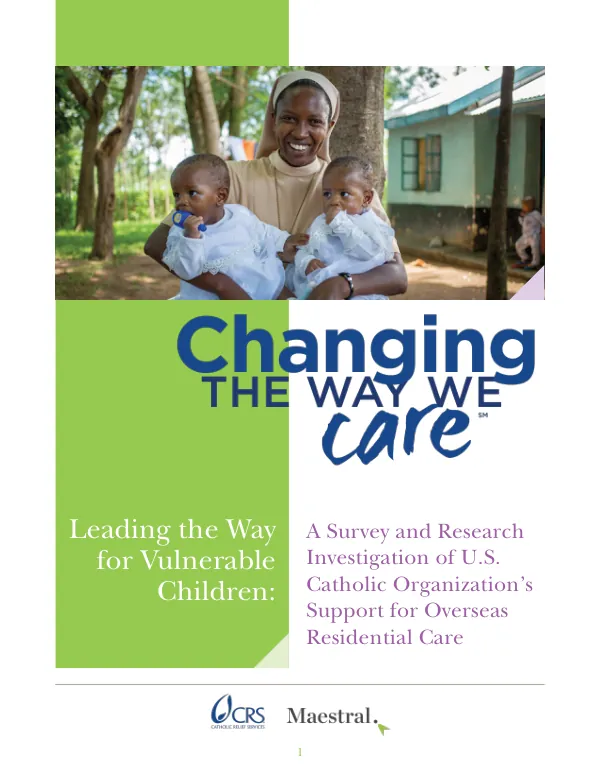
The Changing the Way We Care (CTWWC) initiative is a consortium led by Catholic Relief Services and Maestral International, working to promote safe and nurturing family care for children in institutions and those at risk of child-family separation.
2021 · 7 pages
Sign in to readA free account is required to download.
Abstract
The initiative operates on the understanding that children fare better in a family setting rather than in institutional care. CTWWC's goal is to support current residential care facilities in transitioning to become family-support organizations and to prevent child-family separation before it happens. The CTWWC regional and global strategy aims to shift commitments in international development practices and redirect resources towards promoting family care. To achieve this, CTWWC seeks to work with Catholic and other faith-based organizations to explore transforming the way the faith community supports vulnerable children outside of the U.S. The strategy targets faith-based networks and philanthropic bodies, with the hope of identifying influencers and leaders who can become champions for a new approach to caring for vulnerable children. CTWWC conducted a survey to provide data regarding U.S. Catholic Church support for children's residential care facilities outside of the United States. The survey collected 273 valid responses from various Catholic organizations, including women's religious communities, archdioceses and dioceses, universities and colleges, men's religious communities, non-profit organizations, parishes, high schools, and non-profit volunteer programs. The survey results indicate that over a third of respondents represented women's religious communities, while archdioceses and dioceses, and Catholic non-profits made up 14% of the responses each. The survey found that 86 respondents (31%) said their organization supported one or more residential care facilities in 2018, while 161 (59%) said they did not, and 26 (10%) were not sure. Of those supporting residential care facilities, 64% indicated they supported one or two facilities, with only three respondents supporting more than 10 different facilities. The top 10 countries in which respondents reported supporting residential care were India, Haiti, the Philippines, Uganda, Jamaica, Kenya, Mexico, Guatemala, Honduras, and Ghana. The survey also gauged the knowledge and attitudes of members of these organizations regarding the transition from residential care for children to family-based care. The results indicate that most respondents were in the pre-contemplation stage, with the second highest group in the action phase of transitioning to family-based care. The survey posed various knowledge and attitudes statements to all respondents, and respondents rated their agreement with each statement. Across the stages outlined above and the type of respondent, most agreed with the statement "In general, my organization thinks reintegrating children from orphanages to family-based care is important." The survey results also indicate that most institutions agreed with the statement "Everyone in my organization is on board about wanting to reintegrate children from orphanages to family-based care." Additionally, the survey found that at least half of the respondents sent volunteers to the residential care facilities they support, with most sending short-term groups of 1 to 50 people. Respondents spent significant financial resources on sending these volunteers, with short-term mission trips costing $20,000 on average. The survey results provide valuable insights into the current practices and attitudes of U.S. Catholic organizations regarding residential care for children. The findings suggest that while there is a growing understanding of the importance of family-based care, many organizations are still in the early stages of considering a transition. The survey results can inform the development of strategies and messaging for engaging and raising awareness among U.S. Catholic audiences, with the goal of promoting a shift towards family-based care for vulnerable children.