USAID DEC
A Systematic Review of Positive Youth Development Programs in Low- and Middle-Income Countries
Sign inGEORGE WASHINGTON UNIVERSITY CIBER
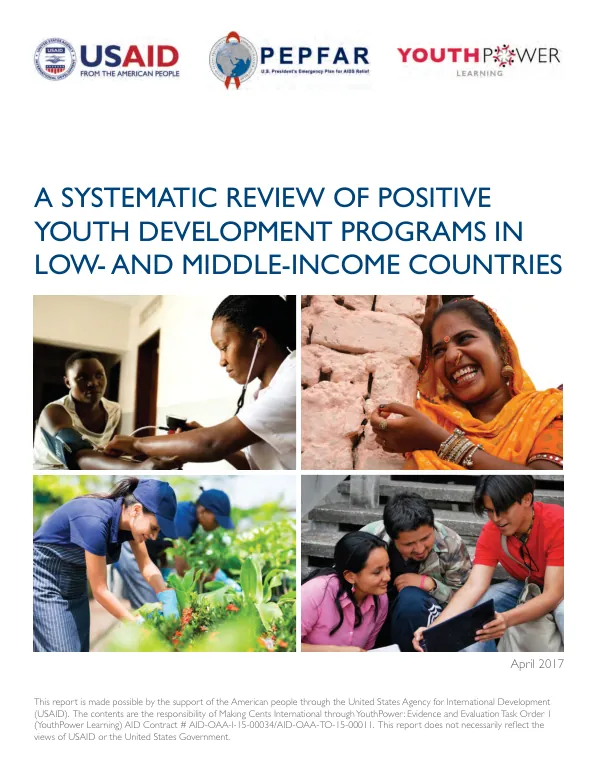
A Systematic Review of Positive Youth Development Programs in Low- and Middle-Income Countries
Positive youth development (PYD) is a global approach to empowering young people to reach their full potential.
2017 · 132 pages
Sign in to readA free account is required to download.
Abstract
PYD engages youth, their families, communities, and governments to build skills, assets, and competencies, foster healthy relationships, strengthen the environment, and transform systems. The approach is defined by the United States Agency for International Development (USAID) as a means to transition young people into productive, healthy adults. PYD has a long history in the United States, dating back to the 1990s. USAID has been a key player in promoting PYD globally, particularly in low- and middle-income countries (LMICs). The agency's YouthPower Learning program generates and disseminates knowledge about the implementation and impact of PYD and cross-sectoral approaches in international youth development. PYD in LMICs aims to address various challenges, including poverty, unemployment, and social inequality. A systematic review of PYD programs in LMICs was conducted to examine the implementation and efficacy of these approaches. The review involved a comprehensive search of existing literature, including peer-reviewed articles, reports, and grey literature. The search terms used for the systematic review included PYD, LMICs, youth development, and program evaluation. The review found that PYD approaches have been implemented in various LMICs, including Bangladesh, China, and South Africa. These programs focused on building skills, assets, and competencies, as well as fostering healthy relationships and strengthening the environment. The review also identified several PYD programs that have demonstrated positive outcomes, including improved youth outcomes, increased economic opportunities, and enhanced social cohesion. However, the review also noted that the quality of evidence for PYD programs in LMICs is generally low. Many studies had methodological limitations, and few used rigorous evaluation designs. The review recommended that future research should prioritize the use of high-quality evaluation methods, including randomized controlled trials and quasi-experiments. The review also identified several key themes and challenges associated with PYD programs in LMICs. These included the need for more effective partnerships between governments, civil society organizations, and the private sector, as well as the importance of addressing the unique needs and challenges of different youth populations. The review also highlighted the need for more research on the long-term impacts of PYD programs and the mechanisms by which they achieve their outcomes. In conclusion, the systematic review of PYD programs in LMICs provides valuable insights into the implementation and efficacy of these approaches. While the quality of evidence is generally low, the review identifies several promising programs and themes that can inform future research and programming. The review's findings and recommendations have implications for policymakers, practitioners, and researchers working in the field of youth development and international development.