USAID DEC
Positive Youth Development: Young People as Assets, Allies, and Agents Connecting Conversations Series: Theme 5, Session 1
Sign inENCOMPASS, LLC
Positive Youth Development: Young People as Assets, Allies, and Agents Connecting Conversations Series: Theme 5, Session 1
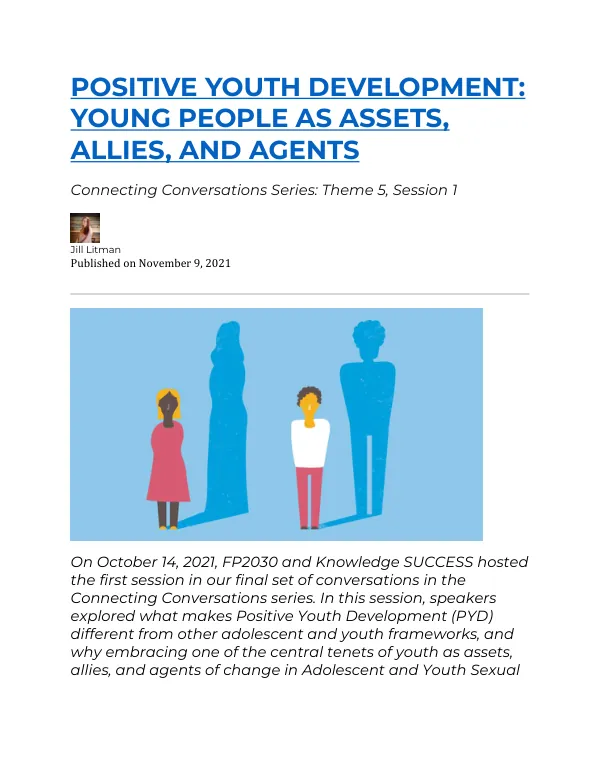
Positive Youth Development (PYD) is a framework that views young people as assets, allies, and agents of change in Adolescent and Youth Sexual and Reproductive Health (AYSRH) programming.
2021 · 8 pages
Sign in to readA free account is required to download.
Abstract
This approach is distinct from other adolescent and youth frameworks, which often focus on deficits and problems. PYD emphasizes the strengths of young people, including competence, confidence, connection, and character. The four C's of PYD are foundational to this approach. Competence refers to the skills and abilities that young people possess, while confidence is about their self-assurance and self-efficacy. Connection is about the relationships that young people have with others, and character is about their values and moral principles. By aligning these strengths with the resources available in their world, young people can increase their ability to thrive throughout their adolescence and into adulthood. PYD approaches can be used in AYSRH programming to promote positive reproductive health outcomes. This can be achieved by empowering young people to take the lead in designing and implementing their activities, providing them with opportunities for leadership and decision-making, and creating an enabling environment that supports their development. The Nama Wellness Community Centre, for example, has a program that allows young people to take the lead in designing and implementing their activities, which has resulted in positive impacts on the adults in the community. Effective PYD programming requires a focus on building positive and sustained relationships between young people and their mentors. This can be achieved through life-skill building curricula, opportunities for youth leadership, and the provision of resources and support. The U.S. Agency for International Development (USAID) Office of Population and Reproductive Health has emphasized the importance of tailoring PYD information to the specific needs and context of the population being served. Sustainability is a key challenge in PYD programming, and it requires community partnerships and multi-sectoral collaborations. Dr. Richard M. Lerner has emphasized the need for research on sustainability and the importance of creating partnerships that can help scale and maintain PYD programming. Pauline Picho Keronyai has highlighted the importance of involving all stakeholders, including schools, the health field, and religious leaders, in the implementation of PYD. Trust is critical to the successful implementation of PYD, and it can be facilitated by drawing on the PYD framework to build trust. This can be achieved by having young people design their own programs, providing high-quality services, and actively listening to youth and prioritizing their feedback throughout PYD programming. Consistency and evaluation are also essential to building trust and sustaining meaningful youth engagement. The "Connecting Conversations" series is a platform for youth leaders and young people to discuss and share their experiences and perspectives on PYD and AYSRH programming. The series features five themes, with four to five sessions each, and is hosted by FP2030 and Knowledge SUCCESS. The series aims to provide a space for young people to share their voices and perspectives on PYD and AYSRH programming, and to promote meaningful youth engagement and participation in these areas.
Related documents