THE JOHNS HOPKINS UNIVERSITY, CENTER FOR COMMUNICATIONS PROGRAMS
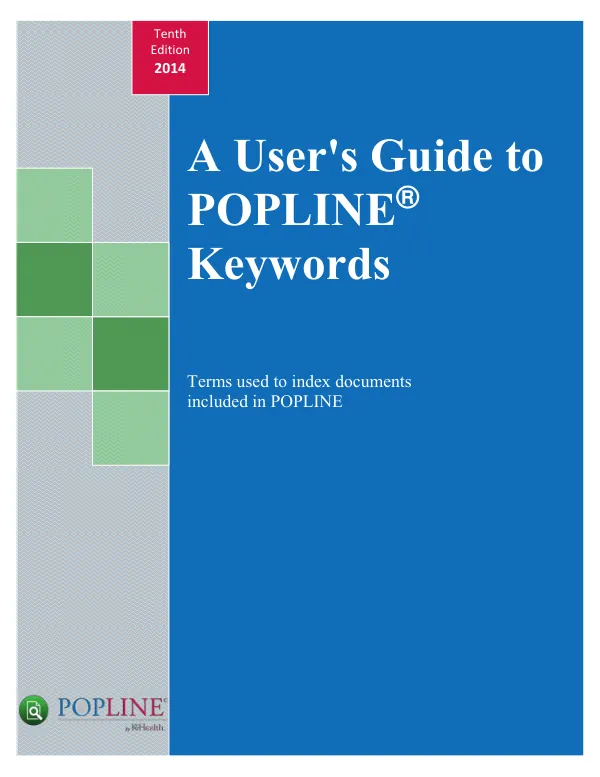
A User's Guide to POPLINE Keywords
POPLINE is a comprehensive collection of population, family planning, and related reproductive health and development literature.
2014 · 240 pages
Sign in to readA free account is required to download.
Abstract
It is an international resource that provides access to scientific articles, reports, books, and unpublished documents. POPLINE is maintained by the Knowledge for Health (K4Health) Project at the Johns Hopkins Center for Communication Programs and is funded by the United States Agency for International Development (USAID). The collection includes information on population and family planning, specifically research in contraceptive methods, family planning services, research in human fertility, maternal and child health, HIV/AIDS in low-resource countries, program operations and evaluation, demography, and other related health, law, and policy issues. Many documents are unique to the collection and are unavailable elsewhere. POPLINE contains a keyword dictionary that provides a standardized vocabulary for indexing and searching documents. The keyword dictionary includes terms used to index documents included in POPLINE, along with their definitions, broader keywords, narrower keywords, and related keywords. The dictionary is organized in a hierarchical structure, with broader keywords providing more general concepts and narrower keywords providing more specific concepts. The keyword dictionary is used to facilitate searching and indexing of documents in POPLINE. It allows users to select keywords that best describe the subject they are researching and to locate relevant documents in the collection. The dictionary also provides a framework for understanding the relationships between broader and narrower keywords, which can save time and produce more accurate search results. The POPLINE keyword dictionary includes terms related to contraceptive agents, such as chemical substances with contraceptive activity, and terms related to family planning, such as abstinence, be faithful, and condom use. It also includes terms related to health services, such as acceptance process and acceptor characteristics. The dictionary is organized into several sections, including a keyword index, a relationship between broader and narrower keywords, and a keyword dictionary. The keyword index provides a list of keywords in alphabetical order, while the relationship between broader and narrower keywords section explains how keywords are grouped under broad subject categories and how they are related to each other. The POPLINE keyword dictionary is an essential tool for researchers, policymakers, and service providers who need to access and analyze population, family planning, and reproductive health data. It provides a standardized vocabulary for indexing and searching documents, facilitating the identification of relevant information and the analysis of complex data. POPLINE's keyword dictionary is regularly updated to reflect current scope coverage in the collection. The revision process includes streamlining certain hierarchies and adding new terms to ensure that the dictionary remains relevant and useful to users. The dictionary is available online and can be accessed through the POPLINE website. In addition to the keyword dictionary, POPLINE also provides a range of other resources and tools to support research and analysis. These include a database of population, family planning, and reproductive health literature, as well as a range of reports, briefs, and other publications on topics related to population and family planning. Overall, POPLINE's keyword dictionary is an essential resource for anyone working in the field of population, family planning, and reproductive health. It provides a standardized vocabulary for indexing and searching documents, facilitating the identification of relevant information and the analysis of complex data.
Related documents